
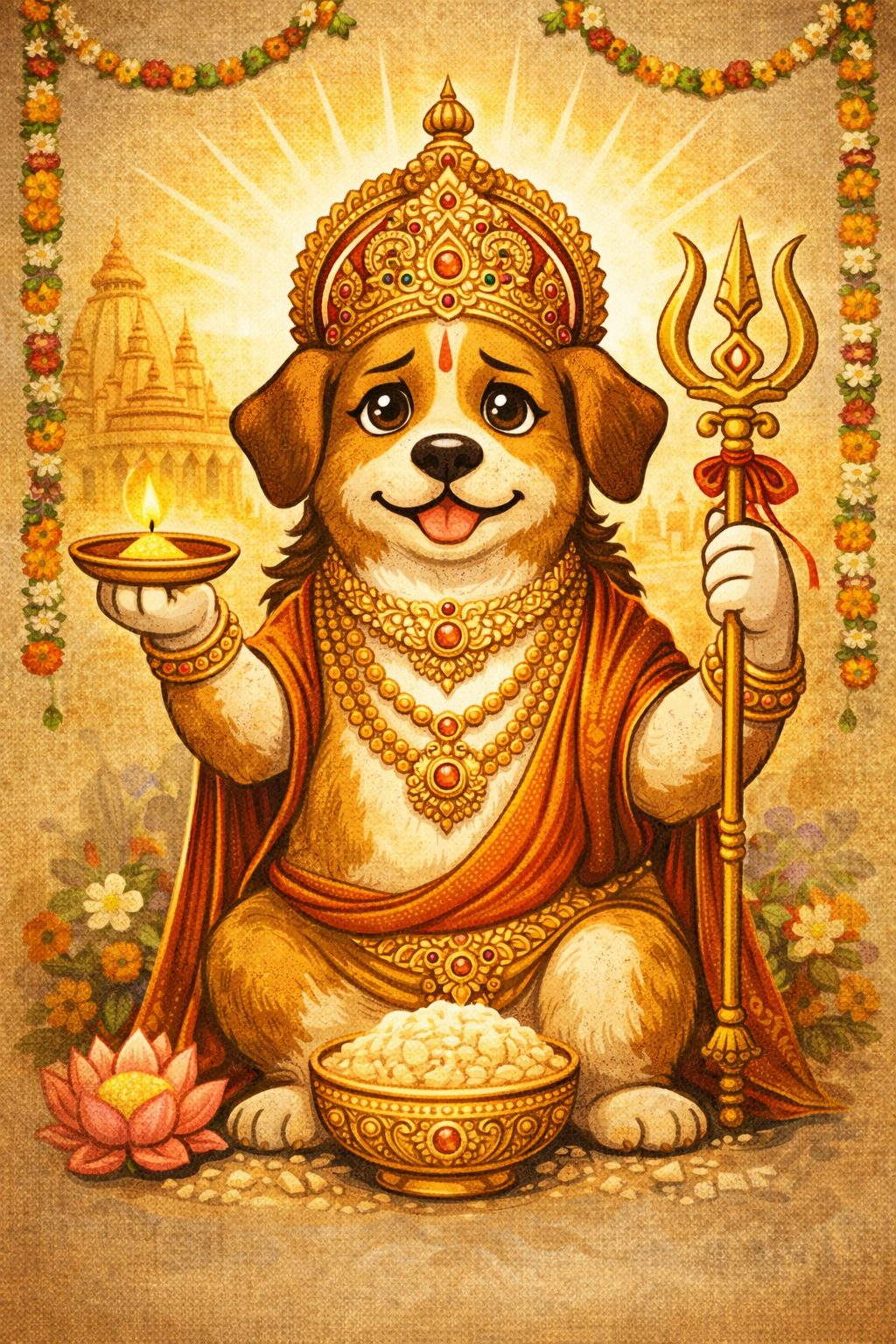
Dogs in Hinduism And Indian Culture: A 15,000-Year Love Story
Here’s something that might surprise you: the relationship between dogs and Indians is one of the oldest human-canine bonds on the planet.
Archaeological evidence suggests dogs have lived alongside humans in the Indian subcontinent for at least 15,000 years—possibly longer. The Indian Pariah dog, that familiar desi street dog you see everywhere, isn’t a “stray breed” or a mutt. It’s one of the most ancient dog lineages in the world, naturally selected over millennia to thrive in this land.
But the history of dogs in India goes beyond biology. Dogs appear throughout Hindu mythology, ancient scriptures, regional traditions, and cultural practices—sometimes revered, sometimes feared, always significant.
This is that story.
Dogs in Hindu Mythology: Divine Companions
Bhairava: The God Whose Vahana Is a Dog
Perhaps the most striking divine association with dogs is Bhairava—a fierce manifestation of Lord Shiva.
Unlike most Hindu deities who ride majestic animals like lions, bulls, or eagles, Bhairava’s vahana (vehicle) is a dog. Not a celestial, mythical creature—a dog. This isn’t accidental or symbolic of something lesser. In Bhairava worship, the dog represents loyalty, protection, and the fearless guardian who accompanies the deity everywhere.
At Bhairava temples across India—especially in Varanasi, Tamil Nadu, and Nepal—dogs are considered sacred. They’re fed, cared for, and treated as living representatives of the divine. During Bhairava Ashtami, devotees specifically feed dogs as an act of worship, believing that caring for a dog is equivalent to serving Bhairava himself.
Think about that: a major Hindu tradition where feeding a street dog is a sacred act.
Dattatreya: Surrounded by Four Dogs
Dattatreya, the combined avatar of Brahma, Vishnu, and Shiva, is traditionally depicted with four dogs at his feet. These dogs are said to represent the four Vedas—Rigveda, Samaveda, Yajurveda, and Atharvaveda.
The symbolism is profound: the highest sacred knowledge of Hinduism, walking alongside a deity in the form of dogs. It suggests that wisdom and devotion can exist in the most humble forms—that divinity isn’t limited to grand temples but can be found in the loyal creature at your feet.
Sarama: The Divine Mother of Dogs
The Rigveda, one of the oldest religious texts in existence, mentions Sarama—a female dog who serves the gods, particularly Indra.
In one famous story, Sarama tracks down stolen cattle hidden by demons called Panis. She’s described as swift, intelligent, and devoted—qualities we still associate with dogs today. Her children, the Sarameyas, are described as the four-eyed guard dogs of Yama, the god of death, who watch over the path to the afterlife.
Dogs guarding the gates of death might sound ominous, but in Hindu thought, Yama isn’t evil—he’s the just lord who ensures souls reach their rightful destination. His dogs are protectors, not threats.
Yudhishthira and the Dog: The Most Beautiful Story of Loyalty
If there’s one story every Indian dog lover should know, it’s this one from the Mahabharata.
After the great war and their time ruling the kingdom, the five Pandava brothers and their wife Draupadi decide to renounce the world and walk toward the Himalayas—toward heaven. As they begin their final journey, a dog joins them and follows along.
One by one, Draupadi and the younger Pandavas fall during the climb—consequences of their earthly flaws. Only Yudhishthira, the eldest and most righteous, reaches the gates of heaven, still accompanied by the dog who never left his side.
At the gates, Indra arrives in his chariot to take Yudhishthira to heaven. But there’s a condition: the dog cannot enter. Heaven is not for animals.
Yudhishthira refuses.
He tells Indra that this dog has been his faithful companion through everything. The dog followed him when his own brothers fell. To abandon such loyalty at the final moment would be a sin greater than any reward heaven could offer.
“I cannot abandon one who is frightened, one who is devoted, one who seeks my protection. I will not go to heaven if this dog cannot come with me.“
At that moment, the dog transforms—revealing himself to be Dharma (the god of righteousness, and Yudhishthira’s divine father) in disguise. It was a final test, and Yudhishthira passed by choosing loyalty and compassion over personal gain.
The message is unmistakable: how we treat the most vulnerable—including animals—reflects our true character. Yudhishthira’s righteousness wasn’t proven by his victories in war, but by his refusal to abandon a dog.
Kukur Tihar: The Festival That Honours Dogs
While primarily celebrated in Nepal, Kukur Tihar (also called Kukur Puja) has roots in the same Hindu traditions shared across the subcontinent, and is observed in parts of Sikkim, Darjeeling, and other regions with Nepali influence.
Kukur Tihar falls on the second day of the five-day Tihar festival (the Nepali equivalent of Diwali). On this day, dogs—pets and strays alike—are worshipped. They’re adorned with tikas (red vermillion marks) on their foreheads, draped with malas (flower garlands), and offered special foods and treats.
The festival acknowledges dogs as messengers of Yama and guardians of the home. It’s a formal, annual recognition that dogs deserve respect and gratitude—not just from their owners, but from society.
Images from Kukur Tihar go viral every year—street dogs covered in flower garlands, looking bewildered but well-fed. It’s a beautiful tradition that reminds us these animals have always held a place in our culture.
The Indian Pariah Dog: A Living Ancient Breed
Let’s talk about the dog that’s been with us through all of this history: the Indian Pariah dog, also called the Desi dog, InDog, or Indian Native Dog.
This isn’t a “mixed breed” or a “stray breed.” The Indian Pariah is one of the oldest and most genetically distinct dog breeds in the world—a landrace that evolved naturally over thousands of years to survive and thrive in the Indian climate.
Characteristics of the Indian Pariah:
- Adapted to Indian climate: Short coat, efficient heat regulation, built for our weather
- Robust health: Natural selection has eliminated many genetic weaknesses that plague purebreds
- High intelligence: Survival on the streets requires sharp instincts and problem-solving ability
- Low maintenance: Generally healthier and easier to care for than imported breeds
- Loyal and alert: Excellent watchdogs and devoted companions
The Indian Pariah’s ancestors likely walked alongside the humans who composed the Vedas, guarded ancient villages, and inspired the mythological stories we’ve discussed. When you look at a street dog today, you’re looking at a living connection to India’s ancient past.
And yet, we often treat them as nuisances while importing breeds that struggle in our climate and suffer from genetic health issues. There’s an irony there worth reflecting on.
The Contradictions: Sacred Yet Neglected
India’s relationship with dogs isn’t all positive, and it would be dishonest to pretend otherwise.
Despite the sacred associations, dogs have also been considered ritually impure in certain Hindu contexts. They’re not allowed inside many temples. In some traditional views, contact with dogs requires purification. This contradiction—dogs as sacred companions of deities, yet impure for ordinary worship—is a tension within Hindu thought.
Then there’s the street dog situation. India has an estimated 35-40 million street dogs—one of the largest populations in the world. While some are community dogs cared for by neighbourhoods, many face cruelty, neglect, and culling. The same culture that tells the story of Yudhishthira’s loyalty to a dog also struggles to humanely manage its stray population.
And in modern urban India, there’s often a preference for foreign breeds—Labradors, German Shepherds, Pugs, Huskies—over the native Pariah. We import dogs bred for European climates while ignoring the breed that evolved specifically for ours. Dogs that pant helplessly in our summers while the Pariah thrives.
These contradictions don’t erase the positive history—but they challenge us to live up to it.
Dogs in Indian Art, History, and Royal Courts
Beyond mythology, dogs appear throughout Indian historical records:
- Mughal paintings: Dogs frequently appear in Mughal miniature paintings, depicted in hunting scenes and court settings. Emperors like Akbar and Jahangir were known to keep hunting dogs and are shown with them in historical artwork.
- Royal hunting traditions: Indian royalty across various kingdoms maintained hunting dogs. The Rajapalayam, Mudhol Hound, and Rampur Greyhound are Indian breeds developed by royal courts for hunting.
- Temple carvings: Dogs appear in stone carvings at various temples, sometimes in hunting scenes, sometimes accompanying deities.
- Folk traditions: Many regional folk stories and songs feature dogs as loyal companions, guardians, or even as forms taken by spirits and deities.
Dogs weren’t just background characters in Indian history—they were companions to emperors, partners in hunts, subjects of art, and characters in stories. They’ve been woven into the fabric of Indian life for millennia.
What This Means for Indian Dog Parents Today
Why does any of this history matter?
Because understanding the depth of our relationship with dogs helps us see them differently. They’re not a Western import or a modern luxury. They’ve been part of Indian life since before recorded history. They appear in our oldest texts, our mythology, our art.
Caring for dogs isn’t a departure from Indian tradition—it’s a continuation of it. The story of Yudhishthira isn’t just mythology; it’s a cultural value encoded into our heritage: loyalty to those who depend on us matters.
When you feed a street dog, you’re participating in a tradition that goes back to Bhairava worship. When you adopt an Indian Pariah instead of an imported breed, you’re choosing a dog whose ancestors walked this land for 15,000 years. When you commit to your dog’s health and wellbeing, you’re living the values that made Yudhishthira worthy of heaven.
India and dogs belong together. They always have.
A 15,000-Year Bond
Dogs in India aren’t newcomers. They’ve been here since humans first settled this land. They’ve been worshipped with Bhairava, walked with Yudhishthira, guarded Yama’s gates, and represented the Vedas at Dattatreya’s feet.
They’ve hunted with Mughal emperors and slept outside village homes. They’ve adapted to our climate, survived our streets, and remained loyal despite everything.
The next time you look at your dog—or a street dog passing by—remember that you’re looking at one of humanity’s oldest relationships, and one of India’s most enduring bonds.
They’ve been with us for 15,000 years. The least we can do is take good care of them now.
Want to learn more about caring for Indian dogs?
Explore The Desi Carnivore — our guide to species-appropriate nutrition designed for Indian dogs and Indian pet parents. Because understanding our dogs’ biology is just as important as understanding our shared history.
────────────────────────────────────────────────────────────
About the Author: Mahiv is a certified canine nutritionist and founder of The Doggos. Beyond nutrition, he’s passionate about understanding the cultural and historical context of dogs in India—because caring for our dogs well means understanding where we’ve come from together.