Your Dog Deserves Better Than Leftover Fish Scraps
Walk through Sassoon Dock in Mumbai at 5 AM, and you’ll see crates of fresh sardines, anchovies, and bombil being hauled off trawlers. That same fish — the kind that’s been feeding coastal Indian families for centuries — is some of the most nutrient-dense food your dog will ever eat.
But here’s the thing most pet parents get wrong: not all fish treats are the same. Sardines, anchovies, and Bombay Duck serve completely different nutritional purposes. Picking the wrong one means your dog misses out. Picking the right one? That’s when you start seeing real changes — shinier coat, less itching, better joints, stronger appetite.
This is the only guide you need. We’re breaking down all three fish — with actual numbers, real feeding guides, and zero fluff.
The Quick Answer: Which Fish Treat Should You Pick?
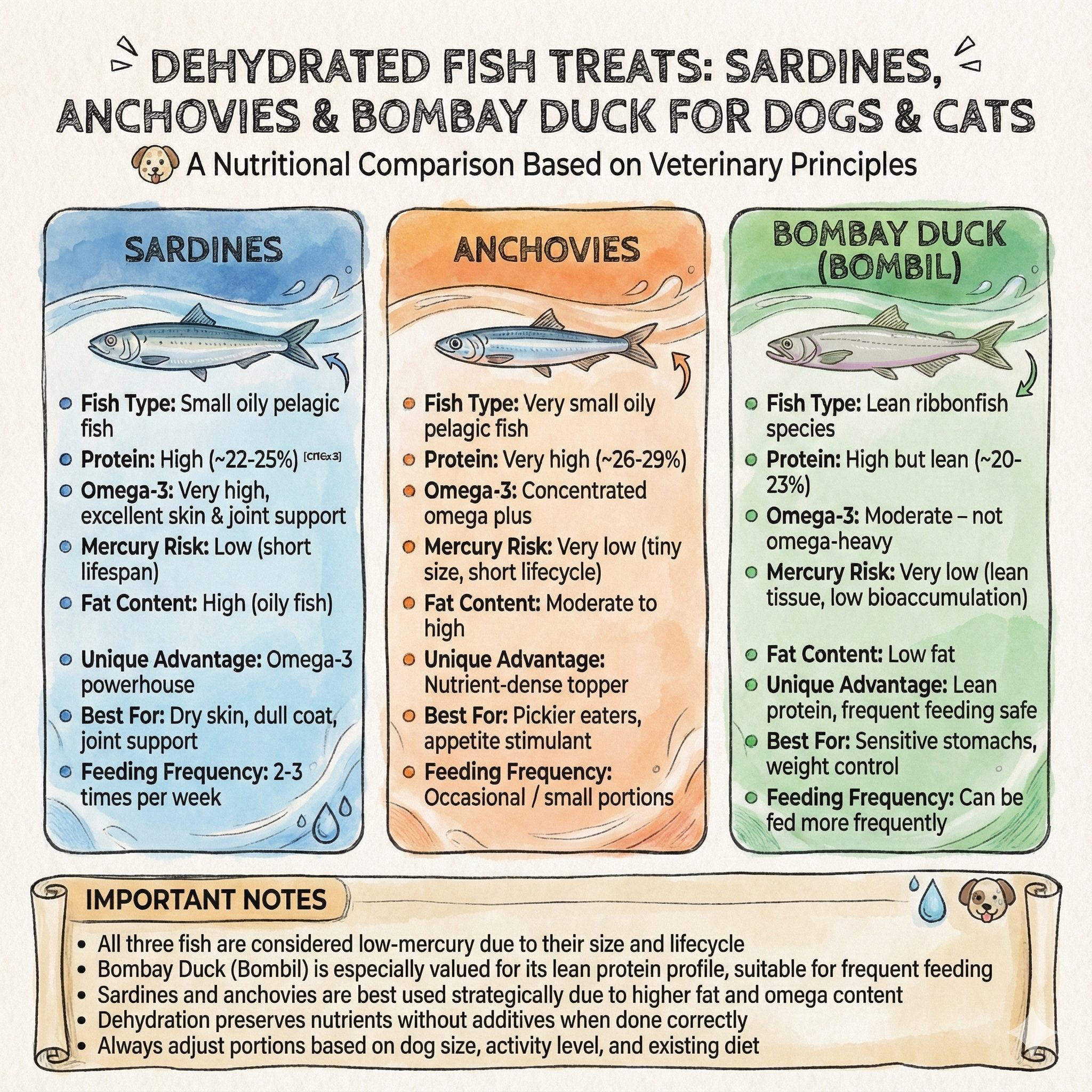
- Sardines → Best for skin, coat, joints, and brain health (highest omega-3)
- Anchovies → Best as a nutrient-dense topper and appetite booster (highest protein per gram)
- Bombay Duck (Bombil) → Best for daily feeding, sensitive stomachs, and weight management (leanest option)
Now let’s get into the why.
Why Fish Is Essential in Your Dog’s Diet
Fish isn’t a “nice to have” — it’s one of the most biologically appropriate protein sources for dogs. Here’s what fish delivers that most other proteins don’t:
Omega-3 Fatty Acids (EPA & DHA)
These are the big ones. EPA (eicosapentaenoic acid) and DHA (docosahexaenoic acid) are long-chain omega-3 fatty acids that dogs cannot produce on their own. They must come from diet.
- EPA (800–1,200 mg per 100g in sardines) — Fights inflammation. Directly helps with itchy skin, allergic reactions, and joint pain. If your dog is always itching, EPA deficiency is often part of the problem.
- DHA (400–800 mg per 100g in sardines) — Critical for brain development in puppies and cognitive function in senior dogs. Also supports retinal health.
Compare this to chicken, which has virtually zero EPA/DHA. Or plant-based omega-3 (ALA from flaxseed), which dogs convert at only 5–10% efficiency. Fish is the direct, bioavailable source.
High-Quality, Easily Digestible Protein
Fish protein has a biological value of 76–92 (depending on species), meaning your dog absorbs and uses most of what they eat. Less waste, less digestive strain.
Naturally Low in Saturated Fat
Even “oily” fish like sardines have healthy unsaturated fats. This isn’t the kind of fat that causes weight gain — it’s the kind that fuels cellular repair.
Rich in Micronutrients
Small whole fish (eaten bones and all) deliver calcium, phosphorus, vitamin D, vitamin B12, selenium, and iodine — a natural multivitamin in treat form.
Nutritional Comparison: Sardines vs Anchovies vs Bombay Duck
Here’s the real breakdown per 100g of dehydrated fish (approximate values):
| Nutrient | Sardines | Anchovies | Bombay Duck (Bombil) |
|---|---|---|---|
| Protein | 22–25g | 26–29g | 20–23g |
| Fat | 8–11g (high) | 6–9g (moderate-high) | 2–4g (low) |
| Omega-3 (total) | 1,200–2,000 mg | 1,400–2,200 mg | 300–600 mg |
| EPA | 800–1,200 mg | 900–1,300 mg | 150–300 mg |
| DHA | 400–800 mg | 500–900 mg | 100–250 mg |
| Calcium | ~380 mg | ~150 mg | ~120 mg |
| Phosphorus | ~490 mg | ~250 mg | ~200 mg |
| Vitamin D | ~270 IU | ~100 IU | ~50 IU |
| Mercury Level | Very Low | Very Low | Very Low |
| Calories (approx) | ~200 kcal | ~190 kcal | ~120 kcal |
| Best For | Skin, coat, joints, brain | Appetite, nutrient density | Daily treats, weight control |
Key takeaway: Anchovies and sardines are your omega-3 powerhouses. Bombay Duck is your lean, everyday option. They complement each other — they don’t replace each other.
Which Fish Treat for Which Problem?
This is where it gets practical. Match the fish to what your dog actually needs:
Dry, Flaky, or Itchy Skin → Anchovies
Anchovies pack the highest concentrated EPA per gram. EPA directly reduces inflammatory skin responses. If your dog is scratching constantly, losing fur in patches, or has dull, flaky skin — anchovies should be your first pick. The strong aroma also means even picky dogs will eat them willingly.
Dull Coat & Excessive Shedding → Sardines
Sardines have the best overall omega-3-to-fat ratio for coat health. The combination of EPA, DHA, and natural fish oils works from the inside out. Most pet parents report visible coat improvement within 3–4 weeks of regular sardine supplementation.
Joint Pain & Mobility Issues → Sardines
Senior dogs, large breeds, and dogs with arthritis benefit most from sardines. The high EPA content reduces joint inflammation, while DHA supports overall cellular health. Think of sardines as a natural anti-inflammatory.
Brain Development (Puppies) & Cognitive Health (Seniors) → Sardines
DHA is the building block of brain tissue. Puppies need it for neural development. Senior dogs need it to slow cognitive decline. Sardines deliver the highest DHA among our three options.
Picky Eaters & Low Appetite → Anchovies
Nothing gets a reluctant dog eating like the smell of dehydrated anchovies. Crush them over kibble, mix into raw meals, or offer whole as a high-value treat. The intense umami flavour is irresistible to most dogs.
Sensitive Stomach & Digestive Issues → Bombay Duck
Bombil is gentle. Low fat, lean protein, easy to break down. Dogs with pancreatitis history, IBD, or general digestive sensitivity do well on Bombay Duck because it doesn’t overload the system with oils.
Weight Management → Bombay Duck
At roughly 120 kcal per 100g (compared to 200 kcal for sardines), Bombay Duck lets you treat generously without calorie guilt. Perfect for dogs on restricted diets or breeds prone to obesity.
Dehydrated vs Raw vs Cooked Fish: What’s Best?
You might be wondering — why dehydrated? Why not just give raw or cooked fish?
Raw Fish
Raw fish can carry parasites (like anisakis) and bacteria. While some raw feeders do include fish, it requires freezing at -20°C for at least 7 days to kill parasites. It’s also messy, spoils fast, and hard to portion.
Cooked Fish
Cooking destroys a significant portion of omega-3 fatty acids (up to 50% loss depending on method). It also requires you to debone carefully — cooked fish bones become brittle and dangerous. You’ll also need to cook without oil, salt, garlic, or onion.
Dehydrated Fish
Low-temperature dehydration (below 70°C) removes moisture while preserving nutrients. Omega-3 retention is significantly higher than cooking. Bones become safely chewable and crunchy (a natural calcium and phosphorus source). No refrigeration needed. No seasoning. No risk of brittle bones.
This is why dehydrated treats are the gold standard for fish-based supplementation. You get maximum nutrition with minimum hassle.
Mercury Concerns: Why Small Fish Are Safe
Mercury in fish is a legitimate concern — but it’s a big-fish problem, not a small-fish problem.
Here’s how it works: mercury accumulates through a process called bioaccumulation. Small fish absorb tiny amounts. Bigger fish eat thousands of small fish and concentrate the mercury. The higher up the food chain, the worse it gets.
- Tuna (large, long-lived) — Mercury: 0.35–0.80 ppm. Not recommended for regular feeding.
- Sardines (small, short-lived) — Mercury: 0.01–0.04 ppm. Negligible.
- Anchovies (tiny, very short-lived) — Mercury: 0.01–0.03 ppm. Among the lowest of all fish.
- Bombay Duck (small, coastal) — Mercury: 0.01–0.05 ppm. Negligible.
All three of our fish are at the very bottom of the food chain. They feed on plankton and tiny organisms. Their lifespans are 1–3 years at most. There simply isn’t enough time or dietary exposure for mercury to accumulate to dangerous levels.
Bottom line: If you’re feeding your dog dehydrated sardines, anchovies, or Bombay Duck, mercury is not a concern. Save your worry for tuna and swordfish.
The Indian Advantage: Why These Fish Make Sense for Us
India’s coastline stretches over 7,500 km. Sardines, anchovies, and Bombay Duck are among the most abundantly caught fish along the western coast — especially in Maharashtra, Gujarat, Goa, Kerala, and Karnataka.
Bombay Duck (Bombil) is uniquely Indian. You won’t find this fish in most international pet treat lines. It’s caught primarily during the monsoon season (June–September) when trawlers bring in massive hauls from the Arabian Sea. Walk through any fish market from Versova to Malvan, and you’ll see bombil drying on racks in the open air — a tradition that’s centuries old.
Sardines and anchovies peak during the post-monsoon months (October–February) when the waters are rich with plankton blooms. This is when the fish are fattest, most nutrient-dense, and most flavourful.
By sourcing locally caught, sustainably available fish, we’re not importing freeze-dried salmon from Norway. We’re using what our waters naturally provide — fresher, more affordable, and with a lower carbon footprint.
Feeding Guide by Dog Size
These are general guidelines for dehydrated fish treats. Adjust based on your dog’s activity level, existing diet, and any specific health conditions.
| Dog Size | Weight Range | Sardines (per serving) | Anchovies (per serving) | Bombay Duck (per serving) | Frequency |
|---|---|---|---|---|---|
| Small | Up to 10 kg | 1–2 small pieces | 2–3 pieces | 1–2 small pieces | 2–3x per week |
| Medium | 10–25 kg | 2–3 pieces | 4–6 pieces | 2–3 pieces | 3–4x per week |
| Large | 25–40 kg | 3–4 pieces | 6–8 pieces | 3–4 pieces | 3–4x per week |
| Giant | 40+ kg | 4–5 pieces | 8–10 pieces | 4–5 pieces | 3–5x per week |
Important notes:
- Bombay Duck can be fed more frequently (even daily) due to its low fat content.
- Sardines and anchovies are richer — stick to 2–4 times per week to avoid loose stools from excess fat.
- For puppies (3+ months), start with half the recommended serving and observe.
- Always ensure fresh water is available — dehydrated treats are low-moisture.
Can cat treats guides Eat Dehydrated Fish Treats?
Absolutely. Cats are obligate carnivores, and fish is a natural part of their ancestral diet.
All three fish — sardines, anchovies, and Bombay Duck — are safe for cats. However, there are a few cat-specific considerations:
- Portion size: Cats need much smaller servings. 1–2 small anchovy pieces or half a sardine piece is plenty.
- Frequency: 2–3 times per week maximum. Fish should supplement their diet, not dominate it.
- Preference: Most cats go absolutely feral for anchovies (the strong smell is catnip-level attractive). Bombay Duck’s milder flavour also works well for cats who prefer subtler tastes.
- Thiaminase note: Some raw fish contains thiaminase (which destroys vitamin B1), but proper dehydration significantly reduces this risk. Still, fish treats should be a supplement, not a primary protein source for cats.
Common Mistakes to Avoid
1. Treating All Fish Treats as Identical
Sardines, anchovies, and Bombay Duck have very different fat and omega-3 profiles. Rotating without understanding what each does means you’re leaving results on the table.
2. Overfeeding Oily Fish
Too many sardines or anchovies can cause loose stools, especially in small dogs or dogs not used to high-fat treats. Start slow. Build up gradually over a week.
3. Choosing Fish Treats with Added Ingredients
If your fish treat has salt, sugar, garlic powder, preservatives, or “flavouring” — put it back. Single-ingredient, nothing else. Read the label.
4. Ignoring Water Intake
Dehydrated treats have almost no moisture. Your dog needs extra water to process them properly. Always offer fresh water alongside.
5. Buying Imported Over Local
Imported freeze-dried fish costs 3–4x more and isn’t necessarily better. Indian-sourced sardines, anchovies, and bombil are fresher, more sustainable, and perfectly nutritious.
Frequently Asked Questions
Can I give my dog fish treats every day?
Bombay Duck — yes, daily is fine due to its low fat content. Sardines and anchovies — stick to 2–4 times per week. Rotation across all three is ideal.
Are dehydrated fish bones safe for dogs?
Yes. Unlike cooked fish bones (which splinter), dehydrated bones are crunchy and crumble safely. They’re actually a great source of calcium and phosphorus.
My dog has never had fish before. How do I start?
Start with one small piece of Bombay Duck (the mildest and leanest option). Wait 24 hours. No reaction? Increase gradually. Introduce sardines and anchovies separately after a week.
Can I give fish treats to a puppy?
Yes, from 3 months onwards. Start with small pieces. DHA in sardines is especially beneficial for brain development in young dogs.
Will fish treats make my dog smell like fish?
Briefly, yes — their breath will smell fishy for a short while. But it’s not permanent, and the nutritional benefits far outweigh a few minutes of fish breath.
Can I mix fish treats with other proteins?
Absolutely. Fish treats pair well with any diet — kibble, raw, home-cooked. Use anchovies as a topper, sardines as a supplement, or Bombay Duck as a standalone snack.
Are these treats grain-free?
Yes. All three are single-ingredient treats — nothing but fish. No grains, no fillers, no binders.
The Smart Way to Feed Fish Treats
Here’s what we recommend at The Doggos:
- Make Bombay Duck your daily go-to. Lean, gentle, and versatile — it works for everyday rewarding and training.
- Add sardines 2–3 times a week for omega-3 maintenance — especially if your dog has skin, coat, or joint concerns.
- Use anchovies strategically — as a meal topper for picky eaters, a high-value training reward, or a short-term appetite booster during illness recovery.
This rotation gives your dog the full spectrum of benefits without overloading on any single nutrient profile.
Your dog’s biology is built for fish. Especially the small, wild-caught, low-mercury fish that swim off our own coastline. Stop overthinking it. Start feeding it.
Explore our full range of dehydrated fish treats — single-ingredient, sustainably sourced, and made for Indian dogs.