
By Mahiv Amit Chhabra, Certified Canine Nutritionist and author of The Desi Carnivore. Last updated: 18 May 2026.
Quick Answer: Can Dogs Eat Chicken Feet?
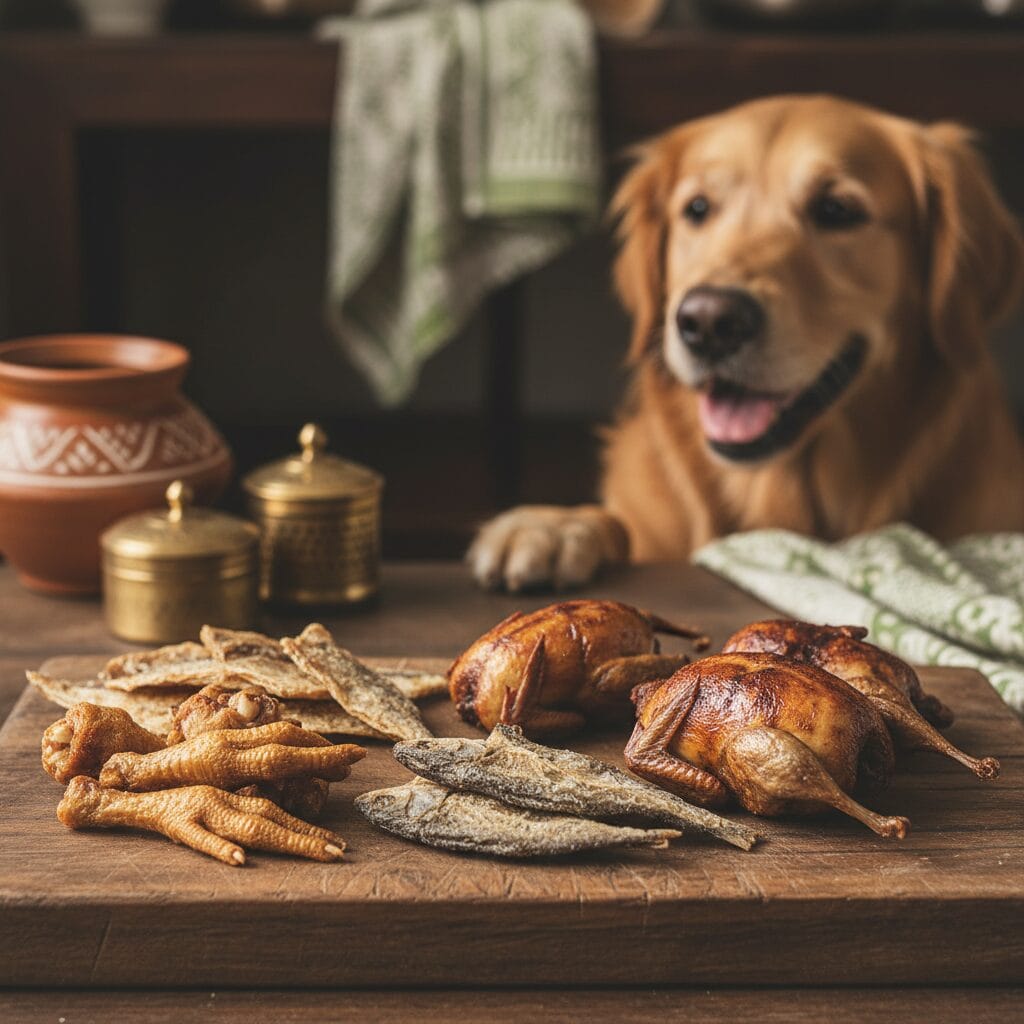
Yes, chicken feet are an excellent, natural, and safe supplement for dogs in India. They offer significant benefits for joint health, dental hygiene, and overall well-being. Dehydrated chicken feet provide essential glucosamine, chondroitin, and collagen in a bioavailable form. This makes them a superior choice over cooked bones, which splinter, or many synthetic supplements. They are a powerful functional treat for your dog.
The first time I gave my older boy Tony a dehydrated chicken foot, my wife stood three feet away with a phone ready to film the disaster. Six years and roughly 400 chicken feet later, his teeth still look like a four-year-old’s and his hips move like a dog half his age. The “danger” of chicken feet is one of the most stubborn pieces of marketing fiction in Indian pet care. It stays alive because most people have never actually watched a dog eat one.
This is the article I wish I could hand every new Doggos customer. The biology of what is actually in a chicken foot. The difference between a cooked bone and a dehydrated one. This is the entire safety argument, please do not skip it. How to feed them. How often. And to whom. No fluff. No hedging.
Are Chicken Feet (or Paws) Good for Dogs? The Nutritional Truth
When asking “are chicken feet good for dogs”, the answer is a resounding yes. A chicken foot (often called chicken paw) is the most concentrated joint-support food a dog can eat. Three things matter:
- Glucosamine and chondroitin sulphate. These are the structural building blocks of cartilage. Per published analyses, a single chicken foot contains roughly 450 mg of glucosamine and 350 mg of chondroitin. For reference, the average glucosamine capsule sold by an Indian pet pharmacy delivers 250 to 500 mg.
- Type II collagen. This is the specific collagen used in joint surfaces, tendons, and the trachea. Type II collagen has been shown in peer-reviewed trials to reduce the inflammatory markers associated with osteoarthritis, even at low doses (10 to 40 mg/day in dogs).
- Bioavailable calcium and phosphorus. The small bones inside a foot are mineralised at the ideal Ca:P ratio of around 1.2:1, which is exactly what the National Research Council recommends for adult dogs.
You can buy each of these as a supplement. You will spend three to five times more per dose. The absorption rates will be lower because isolated nutrients do not move through the gut the way whole-food forms do. This is one of the cleanest findings in nutrient bioavailability research, repeated across human and canine studies.
A chicken foot is a joint pill, a dental tool, and a calcium source, all in one. It is also a treat the dog actively wants. Find me a glucosamine capsule that can claim that.
The “Splintering Bone” Myth, Dismantled
The single most common objection I hear is “but bones splinter and kill dogs.” The objection is correct, with one critical word missing: cooked.
Here is what actually happens. When you boil or pressure-cook a chicken bone, the heat denatures the collagen matrix that holds the mineral lattice together. The bone goes from flexible and porous to brittle and glass-like. Bite it, and it shears into sharp jagged splinters. These can perforate the oesophagus, stomach, or intestines, causing peritonitis. This is a medical emergency. The AVMA is right to warn against it.
Dehydration is a completely different process. Air at 50 to 70 °C is moved across the food for 18 to 24 hours. Water leaves. Heat-sensitive collagen and the bone’s microstructure stay intact. The result is a porous, slightly flexible bone that crumbles under chewing pressure into a chalky powder. The dog’s stomach acid (pH 1 to 2, far more aggressive than a human’s) then dissolves the calcium and phosphorus into absorbable form.
I have fed dehydrated chicken feet to dogs ranging from a 4 kg Indie puppy to a 55 kg Saint Bernard. I have seen zero splintering events. The handful of “chicken feet incidents” I get asked about every year invariably trace back to either a cooked chicken bone (the family’s leftover) or to a giant breed swallowing a whole foot without chewing. That is a feeding-protocol failure, not a product failure.
This is, in short, why the brand’s method is “Cook the Meal, Dehydrate the Bone.” Raw, cooked, and dehydrated bones are not equivalent. They are three different physical states. Only two of them are safe to eat.
How to Introduce Chicken Feet to Your Dog
The first session matters. Get this right and the next 400 are easy.
- Pick a calm time. Not right after a walk, not when the doorbell is about to ring. You want the dog focused.
- Use a hard floor or an old mat. Chicken feet shed small chalky flakes. Carpets will hate you.
- Hand the foot to your dog, do not throw it. A thrown foot triggers the “grab and gulp” reflex. A handed foot encourages slower chewing.
- Sit nearby and watch. Not hovering. Just present. Look for proper chewing (molars engaged, head tilted) versus swallowing whole.
- The first foot should take 2 to 5 minutes. If your dog finishes in under 30 seconds, they swallowed it. Stop, observe for 24 hours (almost always fine, the stomach dissolves it), and next time, hold one end of the foot while they chew.
Toughie, my younger boy, is a gulper. For his first six feet I held the toe-end while he worked on the heel-end. By month two he had learned to chew through them. Patience is the whole training method.
Dosage by Dog Size
Use this as a starting point. Adjust by stool quality and energy.
| Dog weight | Chicken feet per serving | Frequency per week | Why |
|---|---|---|---|
| Toy (under 5 kg) | 1/2 foot | 2 to 3 | Mind the calorie load on a small frame |
| Small (5 to 10 kg) | 1 foot | 3 to 4 | Glucosamine therapeutic threshold |
| Medium (10 to 25 kg) | 1 to 2 feet | 3 to 4 | Standard maintenance dose |
| Large (25 to 40 kg) | 2 to 3 feet | 3 to 5 | Higher joint load, higher mineral need |
| Giant (over 40 kg) | 3 to 4 feet | 4 to 5 | Often paired with mutton trotters |
A chicken foot is roughly 35 to 40 kcal, mostly protein and fat. For dogs on calorie-restricted diets (post-spay, senior, overweight), count it into the daily allowance.
For active joint conditions (hip dysplasia diagnosis, post-CCL repair, senior arthritis), I push the upper end of the range and pair feet with dehydrated mutton trotters for the heavier collagen and connective-tissue load. The combination is what I refer to in client notes as “the joint stack.” More on that below.
Who Should Not Eat Chicken Feet
There is no food that suits every dog. Be honest with yourself about the following:
- Diagnosed pancreatitis. Chicken feet are higher in fat than lean cuts. Skip them or feed half-portions only with veterinary clearance.
- Severe chicken allergy. True chicken protein allergy is rarer than people think (most “chicken allergies” are Omega-6 inflammation), but if your dog genuinely reacts to chicken muscle meat, the feet will likely trigger it too. Use dehydrated quail as the novel-protein alternative.
- Aggressive resource guarders during the early-training phase. Long-lasting chews intensify guarding. Train the behaviour first, then add the chew.
- Dogs with a history of swallowing whole. Use half-feet, or transition to softer chews first.
- Puppies under 12 weeks. Their molars are not in. Wait.
Dehydrated Chicken Feet: A Superior Choice
Here is the part the imported-supplement industry does not want you reading. The Doggos dehydrated chicken feet are a big change.
The Indian poultry trade processes roughly 5 million chickens a day. Historically, feet, heads, and offal were discarded or sold as scrap, because the Indian retail-meat market is geared around chicken breast and thigh. That waste stream is now feeding the dehydrated-treats category, which means you are getting a premium nutrient at a commodity price.
Per Doggos pricing, a 100 g pack of dehydrated chicken feet holds roughly 14 feet and costs ₹199. That works out to about ₹14 per foot, or ₹14 per 450 mg glucosamine dose.
A common Indian-market glucosamine supplement for dogs sells for ₹600 to ₹1,200 for 60 tablets at 500 mg each. That is ₹10 to ₹20 per tablet, similar on a per-mg basis, except the chicken foot also delivers chondroitin (which the cheaper capsules omit), collagen, calcium, dental scraping, and 5 to 15 minutes of enrichment chewing. The capsule delivers a capsule.
I am not saying glucosamine capsules are useless. I am saying that, fed correctly, dehydrated chicken feet outperform them on every single axis except one: ease of pilling a dog that refuses to chew.
Comparison: Chicken Feet vs. Other Joint Support & Chews
To truly appreciate the value of dehydrated chicken feet, let’s compare them to other common options Indian pet parents consider.
| Feature | Dehydrated Chicken Feet | Glucosamine/Chondroitin Capsule | Raw Bone (e.g., Femur) | Cooked Bone (e.g., Chicken Leg) |
|---|---|---|---|---|
| Glucosamine/Chondroitin | High, balanced, bioavailable | Variable, often isolated | Present, but hard to digest | Destroyed by heat |
| Collagen Source | Excellent Type II | Often absent or synthetic | Present | Denatured by heat |
| Dental Cleaning | Mechanical scraping, plaque removal | None | Good, but may be too hard | Dangerous splinters |
| Bioavailability | High, whole food matrix | Variable, isolated nutrients | Limited for large bones | Destroyed |
| Safety for Indian Homes | High (dehydrated, no pathogens) | High | Low (hygiene risk, choking) | Extremely Low (splinters) |
| Cost per Dose | Very affordable (approx. ₹14) | Higher (₹10-₹20 per 500mg) | Low (if available) | Low (leftovers) |
| Enrichment/Chew Time | 5-15 minutes, mental stimulation | None | Long, but supervision needed | None, dangerous |
The Joint Stack: Chicken Feet Plus Bone-and-Organ Boost
For dogs over 7, dogs in active rehab, and large breeds prone to dysplasia, I recommend pairing chicken feet with the Bone and Organ Boost. The boost supplies the taurine, iron, and Vitamin A you cannot get from feet alone. It sits over a cooked-chicken-and-pumpkin base bowl as a daily topper. Feet are the chew, the boost is the foundation. Together they handle the four pillars: cartilage support (feet), connective tissue (boost), mineral balance (both), and chewing-derived dopamine release (feet).
A reasonable senior-dog protocol looks like this: 1 to 2 feet, four days a week, plus 1 teaspoon of the Bone and Organ Boost on the daily meal, plus 2 ml of hemp seed oil to correct the Omega-6:3 ratio for any dog still eating commercial chicken. If you want a deeper read on why that hemp oil matters, our guide to dehydrated treats walks through the inflammation math.
From Mahiv’s practice: A 9-year-old Labrador in Powai came to me last winter with grade-2 hip dysplasia, refusing the prescription mobility kibble her vet had insisted on for four months. We dropped the kibble, switched her to a cooked-chicken-and-pumpkin base bowl, added 2 dehydrated chicken feet per day, 1 tsp Bone and Organ Boost, and 3 ml hemp oil. By week 6 her owner sent me a video of her trotting up a flight of stairs without the usual hesitation. The joint shelf in her kitchen still has the unopened bottle of glucosamine syrup the vet had prescribed. The food was the medicine.
Common Mistakes Indian Dog Parents Make
- Feeding fried, boiled, or pressure-cooked chicken feet. Heat denatures the collagen and ruins the bone. If a friend tells you they “make chicken feet at home” for their dog, gently ask whether they are dehydrating or cooking. If it is the latter, change the subject and the diet.
- Treating chicken feet as a snack. They are functional medicine. Use them with intent: joint support, dental cleaning, enrichment.
- Skipping the first-session supervision. Five minutes of attention prevents the only realistic risk, gulping.
- Worrying about the nails. Dehydrated chicken-foot nails are soft keratin, fully digestible. The Doggos pack already removes the larger nails, but if you see a small one, it is fine.
- Stopping after a week because “I do not see results.” Glucosamine and chondroitin work cumulatively. The visible joint changes show up at week 4 to 6, not day 4.
Frequently Asked Questions
Are chicken feet safe for puppies?
For puppies over 12 weeks with their adult molars coming in, yes, half a chicken foot two times a week is a good introduction. Below 12 weeks, wait. Their jaw musculature and dentition are not ready, and the calcium load can interfere with growth-plate timing in giant breeds.
How many chicken feet can a dog eat per day?
For most adult dogs, one to three feet per day is the upper end. Beyond that you are overloading calories and calcium without any extra joint benefit. The dose-response curve flattens at roughly 1500 mg of glucosamine per day for a 25 kg dog.
Do dehydrated chicken feet really replace glucosamine supplements?
Functionally, yes, for most healthy dogs and dogs with mild to moderate joint issues. For advanced osteoarthritis with diagnosed cartilage loss, your vet may still prescribe a pharmaceutical-grade glucosamine HCl or polysulfated glycosaminoglycan injection alongside the dietary approach. The two are complementary, not exclusive.
Can chicken feet break my dog’s teeth?
Healthy adult teeth, no. A dehydrated chicken foot is softer than a femur, an antler, or a Nylabone (the actual common culprits behind cracked canine teeth in my consulting practice). If your dog has existing dental disease or has lost a tooth root, talk to your vet before introducing any chew, including feet.
Are raw chicken feet better than dehydrated?
Biologically, raw is marginally richer in heat-sensitive enzymes. Practically, in Indian conditions, raw chicken feet from a wet market carry a Salmonella and Campylobacter load that is not worth the risk to your dog or your kitchen surfaces. Dehydrated at low temperature retains the bone structure, glucosamine, chondroitin, and collagen. The trade-off is small and the safety win is large.
About the Author
Mahiv Amit Chhabra is a Certified Canine Nutritionist and author of The Desi Carnivore: The Indian Pet Parent’s Guide to Real Meat, Whole Prey, and Ancient Superfoods. He runs The Doggos from Thane, Maharashtra, alongside his dogs Tony and Toughie, the brand’s longest-serving quality-control team. Read more about Mahiv.