By Mahiv Amit Chhabra, Certified Canine Nutritionist and author of The Desi Carnivore. Last updated: 18 May 2026.
TL;DR
- A senior dog needs more high-quality protein, not less. The “low-protein for seniors” rule is a 1980s assumption that modern research (NRC 2006 and subsequent peer-reviewed work) has overturned. Reduce protein only on a diagnosed renal disease, never as a default.
- The five priorities of a senior bowl are: complete protein, DHA for the brain, joint support, an anti-inflammatory baseline, and slightly fewer calories.
- Hemp Meal Balancer is the foundation supplement for senior dogs. Its complete amino-acid profile means even smaller portions hit protein targets, and the prebiotic supports a senior gut that is losing microbial diversity.
- Cognitive Dysfunction Syndrome (canine dementia) is real, often misdiagnosed as “just old age,” and responds to DHA-rich fish, anti-inflammatory fats, and mental enrichment.
- “Senior” is a life-stage, not a number. Small breeds shift at 9 to 10, mediums at 8, large breeds at 7, giants at 6.
The dog in front of you at 9 is not the dog you brought home at 9 weeks. Her muscle tone has softened, her sleep has lengthened, the leap onto your bed has turned into a thoughtful pause. None of this is “just age.” It is biology you can measure, and most of it is fixable, or at least slowable, from the food bowl.
This is the article I give to clients whose dogs are pushing past 7. The Indian market is full of “senior kibble” that quietly does the opposite of what a senior dog needs, and the loudest piece of conventional wisdom (cut protein because the kidneys) is the one with the weakest evidence. Let us walk through what actually changes, what to feed, and where the senior dog diet India market gets it wrong.
When “Senior” Begins (Hint: It Is Not Always 7)
Life-stage is breed-size dependent. The accepted guide:
| Breed size | Adult weight | Senior begins | Example |
|---|---|---|---|
| Toy | under 5 kg | around 10 | Pomeranian, Chihuahua |
| Small | 5 to 10 kg | 9 to 10 | Indie pup, Pug, Beagle |
| Medium | 10 to 25 kg | 8 | Cocker, Indie adult |
| Large | 25 to 40 kg | 7 | Labrador, GSD |
| Giant | over 40 kg | 6 | Great Dane, Saint Bernard |
The pattern is brutal but consistent: the bigger the dog, the earlier the senior transition. A 7-year-old Labrador is biologically in the same lifestage as a 10-year-old Pomeranian. Use the right anchor.
What Actually Changes Inside a Senior Dog
Five biological shifts matter for the bowl:
- Protein turnover slows. A senior dog’s body recycles its own muscle protein less efficiently. This is sarcopenia, age-related lean-muscle loss. The fix is more dietary protein, not less, so the body has enough raw material to rebuild what it is losing.
- Kidney filtration drops slightly. Glomerular filtration rate (GFR) falls with age in most mammals. This is normal, not disease. The kidney still handles protein fine. What it handles less well is excess phosphorus, which is the actual lever in renal-friendly nutrition (more on this below).
- Cartilage repair slows. Chondrocyte turnover decreases. Joints that handled stairs at 4 begin to grumble at 9. Glucosamine, chondroitin, and Type II collagen become functional inputs, not optional extras.
- Cognitive function declines in some lines. Canine Cognitive Dysfunction Syndrome (CDS) is the dog equivalent of Alzheimer’s. Prevalence rises sharply after age 11. Pacing at night, getting “stuck” in corners, forgetting house-training, blank staring at walls. These are not “old dog quirks.” They are clinical signs.
- Gut microbial diversity shrinks. Senior dogs lose bacterial species the way senior humans do. Prebiotic fibre and fermentable substrates help repopulate the bowl.
Notice what is missing from that list: a need to reduce protein. The NRC 2006 Nutrient Requirements of Dogs and Cats and subsequent work (Laflamme, Veterinary Clinics of North America, 2012) make this clear. Reducing protein in a healthy senior dog drives sarcopenia faster and produces the “wasting away” old-dog look most owners blame on age itself. The food was the cause.
The Five Priorities of a Senior Bowl
1. Complete, High-Quality Protein
A healthy senior dog needs roughly 2.5 to 3.5 g of protein per kg of body weight per day, depending on activity. That is at the top of the adult range, not below it. The quality matters more than the quantity: complete amino-acid profile, high digestibility, low contaminant load.
A boiled-chicken-and-rice bowl, the default Indian senior diet, is amino-acid-deficient on its own. Chicken muscle is low in taurine, methionine, and tryptophan compared to what a senior dog needs. The fix is not more chicken. The fix is a balancer.
2. DHA for the Brain
DHA (docosahexaenoic acid) is the structural fat in neuronal membranes. Multiple peer-reviewed trials (Pan et al., British Journal of Nutrition, 2010; Hadley et al., Translational Research, 2017) show DHA supplementation slows cognitive decline in senior dogs and reduces CDS symptoms. The Indian way to get DHA into a dog is whole small oily fish, not capsules that oxidise within weeks in a humid kitchen.
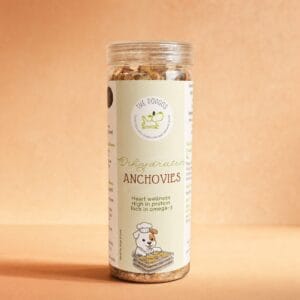
Dehydrated sardines and anchovies are the most concentrated DHA delivery food in our catalog. They are also small enough to break apart for a fussy senior who has lost interest in larger meals.
3. Joint Support
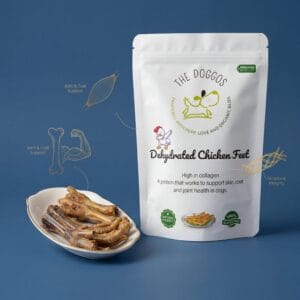
This is where the joint care protocol for large Indian breeds becomes relevant from age 6 onward. The stack: dehydrated chicken feet for glucosamine and chondroitin, dehydrated mutton trotters for collagen and recovery, both feeding cartilage that is rebuilding itself slower than it used to.
Common Indian owner mistake: stopping chicken feet “because she is old.” The opposite is correct. Joint inputs matter more at senior age, not less. A 9-year-old Lab needs feet two to three times a week as a baseline.
4. Anti-Inflammatory Baseline
Chronic low-grade inflammation, “inflammaging” in geriatric biology, is the silent driver of arthritis, cognitive decline, and skin issues in older dogs. Two food levers help.
- Omega-3 from whole fish (sardines, anchovies). Read our Omega-3 for dogs in India primer if you have not seen the EPA versus DHA math.
- GLA from hemp seed oil. A rare anti-inflammatory Omega-6 that bypasses the broken enzymatic conversion most senior dogs are running.
5. Calorie Management
Seniors burn fewer calories. Metabolic rate drops 12 to 20% between adult and senior life-stage. The bowl needs to shrink by roughly the same proportion, while the nutrient density of every gram stays the same or rises. This is the case for a balancer rather than just smaller portions of the same food. Smaller portions of nutritionally thin food is how dogs end up malnourished and overweight at the same time, the classic Indian senior-kibble pattern.
Why Hemp Meal Balancer Is the Senior Staple
Hemp Meal Balancer is the product I anchor most senior protocols on. The reasoning, in plain terms:
- Complete amino-acid profile. Hemp protein contains all 9 essential amino acids in a usable ratio, including the limiting ones (lysine, methionine) that chicken-rice bowls lack. A senior dog eating smaller portions still hits her protein needs.
- Prebiotic fibre. Senior dogs lose gut microbial diversity. Hemp meal supplies the fermentable substrate gut bacteria need to recover.
- Anti-inflammatory by composition. The fat fraction includes GLA, the anti-inflammatory Omega-6 senior joints respond to.
- Appetite-friendly. Mild, nutty, easy to dust onto a smaller bowl. Senior dogs who have lost interest in food often accept a balancer-topped meal when they have refused plain protein.
A standard senior protocol uses one to two teaspoons of Hemp Meal Balancer over the daily bowl, depending on dog size. It is the nutritional safety net that lets you confidently feed a smaller bowl without short-changing the dog.
The Cognitive Dysfunction Syndrome (CDS) Angle
CDS is the most under-diagnosed condition in Indian senior dogs. The signs, by clinical convention, fit the DISHA acronym:
- Disorientation: getting lost in familiar rooms, staring at corners
- Interaction changes: less interest in family, or sudden clinginess
- Sleep cycle disruption: pacing at 3 am, sleeping all day
- Housetraining loss: indoor accidents from a previously trained dog
- Activity changes: reduced exploration, repetitive circling
If your senior dog has any two of these, talk to your vet about CDS specifically. Most owners are told “she is just old.” She might be, or she might have a treatable cognitive condition that responds well to nutrition.
The nutrition lever has three parts: DHA daily (sardines or anchovies), anti-inflammatory baseline (Hemp Meal Balancer plus hemp seed oil), and enrichment chewing (chicken feet, mutton trotters, a Whole Quail). Chewing matters cognitively the way crossword puzzles matter for humans: it activates and exercises the brain.
Indian Climate, Senior Edition
Older dogs lose thermoregulation efficiency. They overheat faster in Mumbai humidity, dehydrate faster in Delhi summers, and stiffen faster in the brief Bangalore cold spell. Two consequences:
- Lean toward cooling proteins. Goat (mutton) and fish carry less metabolic heat than commercial corn-fed chicken. A senior dog in Chennai will visibly do better on a mutton-and-fish weekly rotation than on daily chicken.
- Hydration matters more. A fresh, moisture-rich bowl (70% water) is dramatically easier on senior kidneys than dry kibble (10% water). This is the single biggest argument against “senior kibble” for an Indian climate.
Common Indian Owner Mistakes
The senior-dog mistakes I see weekly:
- Switching to “senior kibble.” Most senior kibbles in the Indian market are lower in protein and higher in carbohydrates than their adult versions. This is biologically wrong. The packaging says “easier to digest.” The bag says “less of what your dog needs.”
- Reducing protein because “her kidneys.” Unless your vet has diagnosed renal disease with bloodwork (elevated BUN, creatinine, SDMA), do not cut protein. The relevant lever for actual renal disease is phosphorus restriction, not protein restriction. These are not the same.
- Removing chicken feet “because she is old.” Joint inputs matter more at senior age, not less. Keep the feet, possibly increase them.
- Dropping fish “because of smell.” Use dehydrated sardines or anchovies instead of fresh. The DHA is what the brain needs. The smell is solvable.
- Treating less appetite as the new normal. Reduced appetite is often a tooth problem, a nausea problem (early renal), or a CDS sign. Investigate before accepting it.
A Senior Weekly Meal Plan
This is the framework I hand a 9-year-old Lab’s owner. Adjust portions to your dog’s weight.
| Day | Base bowl | Topper | Chew |
|---|---|---|---|
| Mon | Cooked chicken, pumpkin, sweet potato | 1 tsp Hemp Meal Balancer + 2 ml hemp oil | 1 chicken foot |
| Tue | Cooked mutton (goat), spinach, carrot | 1 tsp Hemp Meal Balancer + 5 g Bone and Organ Boost | 1 mutton trotter |
| Wed | Cooked chicken, pumpkin, beans | 1 tsp Hemp Meal Balancer + 5 g dehydrated sardines | 1 chicken foot |
| Thu | Cooked mutton, sweet potato, courgette | 1 tsp Hemp Meal Balancer + 2 ml hemp oil | Whole egg shell powder pinch |
| Fri | Cooked chicken, pumpkin, spinach | 1 tsp Hemp Meal Balancer + 5 g anchovies | 1 mutton trotter |
| Sat | Cooked goat, pumpkin, carrot | 1 tsp Hemp Meal Balancer + 5 g Bone and Organ Boost | 1 chicken foot |
| Sun | Cooked chicken, pumpkin, beans | 1 tsp Hemp Meal Balancer + 5 g sardines | Rest day chew |
The plan rotates proteins (chicken and goat), keeps fish two to three days a week for DHA, and uses Hemp Meal Balancer daily so the smaller senior bowl still hits the amino-acid target.
From Mahiv’s practice: A 13-year-old Labrador in Pune came to me with three months of suspected CDS, pacing at 4 am, blank staring at the kitchen wall, getting “stuck” behind the sofa. Her vet had ruled out hearing loss and a stroke. We switched her to a cooked-mutton-and-pumpkin base bowl, 1 tsp Hemp Meal Balancer every day, 5 g dehydrated sardines five days a week, and 3 dehydrated chicken feet a week. Her owner messaged me at week 6: she was sleeping through the night, recognising her grandson again, and standing at the door for her walk. The food was not a cure. It was the lever that took the brain from declining to stable.
Frequently Asked Questions
Should I reduce protein for my senior dog?
No, not as a default. Modern research (NRC 2006 and follow-up work) shows healthy senior dogs need more high-quality protein, not less, to offset age-related muscle loss (sarcopenia). The only time to reduce protein is on a vet-diagnosed renal disease with bloodwork to support it, and even then the more important lever is reducing phosphorus, not protein.
What about kidney disease, when should I worry?
If your vet has run a urine specific gravity, BUN, creatinine, and SDMA, and the numbers are flagged, follow their renal protocol. Otherwise, a slight age-related drop in filtration is normal and does not require dietary changes beyond keeping phosphorus moderate. Annual senior bloodwork from age 8 onward is the right monitoring cadence.
When should I switch my dog to senior food?
Switch to a senior-appropriate diet, not necessarily a senior-labelled kibble. Most commercial senior kibbles in India reduce protein and raise carbs, which is biologically the wrong move. A fresh, complete-protein bowl topped with Hemp Meal Balancer is the better answer from age 7 (large breeds) or 9 (smaller breeds).
Are chicken feet safe for an old dog?
Yes, and they matter more at senior age, not less. The glucosamine and chondroitin in a dehydrated chicken foot feed cartilage that is rebuilding slower than it used to. Two to three feet a week is a sensible senior baseline. Skip them only if your dog has lost molars or has been diagnosed with pancreatitis.
Can my senior dog eat dehydrated fish daily?
For most senior dogs, yes. Five to ten grams of dehydrated sardines or anchovies daily is a strong DHA dose. Reduce to three to four days a week for dogs prone to soft stools. The fish does not need to be cooked or thawed, dehydrated is shelf-stable and travel-friendly.
My senior dog has lost her appetite, what should I do?
First, rule out a tooth problem (cracked molar, gum disease) and early CDS or nausea (often a renal sign). Then, increase the smell-and-flavour density of the bowl with a topper: dehydrated sardines crumbled in, a teaspoon of Hemp Meal Balancer, or 5 g of Bone and Organ Boost. Warm food slightly (room temperature, not hot). Switch from chicken to goat for a fortnight, many senior dogs find the stronger flavour reignites interest.
Do senior dogs need supplements I cannot get from food?
For most healthy senior dogs, no. A complete fresh diet plus Hemp Meal Balancer, dehydrated fish, and the joint stack covers everything an Indian senior dog needs. Pharmaceutical-grade supplements (chondroprotectives, B12 injections) become relevant only when bloodwork or a specific diagnosis calls for them. Talk to your vet rather than buying off Amazon.
About the Author
Mahiv Amit Chhabra is a Certified Canine Nutritionist and author of The Desi Carnivore: The Indian Pet Parent’s Guide to Real Meat, Whole Prey, and Ancient Superfoods. He runs The Doggos from Thane, Maharashtra, alongside his dogs Tony and Toughie, the brand’s longest-serving quality-control team. Read more about Mahiv.