By Mahiv Amit Chhabra, Certified Canine Nutritionist and author of The Desi Carnivore. Last updated: 18 May 2026.
TL;DR
- Almost every Indian dog on commercial chicken or kibble is running an Omega-6:3 ratio of 20:1 to 30:1, against an ideal of 7:1 or lower. That gap is what most owners are calling “heat”, “allergies”, or “unexplained itching”.
- Whole fish beats fish oil capsules on bioavailability, freshness, and cost. Most capsules sold in Indian pet stores are oxidised (rancid) by the time they reach the bowl, because polyunsaturated oils degrade fast in Mumbai humidity and 32 degree shelves.
- Dehydrated sardines deliver roughly 200 to 300 mg of combined EPA and DHA per 10 g serving, in a stable, smell-controlled, single-ingredient form. They are the cleanest Omega-3 source we can give Indian dogs.
- Eat low on the food chain. Sardines, anchovies, and bombil (Bombay duck) are small, short-lived plankton-feeders with negligible mercury. Salmon, tuna, and king mackerel are not.
- Plant-based ALA (flaxseed, walnut) converts at under 5% to EPA and DHA in dogs. For vegetarian households, hemp seed oil is the right plant choice, because of its GLA, not because it replaces fish.
Most fish oil capsules sold in Indian pet stores are rancid by the time they reach the bowl. That is not a marketing line, it is a chemistry problem. Polyunsaturated fats oxidise on contact with heat, light, and air, and a soft-gel capsule that has spent weeks moving from warehouse to shelf to home has often degraded into the inflammatory molecule you were trying to fix.
The same consultation happens every week. An Indian dog parent walks in worried about itching, hot spots, dull coat, or the catch-all “she has too much heat”. Nine times out of ten the missing piece is Omega-3, and ten times out of ten the bottle of capsules in the kitchen is not the solution.
Why Your Dog Needs Omega-3 in the First Place
Omega-3 fatty acids are essential, meaning the body cannot make them and they must come from food. Two of them do most of the work in dogs:
- EPA is the anti-inflammatory workhorse. It downregulates the prostaglandin and leukotriene pathways that drive itching, joint pain, hot spots, and ear inflammation.
- DHA is structural, making up roughly 30% of the lipid in the brain and retina. Puppies need it for cognitive development, seniors need it to slow Cognitive Dysfunction Syndrome.
The third Omega-3 on Indian shelves is ALA, the plant-derived one from flaxseed, chia, or walnut oil. Dogs convert ALA to EPA and DHA at under 5% (most studies closer to 1 to 3%). If a supplement says “rich in Omega-3” and the source is flaxseed, you are paying for a label, not a biological effect. The Omega-3 that matters comes from fish, krill, or algae. In India, small whole fish is the cleanest, cheapest, most stable source.
The Omega-6:3 Disaster in Indian Dog Bowls
Wild prey, the diet a dog’s biology is built around, runs an Omega-6 to Omega-3 ratio of 1:1 to 4:1. The National Research Council’s 2006 guidance for adult dogs sits in the 5:1 to 10:1 range as a safe upper bound, and 4:1 to 7:1 is the therapeutic anti-inflammatory zone. Now look at what we actually feed.
| Food source | Approximate Omega-6:3 ratio | Why |
|---|---|---|
| Wild rabbit, wild fish | 1:1 to 4:1 | Plant-fed prey eating greens |
| Pasture-raised chicken | 5:1 to 7:1 | Free-range, foraging insects and greens |
| Commercial Indian chicken | 20:1 to 30:1 | Corn and soy feed, zero greens, zero movement |
| Most kibble (India and global) | 15:1 to 25:1 | Cheap vegetable oils, grain-heavy formula |
| Boiled chicken plus rice home bowl | 22:1 to 30:1 | Same problem, no balancing fat added |
The 20:1 to 30:1 number comes from the bird’s diet. An Indian broiler is corn-and-soy-fed inside a shed for 35 days with no movement and no green leaf, and its flesh carries that lopsided fat profile straight into your dog’s bowl. When the ratio sits at 20:1 or higher, the body manufactures inflammatory prostaglandins (PGE2, leukotriene B4) faster than it can resolve them. The dog presents with paw licking, hot spots, chronic ear gunk, tear staining, dull coat, and the “unexplained itching” that drives the entire steroid prescription industry in Indian veterinary practice.
You can keep feeding chicken, you just have to fix the ratio. Adding 200 to 300 mg of EPA and DHA per meal is the single most effective lever in Indian dog nutrition, and a small handful of dehydrated sardines does exactly that in one shot.
The “Heat” Myth, Decoded
Indian dog parents grow up with the Ayurvedic idea that chicken and eggs are “garam” (heating), and that summer rashes or itching mean the dog has eaten too much heating food. The instinct is to pull the chicken and shift to “thanda” foods like curd, rice, or vegetarian bowls.
The instinct is half right and entirely the wrong fix. What we call “heat” is not thermal, it is the Omega-6 inflammation spike from above. Pull the chicken and inflammation drops because the Omega-6 source is gone, which is why “thanda” diets seem to work for a while. But you have also pulled the high-quality animal protein the dog needs. The cleaner fix is to keep the chicken and add the Omega-3. Fish balances chicken, it does not replace it. The same logic runs through our why is my dog always itching and hot spots on dogs in India guides.
Why Whole Fish Beats Capsules in India
Fish oil capsules look like the convenient answer. They are not, for three reasons that compound badly in the Indian climate.
Rancidity. EPA and DHA are highly unsaturated, every double bond a target for oxygen. The peroxide value of fish oil rises measurably within weeks even in cold-chain Western conditions, and in a 32 degree Indian pharmacy with no climate control that timeline shrinks dramatically. A rancid Omega-3 capsule is worse than no Omega-3 at all, oxidised lipids are pro-inflammatory. Whole dehydrated fish is far more stable, the Omega-3 sits inside intact cellular structures protected by the antioxidants the fish carried while alive (selenium, Vitamin E). A sealed pack stays fresh for months.
Bioavailability. Whole-food Omega-3 absorbs better than isolated triglyceride or ethyl ester forms. The phospholipids in fish flesh deliver EPA and DHA in the same molecular form your dog’s cell membranes are built from. Isolated capsule Omega-3 has to be repackaged through several digestive steps with absorption losses at each one.
Cost per real milligram. A bottle of 60 fish oil capsules runs ₹900 to ₹1500 in an Indian pet pharmacy. Once you discount for shelf oxidation, you are paying ₹15 to ₹25 per real dose. A 100 g pack of dehydrated sardines delivers 2000 to 3000 mg of combined EPA and DHA, so a 10 g serving runs ₹35 to ₹40 for 200 to 300 mg of fresh, bioavailable Omega-3. Dehydrated fish wins.
Sardines vs Salmon: Eat Low on the Food Chain
The Omega-3-from-salmon marketing is everywhere, and for Indian dogs it is the wrong call. Mercury bioaccumulates up the food chain. Small fish eat plankton, bigger fish concentrate the mercury, and apex predators (tuna, king mackerel, shark) carry loads orders of magnitude higher than plankton-eaters. Salmon sits in the middle, and farmed salmon adds dyes, antibiotics, and grain-fed Omega-6 of its own.
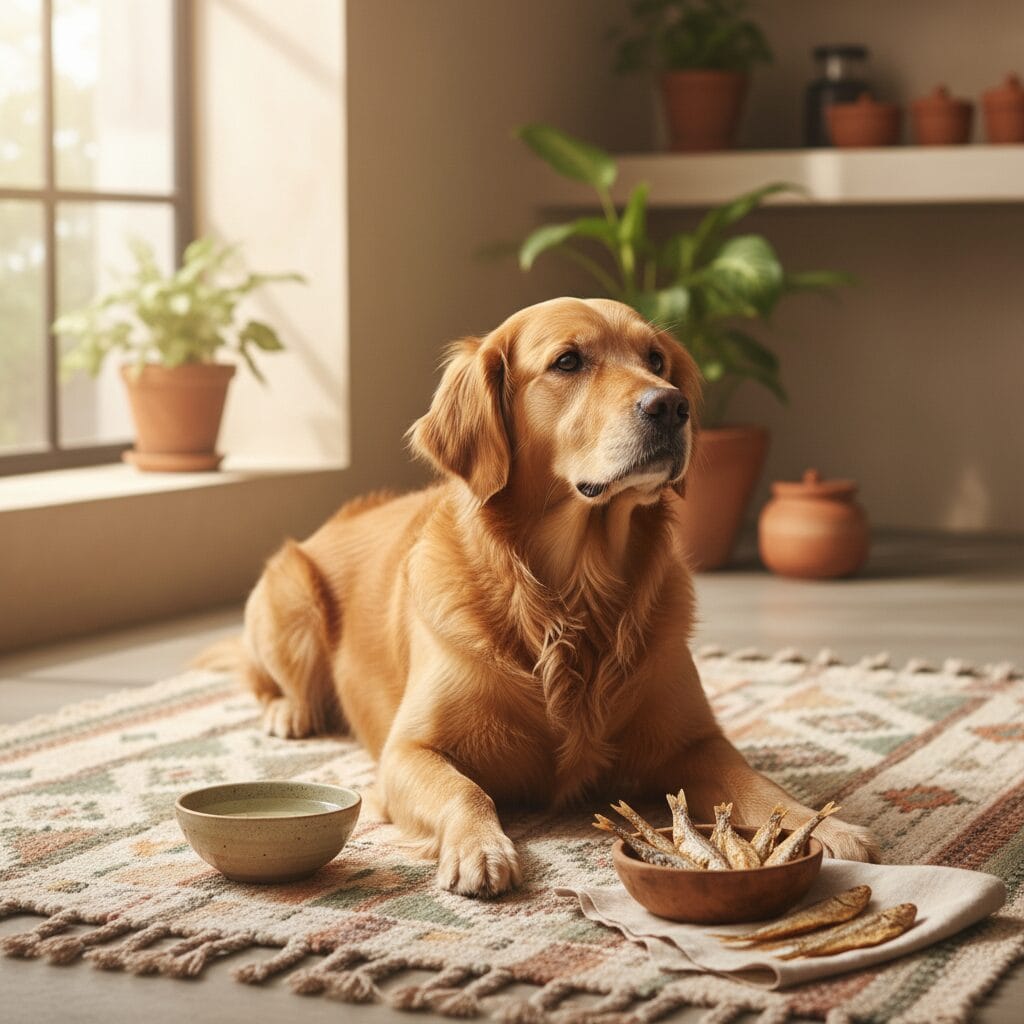
Sardines, anchovies, and bombil (Bombay duck) are the cleanest fish on the chain. They live 2 to 4 years, too short to bioaccumulate heavy metals, eat plankton, and carry negligible mercury, dioxins, or PCBs. They are abundant along the Goa, Karnataka, and Kerala coast (sardines) and the Maharashtra and Gujarat coast (bombil), at a fraction of salmon’s price. For Indian dogs, the answer is sardine, anchovy, or bombil. Not salmon.
Dehydrated Sardines: What You Are Actually Getting
A whole dehydrated sardine is a complete Omega-3 delivery system. Fresh sardine is roughly 25% protein and 11% fat, with 1.5 to 2.5 g of combined EPA and DHA per 100 g. Dehydration removes about 75% of the water, concentrating nutrients roughly 4x by weight, so a 10 g serving delivers 200 to 300 mg of combined EPA and DHA, plus complete protein, naturally occurring Vitamin D, selenium, and CoQ10. The bones, fully consumable, deliver bioavailable calcium and phosphorus at a Ca:P ratio close to 1.2:1.
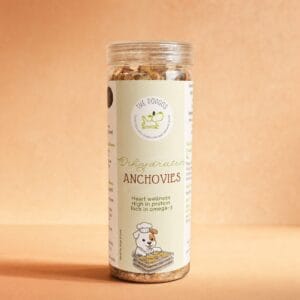
Our dehydrated sardines are single-ingredient, low-temperature dried over 18 to 22 hours, gut tract cleaned, skin, bones, and head retained. For smaller dogs and training, dehydrated anchovies deliver the same Omega-3 profile in a bait-sized form. For dogs needing protein rotation, dehydrated Bombay duck is the novel-protein fish that also covers the Omega-3 brief.
Dosage by Dog Size
Use this as a starting point. Adjust by stool quality, coat condition, and how much fat your dog tolerates.
| Dog weight | Sardines per serving | Frequency per week | EPA + DHA per serving |
|---|---|---|---|
| Toy (under 5 kg) | 5 g (half a fish) | 3 to 4 | 100 to 150 mg |
| Small (5 to 10 kg) | 10 g (1 sardine) | 3 to 4 | 200 to 300 mg |
| Medium (10 to 25 kg) | 15 to 20 g (2 sardines) | 3 to 5 | 400 to 600 mg |
| Large (25 to 40 kg) | 25 to 30 g (3 sardines) | 4 to 5 | 600 to 900 mg |
| Giant (over 40 kg) | 35 to 45 g (4 to 5 sardines) | 4 to 5 | 900 mg to 1.3 g |
For dogs with active inflammatory issues (hot spots, atopic dermatitis, joint pain, post-surgery), push the upper end and serve daily for 6 to 8 weeks, then drop to maintenance. The skin and coat response shows at week 3 to 4. For puppies over 12 weeks, start at half the toy-breed dose for the DHA brain-development window and build up over 7 days.
How to Introduce Sardines and Store Them
Most dogs take to fish on the first try. For the few that hesitate, crumble half a sardine over the regular meal for two days, then hand them a whole sardine on day three. Slightly looser stool over the first 24 to 48 hours is normal. Coat softens by week 3, itching reduction follows by week 4 to 6. Fish-averse dogs (more common in those raised on bland boiled chicken) usually take to the smaller dehydrated anchovies crumbled as a topper.
Storage is simple. Sealed pack in a cool place is enough. In Mumbai or Chennai humidity, transfer to an airtight glass jar after opening, optionally with a silica sachet. Refrigeration is not required. Smell-check before serving, fresh dehydrated sardines smell clean and fishy, a sharp ammonia note means the pack has spoiled.
Vegetarian Households: The Hemp Seed Oil Question
If you keep a strict vegetarian kitchen, plant-based ALA is not a substitute for fish-derived EPA and DHA, the conversion rate is too poor. Many vegetarian households I work with keep a single sealed jar of dehydrated sardines specifically for the dog, served outside or in a separate utensil. The household compromise is small.
If fish genuinely cannot enter the home, hemp seed oil is the strongest plant option, not because it replaces fish, but because it brings GLA (gamma-linolenic acid) into the picture. GLA is a rare Omega-6 that converts to anti-inflammatory Prostaglandin E1, the same direction fish Omega-3 works in. It will not match dehydrated fish dose-for-dose but it moves the needle. For active inflammatory or skin cases, fish is still the gold standard.
The Joint, Coat, and Inflammation Stack
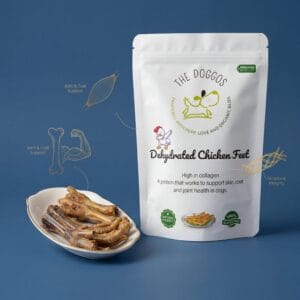
For dogs already on dehydrated chicken feet for joint support, sardines complete the picture. Chicken feet handle the structural side (glucosamine, chondroitin, collagen), sardines handle the inflammation side (EPA, DHA). Together they cover the two pillars of canine joint health, building the cartilage and quieting the inflammation eating it. A reasonable maintenance protocol for a 25 kg adult is a daily deboned chicken or mutton plus pumpkin base, 1 to 2 chicken feet two to three times a week, 15 to 20 g dehydrated sardines three to four times a week, and 2 to 3 ml hemp seed oil on the off days. This is the template I run for Tony, my older boy, and at 8 his coat is what my groomer keeps asking about.
From Mahiv’s practice: A 3-year-old Indie in Andheri came in last June with grade-3 atopic dermatitis, scratching herself raw at every monsoon, on a third round of steroids. Her diet was kibble plus a “premium” fish oil capsule the owner had been giving daily for 18 months. We opened the bottle, the smell told the story in two seconds. Pulled the kibble, switched to a cooked chicken plus pumpkin base, added 15 g dehydrated sardines four times a week, and 2 ml hemp oil on the off days. Steroid course tapered by her vet over week 4. By week 7 the scratching was gone, the bald patches had refilled, and we have not seen her back since.
Common Mistakes Indian Dog Parents Make
- Buying fish oil capsules from a non-refrigerated pharmacy. A bottle sitting on a 30 degree shelf for months is oxidised regardless of what the label promises.
- Calling flaxseed oil Omega-3. ALA conversion in dogs is under 5%. You are paying for a label, not a biological effect.
- Feeding salmon instead of sardines. Higher mercury, higher cost, often farmed with its own Omega-6 issues. Sardine, anchovy, or bombil is the Indian answer.
- Cooking the sardines. High heat damages the EPA and DHA you bought them for. Dehydrated is already shelf-stable and ready to feed.
- Stopping after a week. The skin and coat response shows at week 3 to 4. Hold the line for 6 weeks before you judge it.
- Treating sardines as a treat, not a balancer. They are not a snack, they are the missing fat in the bowl. Feed them with intent and frequency.
Frequently Asked Questions
How much Omega-3 does my dog need per day?
For a healthy 25 kg adult dog, the working maintenance dose is roughly 50 to 75 mg of combined EPA and DHA per kg of body weight, so 1.2 to 1.9 g per day total. Therapeutic doses for active inflammation (skin disease, arthritis, post-surgery) sit at the higher end of that range. A 15 to 20 g serving of dehydrated sardines delivers 400 to 600 mg, so four servings a week meets the maintenance need with margin.
Are dehydrated sardines better than fresh sardines for dogs?
For Indian conditions, yes. Dehydration removes the water content that would otherwise spoil quickly, preserves the Omega-3 in a stable form, removes the cooking step that destroys the EPA and DHA, and eliminates the wet-market hygiene risk. Fresh sardines, gently steamed or served raw, are nutritionally fine if you have a reliable cold-chain source. For most Indian homes, dehydrated is the cleaner choice.
Can puppies eat dehydrated sardines?
Yes, and they should. DHA is critical for puppy brain and retinal development through the first 12 months. Start at 5 g (about half a small fish) for puppies over 12 weeks, building to size-appropriate adult dosage by 6 months. Puppies on sardines tend to be easier to train, the DHA correlation is well documented in cognitive development studies.
My dog is allergic to chicken. Are sardines safe?
Almost always. True chicken protein allergy is rare, and even when present, fish is a different protein family entirely and rarely cross-reacts. Sardines (and the related anchovy or bombil) are common novel-protein recommendations in canine elimination diets. Introduce gradually and watch for the standard 7 to 10 day reaction window.
What about cats? Can cats eat dehydrated sardines?
Yes, and most cats love them. Cats are obligate carnivores and need taurine in every meal, which whole fish provides. Sardines work as a topper on the main meal or as a high-value training reward. Smaller cats may prefer the anchovies for size.
Will dehydrated sardines make my house smell of fish?
The smell is contained in the sealed pack and far less invasive than cooking fresh fish at home. Once opened, transfer to an airtight glass jar (especially in humid coastal cities) and the smell stays managed. Many of my vegetarian-household clients feed sardines daily without any kitchen aroma issue.
How do dehydrated sardines compare to anchovies for my dog?
Same biology, different size. Sardines are larger, 1 to 1.5 fish makes a meal-side serving for a medium dog. Anchovies are smaller, better as training treats or toppers, and the smaller size suits toy breeds and cats. Many homes keep both: anchovies in the training pouch, sardines on the meal plate.
Can I give too much fish to my dog?
You can. Excess Omega-3 thins blood and can cause loose stools at very high doses. The thresholds are forgiving (you would need to feed roughly 5x maintenance dose daily to see issues in a healthy dog), but stay within the table above and you will not run into trouble. If your dog is on blood-thinning medication or scheduled for surgery, mention the fish intake to your vet.
About the Author
Mahiv Amit Chhabra is a Certified Canine Nutritionist and author of The Desi Carnivore: The Indian Pet Parent’s Guide to Real Meat, Whole Prey, and Ancient Superfoods. He runs The Doggos from Thane, Maharashtra, alongside his dogs Tony and Toughie, the brand’s longest-serving quality-control team. Read more about Mahiv.