By Mahiv Amit Chhabra, Certified Canine Nutritionist and author of The Desi Carnivore. Last updated: 18 May 2026.
TL;DR
- Dehydrated mutton trotters are the densest joint-and-collagen food a large or giant Indian breed dog can eat, delivering both Type I and Type II collagen in one whole-food chew.
- Compared with chicken, goat carries roughly 3x the iron and 4x the zinc per 100 g, critical for tick-fever recovery, skin barrier under heavy coats, and the slower cartilage turnover of dogs over 25 kg.
- Cooked paya bones splinter and can kill a dog. Dehydrated mutton trotters do not. The rule is “Cook the Meal, Dehydrate the Bone.”
- Feed 1 trotter per 15 to 20 kg of body weight, 1 to 2 times a week. Pair with dehydrated chicken feet for daily glucosamine.
- Skip for dogs with a pancreatitis history, certain renal cases, and puppies under 16 weeks.
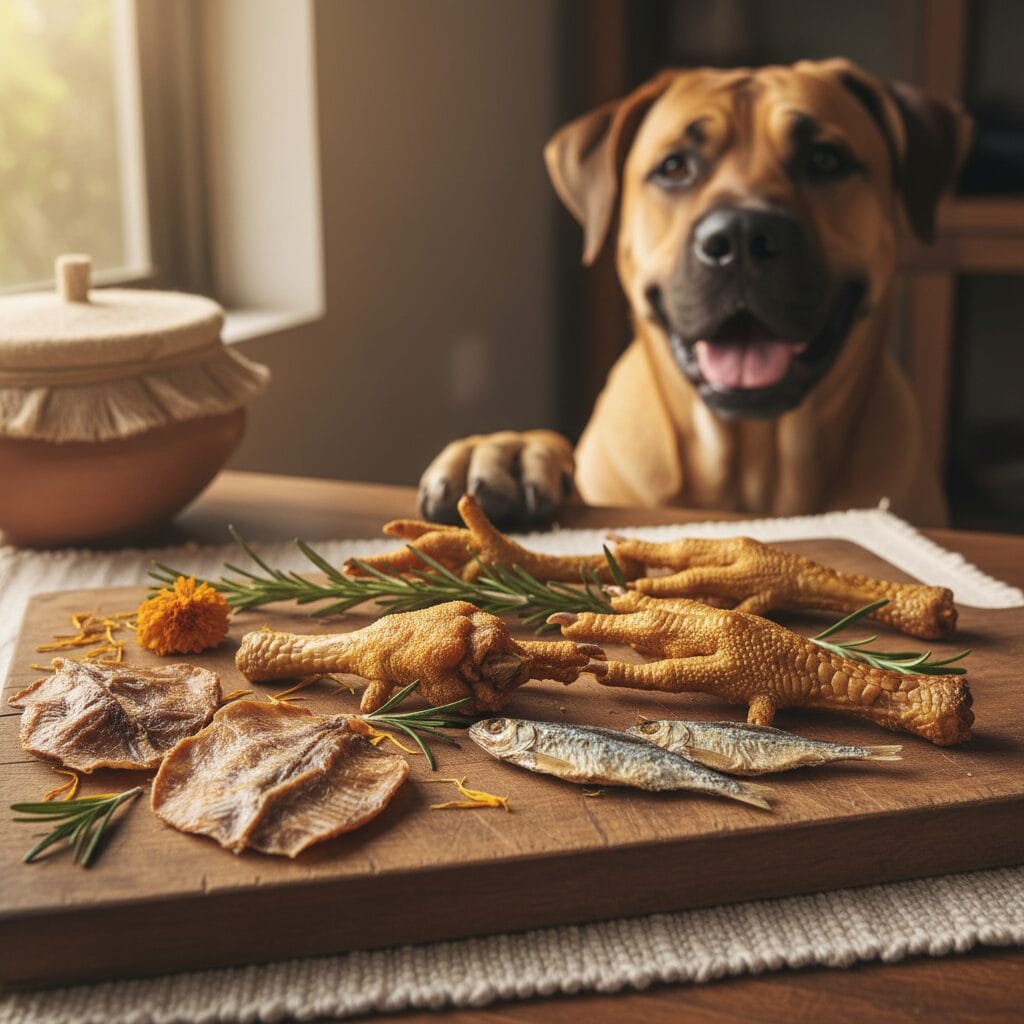
The first mutton trotter I handed Toughie sat in his mouth for four seconds while he decided whether he was being pranked. Then he carried it to his corner of the balcony and chewed steadily for the better part of half an hour. Large dogs in India do not need another tin of joint capsules. They need real connective tissue.
This is the article for the GSD owner whose dog is limping on stairs, and the Lab parent watching the joint supplement aisle expand. The biology, the dosage, the safety distinction between cooked paya and dehydrated trotters, and where mutton trotters fit in the joint stack.
What Is Actually in a Mutton Trotter
A mutton trotter is the lower-leg-and-foot of a goat (in India “mutton” almost always means goat, not sheep). It is almost entirely skin, tendon, cartilage, small bones, and marrow. Four things matter.
- Type I and Type II collagen, both. Skin and tendons give Type I, which rebuilds elastic skin and ligaments. The cartilage caps give Type II, the form used in joint surfaces. A capsule promising “collagen” usually delivers one type, hydrolysed beyond recognition. A trotter delivers both, in food matrix.
- Marrow. The hollow bones carry dense yellow marrow, rich in fat-soluble vitamins (A, D, K2), bioavailable iron, and saturated fats your dog’s brain and joint capsule both use.
- Iron and zinc, well ahead of chicken. Per 100 g, goat carries roughly 3.7 mg of iron versus 1.1 mg in chicken breast, and 4.0 mg of zinc versus 1.0 mg. Iron rebuilds red blood cells after tick fever. Zinc keeps the skin barrier intact under heavier coats in Mumbai humidity.
- Ca:P 1.2:1 ratio. The small bones mineralise at roughly the ratio the National Research Council (NRC 2006, Nutrient Requirements of Dogs and Cats) sets for adult dogs. Chicken-and-rice home bowls by themselves never hit this.
You can chase each from a separate bottle. You will spend more, get lower absorption, and lose the chewing satisfaction that makes the food work.
Mutton Trotters vs Chicken Feet: When to Use Which
They are not competitors. They are different tools.
| Feature | Dehydrated Chicken Feet | Dehydrated Mutton Trotters |
|---|---|---|
| Best for | Daily joint maintenance, dental | Heavy collagen load, large breeds, recovery |
| Collagen type | Type II dominant | Type I and Type II |
| Iron (per 100 g cut) | 1.1 mg | 3.7 mg |
| Zinc (per 100 g cut) | 1.0 mg | 4.0 mg |
| Chew time, medium dog | 5 to 15 minutes | 20 to 45 minutes |
| Calorie load | 35 to 40 kcal per foot | 90 to 130 kcal per trotter |
| Best frequency | 2 to 4 times a week | 1 to 2 times a week |
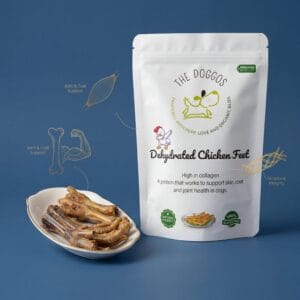
The full chicken-feet half sits in our chicken feet for dogs India guide. For a 35 kg Labrador with mild stiffness, my standard write-up is two chicken feet four days a week plus one trotter on the weekend.
Why Large and Giant Breeds Especially Benefit
A 40 kg dog carries roughly eight times the joint load per square centimetre of cartilage that a 10 kg dog does, and that cartilage turns over more slowly. Large breeds need more raw material to maintain the same joint, and they lose ground faster when it is missing.
Three specific arguments for trotters in large breeds.
- Connective tissue volume. A trotter is mostly tendon, cartilage cap, and skin. Per chew, a large dog takes in more collagen-precursor amino acids (glycine, proline, hydroxyproline) than from any equivalent serving of muscle meat.
- Zinc for skin under a heavy coat. GSDs, Labs, Goldens, and most Indie mixes carry a denser undercoat than thin-coated breeds. Zinc deficiency under that coat shows up as scaling, hot spots, and slow wound healing. Goat is the cleanest natural zinc source in our catalogue.
- Iron for the post-tick-fever rebuild. The platelet and red-cell crash after ehrlichiosis or babesiosis is one of the slowest things to recover from on a chicken-only diet. Trotters supply iron in heme form, the form dogs actually absorb.
The Connective Tissue Argument, in Plain English
A capsule of “joint supplement” delivers a known milligram dose of glucosamine, chondroitin, and maybe hydrolysed collagen. What the capsule cannot deliver is the chewing, which does three things a pill cannot.
- Mechanical scraping of plaque off molars and pre-molars, with biological force the dog applies on their own.
- Release of dopamine and serotonin, the neurochemistry of a satisfied predator. A dog who has chewed a trotter for thirty minutes is calmer for the next four hours.
- Jaw muscle development in growing large-breed pups. Soft kibble produces weak jaw muscles that feed back into worse dental health a decade later.
Our long read on why dehydrated treats work nutritionally goes deeper on the chemistry.
Why Dehydrated Mutton Trotters Solve the Joint-Loading Problem
The cut you want for a large Indian breed under joint load is the dehydrated mutton trotter. Two reasons.
First, the bone state. Raw paya bones from a wet market carry a Salmonella, Campylobacter, and (in monsoon) Listeria load that Indian conditions breed in minutes. Cooked paya bones splinter aggressively, because heat denatures the collagen matrix holding the mineral lattice together. Dehydration at 50 to 70 degrees C for 20 to 24 hours removes water without cooking the bone. The bone stays porous and crumbles to chalky powder under chewing. This is the “Goldilocks” position, not raw, not cooked. For the broader chew-safety conversation, see can dogs eat bones.
Second, the structural geometry. A trotter is a multi-knuckled, irregular shape that forces the dog to reposition, regrip, and grind. For a large breed who would otherwise inhale a chew in two seconds, the trotter’s shape is the safety feature.
Serving by Dog Size
Use this as a starting point. Adjust by stool consistency, weight trend, and chew time.
| Dog weight | Trotter per serving | Frequency per week | Notes |
|---|---|---|---|
| Toy (under 5 kg) | Not recommended | Use chicken feet instead | Geometry too large for safe gripping |
| Small (5 to 10 kg) | 1/4 trotter | 1 | Break with kitchen shears |
| Medium (10 to 25 kg) | 1/2 trotter | 1 to 2 | Standard maintenance dose |
| Large (25 to 40 kg) | 1 trotter | 1 to 2 | Best for Labs, GSDs, Goldens |
| Giant (over 40 kg) | 1 to 2 trotters | 2 | Pair with chicken feet on alternate days |
A trotter sits at roughly 90 to 130 kcal. For dogs on calorie-restricted diets, count it in.
Who Should NOT Eat Mutton Trotters
- History of pancreatitis. Trotters are higher in fat than a lean cut. Skip them, or limit to a quarter portion with veterinary clearance.
- Certain chronic renal cases. Dogs on a protein-restricted renal diet should not have extra high-protein chews on top. Discuss with the treating vet.
- Puppies under 16 weeks. Dentition is incomplete and the calcium-phosphorus load can interfere with growth-plate timing in large breeds.
- True goat allergy. Rare but real. If your dog reacts to goat in the bowl, the trotter will not be an exception.
Mutton Paya: the Broth Is Fine, the Cooked Bone Is Not
Mutton paya, the slow-cooked goat-trotter soup, is a winter staple in Lucknow, Hyderabad, and Bombay’s Bohri kitchens. The broth itself, strained of all bones, fed lukewarm in small amounts, is good for a dog: soluble collagen-derived amino acids, light hydration, real flavour.
The trap, every cold season, is that the family hands the dog a cooked leg with the bones in. Those bones have just been pressure-cooked for an hour. They splinter on the first bite. The dogs I have seen in vet ER with a punctured oesophagus from a paya bone are always the “she has been eating my mum’s paya for years” cases, until it stops working. Feed the broth, never the cooked bone. The safe dog chews guide covers the same logic for every chew.
The Joint Stack for Seniors and Large Breeds
For seniors, post-surgical rehab, and large breeds with diagnosed dysplasia, the protocol I write for clients is:
- Daily: 1 teaspoon of Bone and Organ Boost over the main meal, for taurine, iron, Vitamin A, and organ-fraction cofactors.
- Four days a week: 1 to 2 dehydrated chicken feet, the everyday glucosamine and dental scrape.
- One to two days a week: 1 dehydrated mutton trotter, in place of the feet on those days.
The stack hits four pillars: structural support, organ-derived cofactors, mineral balance, and chewing-derived enrichment.
From Mahiv’s practice: A 6-year-old GSD in Bandra came to me last August, post-CCL repair, struggling on the stairs to her apartment. Her family had been pilling three different joint capsules a day for eight weeks with no visible change. We dropped the capsules for one dehydrated mutton trotter twice a week, two chicken feet on the in-between days, and a daily teaspoon of Bone and Organ Boost. By week 7 she was taking the stairs without pausing. The food was the medicine, and it cost less per month than the prescription stack.
Common Mistakes Indian Dog Parents Make
- Feeding pressure-cooked paya bones. The most dangerous mistake on this list.
- Treating trotters as a daily snack. They are functional food, two or three times a week maximum.
- Skipping first-session supervision. A new chew shape needs the parent in the room for five minutes.
- Stopping at two weeks because “I do not see results.” Connective tissue rebuild takes six to eight weeks.
Frequently Asked Questions
Are mutton trotters safe for puppies?
For large-breed puppies over 16 weeks with their adult premolars in, half a trotter once a week is fine, supervised. Below 16 weeks, wait. Jaw musculature is not ready and the calcium load can interfere with growth-plate timing. For toy and small breeds at any age, use chicken feet instead.
How are dehydrated mutton trotters different from cooked paya bones?
Completely different bone states. Dehydration at 50 to 70 degrees C for 20 to 24 hours removes water without denaturing collagen, so the bone stays porous and crumbles under chewing. Pressure-cooking denatures collagen, the bone goes brittle and shears into splinters. Paya broth strained of bones is fine. The cooked bone is a life-threatening perforation risk. Never feed cooked bones.
Can my dog eat raw mutton trotters from the butcher?
Biologically a dog’s stomach acid can handle the pathogen load. Practically, in Indian wet-market conditions and especially in monsoon, the Salmonella and Listeria risk to your kitchen surfaces is high. The brand position is “Cook the Meal, Dehydrate the Bone.” Dehydration is the safer route to the same biology.
How many mutton trotters per week is too many?
For a 25 kg dog, two trotters a week is the upper end. Beyond that you are loading calories and fat without adding joint benefit. If you want more chewing volume, layer in chicken feet on the off days rather than adding more trotters.
Do dehydrated mutton trotters replace a vet-prescribed joint supplement?
For mild to moderate joint issues, functionally yes, especially when combined with chicken feet and Bone and Organ Boost. For advanced osteoarthritis or post-surgical CCL recovery, your vet may still prescribe pharmaceutical-grade injections (Adequan, Cartrophen) alongside the dietary approach. The two are complementary.
Will mutton trotters cause “heat” or itching in my dog?
What Indian households call “heat” from red meat is usually an Omega-6 inflammation spike, not thermal heat. Goat is leaner and lower in Omega-6 than commercial chicken, and the marrow fat is mostly saturated. For most dogs trotters reduce itching, not worsen it. If your dog has chronic skin issues, fix the Omega-6:3 ratio with hemp oil or anchovies first.
How do I store dehydrated mutton trotters?
Cool, dry, sealed. The product pack is the easiest container. In Mumbai or Chennai humidity, transfer to an airtight jar after opening. Refrigeration is not required and freezing changes the texture. Shelf life on a sealed pack is six months.
About the Author
Mahiv Amit Chhabra is a Certified Canine Nutritionist and author of The Desi Carnivore: The Indian Pet Parent’s Guide to Real Meat, Whole Prey, and Ancient Superfoods. He runs The Doggos from Thane, Maharashtra, alongside his dogs Tony and Toughie, the brand’s longest-serving quality-control team. Read more about Mahiv.
If this was useful, the companion piece on chicken feet for dogs in India covers the everyday glucosamine half of the joint stack, and a daily teaspoon of dehydrated mutton trotters paired with Bone and Organ Boost is the senior protocol I use most often.