By Mahiv Amit Chhabra, Certified Canine Nutritionist and author of The Desi Carnivore. Last updated: 18 May 2026.
TL;DR
- Dehydrated pig bones are one of the best long-format recreational chews available to Indian dogs, delivering 30 to 60 minutes of structured chewing, dental scraping, and a steady dopamine release that settles anxious and destructive dogs.
- Cooked pork bones are dangerous. Heat denatures the bone’s collagen lattice, leaving glass-like splinters that can perforate the gut. The AVMA is correct on cooked bones. Their position predates the dehydrated-bone category.
- Dehydrated pig bones are different. Low-temperature water removal over 20+ hours preserves the porous microstructure, so the bone crumbles under molar pressure instead of fracturing into shards.
- Size-match the bone to the jaw. A 5 kg Pomeranian gets a small section, not a femur. Wrong-size matching is the only meaningful risk with a dehydrated bone.
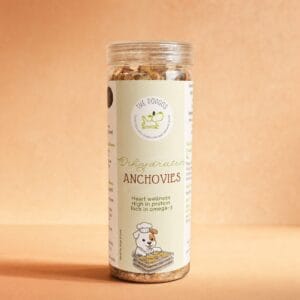
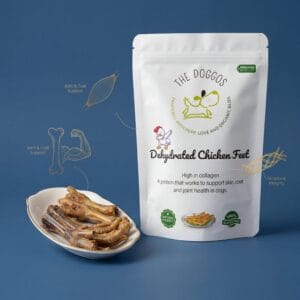
- Anchor product: the dehydrated pig bone from The Doggos, the long-chew counterpart to faster treats like chicken feet and goat ears.
If you have watched a Lab destroy a sofa cushion in twenty minutes, you have watched a dog with nothing legal to chew. Chewing is a biological need, not a behaviour problem. The question is never “should my dog chew”, it is “what should my dog chew, and for how long”.
This article is the deep-dive on pig bones, the long-format recreational chews most Indian pet parents have never been offered. For the general safety overview across all bone types, our bones for dogs guide is the foundation. This post sits on top of it.
What Chewing Actually Does for a Dog
Three things happen inside the body during a long chew session.
- Mechanical dental scraping. The molars drag across the bone’s porous surface, lifting plaque before it mineralises into tartar. A 2014 Journal of Veterinary Dentistry study documented a 70 percent reduction in dental calculus in dogs given recreational bones over a 12-day period.
- Dopamine and serotonin release. Rhythmic chewing activates the same reward loop that long walks do. The dog is literally medicating themselves. This is why a chewing dog is a calm dog, and why a dog deprived of chewing becomes destructive or anxious.
- Calcium and phosphorus absorption. A dog’s stomach (pH 1 to 2) breaks down the chalky bone residue into bioavailable minerals at roughly the 1.2:1 Ca:P ratio the National Research Council recommends for adult dogs.
A chew is not a snack. It is mental and physical maintenance, the closest thing your urban Indian dog gets to the work their ancestors did on the Deccan plateau 30,000 years ago.
Why Cooked Pork Bones Are Dangerous
This is the most important paragraph in the article. Never give your dog a cooked pork bone. Not from your kitchen, not from a restaurant, not from a pressure cooker, not from a tandoor.
When you cook a bone at high temperature, the collagen matrix that holds the mineral lattice together denatures. The bone goes from flexible and porous to brittle and glass-like. Bite it, and it fractures into sharp jagged splinters that can perforate the oesophagus, stomach, or intestines. The resulting infection is peritonitis. It is frequently fatal, and even when survivable, requires emergency surgery costing ₹40,000 to ₹1,50,000 in most Indian cities.
The American Veterinary Medical Association’s position against feeding bones is built on this risk, and they are right about it. Their position predates the dehydrated-bone category, which is a different physical state with a different safety profile.
Why Dehydrated Pig Bones Don’t Splinter
Dehydration is not cooking. Air at 50 to 70 degrees Celsius is moved across the bone for 20 to 30 hours. Water leaves. The collagen matrix and the bone’s microstructure stay intact.
The result is a bone firm enough to demand real chewing effort but porous enough to crumble into a chalky residue under molar pressure, rather than fracturing into shards. Picture the difference between snapping a dry biscuit (clean break, sharp edges) and crushing a piece of dehydrated mango (collapses inward, no sharp edges). The bone behaves like the mango.
This is the brand’s whole philosophy in one sentence: Cook the Meal, Dehydrate the Bone. Raw bones carry the wet-market hygiene gap (our raw vs dehydrated comparison goes deep on this). Cooked bones carry the splintering risk. Dehydrated bones sit cleanly in the middle.
Why Pig Bones Specifically
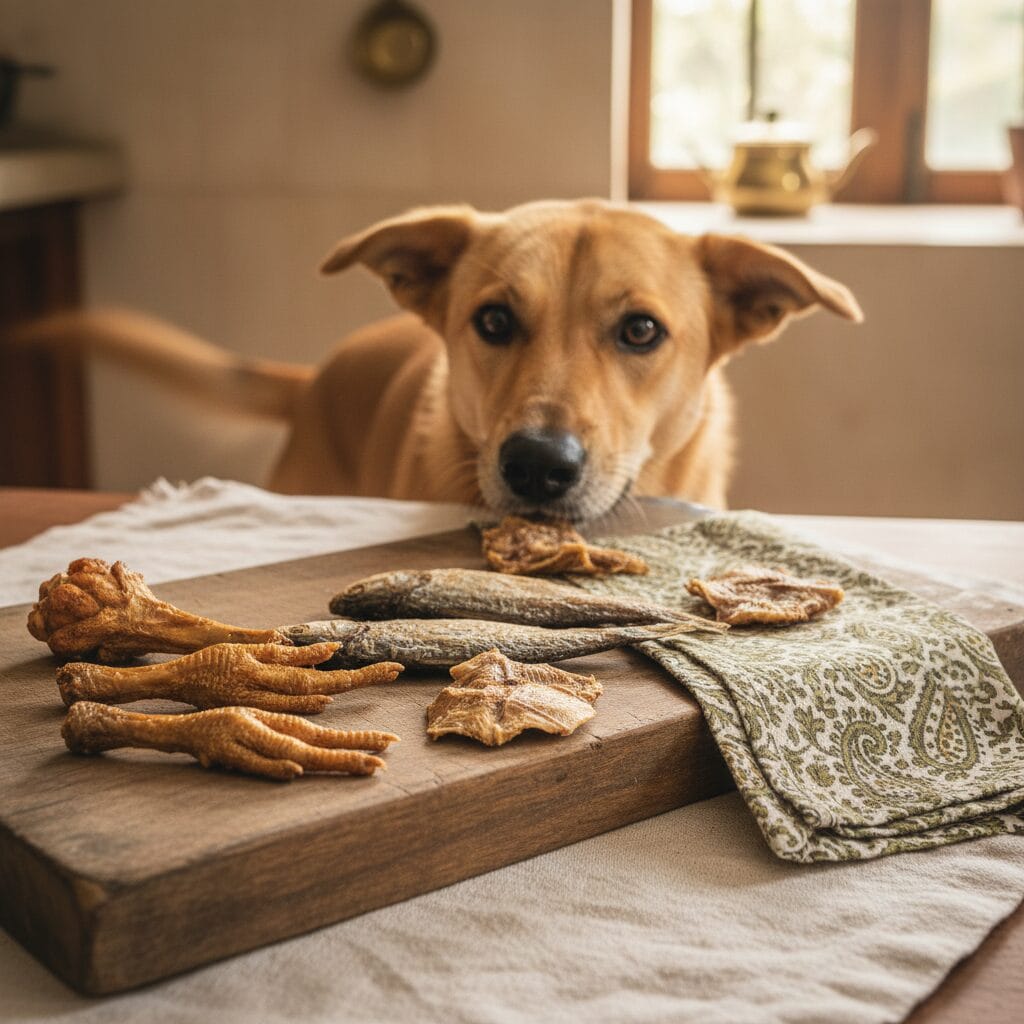
Shorter chews in the catalogue, like dehydrated chicken feet at 2 to 5 minutes per foot and dehydrated goat ears at 5 to 10 minutes, are excellent for daily dental work (our chicken feet for dogs guide covers the joint-supplement angle on those). For a determined chewer, they are the equivalent of a quick rinse.
A pig bone is structurally different. It is dense, marrow-rich, with thick cortical walls and a long surface area. A 100 g dehydrated pig bone delivers 30 to 60 minutes of structured chewing for a medium-to-large dog. That is meaningful working time, the kind of session that genuinely depletes mental energy.
- Density. Pig bones have more cortical bone than chicken or quail bones. They demand jaw work, not just nibbling.
- Marrow. The marrow inside delivers fat, iron, and a strong flavour signal that holds interest right to the end.
- Novel protein. Pork is rare in commercial Indian dog food, so most dogs have not over-exposed their immune systems to it the way they have to chicken.
Size-Matching: The One Rule That Actually Matters
Almost every dehydrated-bone incident I have been consulted on traces back to one mistake. A bone too small for the dog’s jaw. A 30 kg Lab can swallow a small bone whole. A 5 kg Pomeranian cannot work a femur. Match the bone to the jaw.
| Dog weight | Pig bone size | Why |
|---|---|---|
| Toy (under 5 kg) | Small fragment, supervised | Whole bones too dense for tiny jaws |
| Small (5 to 10 kg) | Small section (50 to 80 g) | Sufficient surface for sustained chewing |
| Medium (10 to 25 kg) | Standard bone (100 g) | The default sweet spot |
| Large (25 to 40 kg) | Large bone (150 to 200 g) | Anything smaller becomes a swallowing risk |
| Giant (over 40 kg) | Largest available | Pair with mutton trotters on alternate days |
The simple rule: the bone should be visibly larger than the back of the dog’s throat. If the whole bone fits in the mouth, it is too small.
How to Introduce a Pig Bone
- Pick a calm time. Not after a long walk, not before the doorbell rings. Settled, energy steady.
- Use a hard floor or chew mat. Carpets will not survive the bone dust.
- Hand the bone over, do not throw it. A handed bone says “work on it”. A thrown bone triggers grab-and-gulp.
- Observe. Not hovering. Just present. Watch for molar engagement, not front-tooth gnawing or attempts to swallow.
- Cap the first session at 15 to 20 minutes. Take the bone away even if the dog wants more. This builds anticipation rather than over-arousal.
- Watch the residue. A correctly chewed pig bone leaves a chalky white film around the mouth and on the mat. That is the bone breaking down the way it should.
- Repeat across day 2 and 3. By session four, most dogs have established their chewing technique and sessions can extend to the full 30 to 60 minutes.
From Mahiv’s practice: A 4-year-old Lab in Bandra came to me last August with what the owner called “destructive boredom chewing”, the dog had worked through two slippers, a TV remote, and the corner of a leather sofa in three weeks. We added more walks and a dog walker, but the lever that actually moved the needle was three pig bone sessions a week, 40 minutes each, in the late afternoon when the destruction window opened. The sofa is intact. The slippers are intact. The dog sleeps through the evening for the first time in his adult life. Chewing was the missing piece.
Dosage and Frequency
For a healthy adult dog with no pancreatitis history:
- Small (under 10 kg): 1 small bone, 1 to 2 times per week.
- Medium (10 to 25 kg): 1 standard bone, 2 to 3 times per week.
- Large (25 to 40 kg): 1 large bone, 2 to 4 times per week.
- Giant (over 40 kg): 1 large bone, 3 to 4 times per week, often paired with mutton trotters.
A 100 g dehydrated pig bone sits around 300 to 350 kcal, much of it marrow fat. For calorie-restricted dogs (post-spay, overweight, senior), count it into the day’s total.
Supervised vs Unsupervised Chewing
The first 5 to 10 sessions are supervised. After that, with a dog who has demonstrated good technique (molar engagement, no swallowing), unsupervised chewing is acceptable for a dog who works on the bone quietly on their bed.
Unsupervised does NOT mean overnight or for hours while you are out. Retrieve the bone when the dog loses interest, and always retrieve it once the bone is small enough to swallow whole. The rule of thumb: when the bone is smaller than the dog’s fist, it goes back into the sealed jar for the next session.
Who Should Not Eat Pig Bones
- Diagnosed pancreatitis. The marrow fat is the issue. Skip pig bones, choose lower-fat chews like goat ears.
- Broken or worn teeth. Any hard chew is risky on compromised dentition. Vet check first.
- Puppies under 6 months. Adult molars and jaw musculature are not in yet. Use softer chews like chicken feet until then.
- Severe resource guarding. Long-format chews intensify the behaviour. Train it first, then add the chew.
- Aggressive gulpers. Supervise every session and consider tying the bone to a rope handle for the first month.
Common Mistakes Indian Dog Parents Make
- Buying a small bone because it looks cheaper. A bone too small for the dog is the only common cause of incidents. Size up.
- Giving the bone right before a walk. Chewing relaxes a dog. Walks need an alert dog. Reverse the order.
- Leaving the bone in monsoon humidity. Mumbai monsoon softens a dehydrated bone within hours. Store in an airtight jar.
- Treating it as a daily ritual on day one. Build up across two weeks. Establish your dog’s chewing style first.
- Worrying about the residue around the mouth. That chalky white film is broken-down bone doing what it should. Wipe with a damp cloth.
The Doggos Pig Bone Versus Everything Else
Most dental chews sold in Indian pet stores are extruded products with a long ingredient list (rice flour, glycerin, sugars, colourings, “natural flavour”). They are sugar sticks shaped like a bone. They do not scrape teeth, do not satisfy the chewing drive, and often contribute to tartar rather than removing it.
A dehydrated pig bone from The Doggos is one ingredient: pig bone, water removed at low temperature. No additives, no fillers. It is a tool for dental hygiene, mental enrichment, and mineral nutrition, in that order. For a wider look at the category, our safe dog chews India guide covers the full landscape, and the dehydrated treats explainer covers why the process matters.
Frequently Asked Questions
Are pig bones safe for dogs in India?
Dehydrated pig bones, yes, with size-matching and supervision in the early sessions. Cooked pork bones, no, ever. Raw pig bones from an Indian wet market are not recommended either, given the hygiene gap in Indian retail meat supply. Dehydrated is the safe middle path.
How often can I give my dog a pig bone?
Two to four sessions per week is the realistic range for most adult dogs. Daily is excessive on the calorie side and offers no extra dental benefit. Less than weekly and the dog loses the cumulative dental advantage.
Can puppies have pig bones?
Wait until 6 months, when the adult molars and jaw musculature are in place. Before 6 months, use softer chews like dehydrated chicken feet or goat ears. After 6 months, introduce with a smaller bone first and supervise every session for the first month.
Will a pig bone break my dog’s teeth?
A dehydrated pig bone is softer than a cooked femur, an antler, or a Nylabone, which are the actual common culprits behind cracked canine teeth in my consulting practice. Healthy adult teeth handle a dehydrated pig bone without issue. If your dog has existing dental disease or a history of fractures, vet check before any new chew.
How long does a pig bone session last?
For a medium to large dog, 30 to 60 minutes per session is typical, sometimes more for a slower chewer. For a small dog working on an appropriately sized small bone, 15 to 30 minutes. Once the dog walks away from the bone, that session is over, store the bone for next time.
What if my dog swallows a large piece?
For a medium or large dog, in almost every case the stomach acid dissolves the piece within 4 to 8 hours. Watch for 24 hours for vomiting, lethargy, or refusal to defecate. For a toy breed who swallowed a piece that looks oversized, call your vet for reassurance. In nearly a decade of fielding this question I have seen one case that required intervention, and that dog had a pre-existing oesophageal narrowing.
How do I store a dehydrated pig bone between sessions?
Cool, dry, sealed. An airtight jar on a kitchen shelf is fine. In Mumbai monsoon humidity, the jar matters more, a soft bone is a less effective chew. Do not refrigerate or freeze, the texture changes in a way most dogs dislike.
About the Author
Mahiv Amit Chhabra is a Certified Canine Nutritionist and author of The Desi Carnivore: The Indian Pet Parent’s Guide to Real Meat, Whole Prey, and Ancient Superfoods. He runs The Doggos from Thane, Maharashtra, alongside his dogs Tony and Toughie, the brand’s longest-serving quality-control team. Read more about Mahiv.