By Mahiv Amit Chhabra, Certified Canine Nutritionist and author of The Desi Carnivore. Last updated: 18 May 2026.
TL;DR
- Quail is a novel protein for almost every Indian dog, meaning the immune system has never built antibodies against it. That makes dehydrated whole quail the cleanest food to run an elimination diet on.
- Most Indian “chicken allergies” are not really allergies, they are years of over-exposure (kibble + boiled chicken + chicken jerky) plus an unfixed Omega-6:3 imbalance. Quail breaks the loop.
- A whole dehydrated quail is leaner than chicken, denser in iron, and carries manganese in the bone, which protects ligaments from the cruciate-ligament tears we see in active Indies and Labs.
- The feathers we leave on are not a gimmick. They are insoluble keratin that scrubs the colon, bulks the stool, and helps a scooting dog naturally express the anal glands.
- 4-week protocol: feed quail-only protein for 28 days, watch the skin and ears reset, then reintroduce one protein at a time to find the real trigger. No fancy hydrolysed prescription kibble required.
Every two weeks, somebody emails me a photo of a Labrador with red ear flaps, a chewed paw, and a vet’s prescription for hydrolysed-protein kibble that costs ₹14,000 a month. The dog has eaten chicken since the day she came home. Nobody has asked about her food, only what to add to it. This is the post I wish I could send back.
Quail is not exotic and not a magic bird. It is simply a protein your dog’s immune system has not yet learned to attack. That single biological fact is the entire argument for a 4-week reset, and for keeping a few whole dehydrated quail in the pantry the way other households keep cumin.
The Novel-Protein Concept, in One Paragraph
A food allergy is the immune system mistaking a harmless protein for a parasite. The catch is that the immune system can only mistake a protein it has seen before. Antibodies are trained against repeated exposure, not against first contact. This is why the NRC’s 2006 Nutrient Requirements of Dogs and Cats recommends elimination diets built on a protein the dog has never historically eaten. Quail, venison, kangaroo, and rabbit are the classical candidates. In the Indian context, quail is the only one you can actually source reliably at a reasonable price.
Why So Many Indian Dogs End Up Allergic to Chicken
The Indian feeding habit is unusually mono-protein. Most pet parents I consult with have fed the same dog the same chicken-and-rice meal every day for years. A study tracking food-allergy patterns in commercial dog populations (Mueller et al., 2016, BMC Veterinary Research) found that chicken and beef were the two most frequently identified triggers, almost certainly because they are the two most frequently fed proteins.
There is a second layer specific to India. Commercial Indian chicken is corn and soy fed, producing meat with an Omega-6 to Omega-3 ratio of 20:1 to 30:1, against a healthy target of around 4:1. That floods the tissues with inflammatory precursors, and the dog presents with what looks identical to an allergy: paw chewing, ear infections, hot spots, a yeasty smell. The protein may be fine. The fat profile is the problem. Either way, pulling chicken out for 4 weeks is the cleanest way to find out which one is biting you. Our guide on chronic itching covers the parallel environmental and parasitic causes.
Quail Versus Chicken, on the Numbers
Quail is not chicken-but-smaller. The biology genuinely differs.
| Per 100g | Quail (whole, with bone) | Chicken (whole, with bone) |
|---|---|---|
| Protein | 22 g | 20 g |
| Fat | 12 g | 15 g |
| Iron | 4.5 mg | 1.3 mg |
| Manganese | 0.10 mg | 0.02 mg |
| Bone size | Small, fine, easily crumbled when dehydrated | Larger, denser |
Three things matter for the Indian context.
- Leaner meat, denser iron. Quail is closer to mutton than to chicken on the iron front. Useful for tick-fever convalescents and for senior dogs that have started looking pale at the gums.
- Smaller, more digestible bones. A dehydrated quail bone is fine, almost hollow, and crumbles into chalky powder under any adult dog’s molars. For an introduction to why dehydrated bone is safe and cooked bone is not, our chicken-feet guide walks through the physics.
- Manganese, the quiet ligament mineral. Manganese is a cofactor for glycosyltransferase, the enzyme that builds the cartilage proteoglycans your dog’s cranial cruciate ligament depends on. CCL tears are the single most common orthopaedic surgery in active Labradors and Indies in India. Manganese deficiency is not the only cause, but it is one of the easiest to fix, and quail bone is one of the densest dietary sources.
The Feather Trick: How Quail Helps Scooting Dogs
This is the part nobody writes about, because nobody else leaves the feathers on.
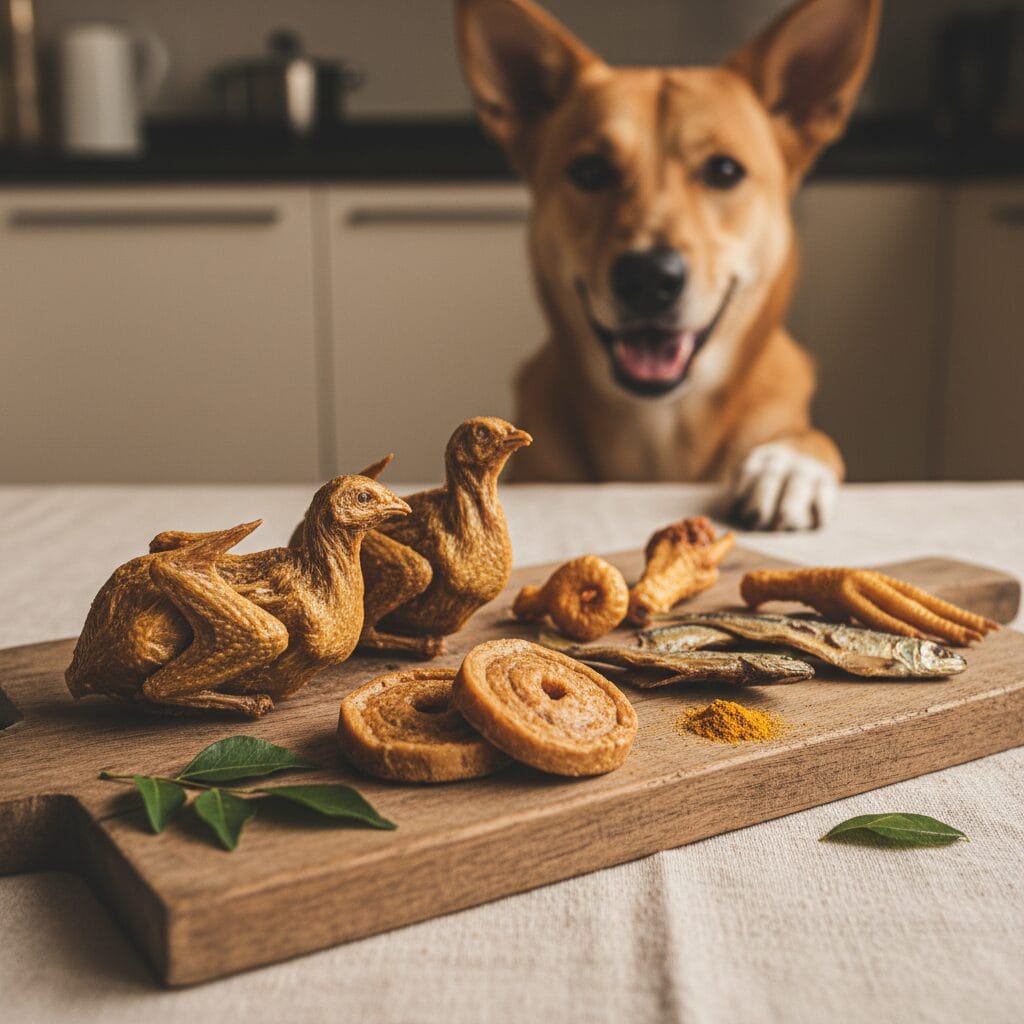
We dehydrate our quail with the feathers intact. Feathers are beta-keratin, an insoluble protein the dog cannot digest. That is the point. As the keratin passes through the colon, it acts as a physical scrubbing fibre. It bulks and firms the stool, which then presses outwards against the anal sacs on the way out, naturally expressing them.
If your dog scoots her bottom across the carpet (the classic “sled” behaviour), the textbook cause is impacted anal glands, which most vets manually express. Repeated manual expression weakens the sphincter and makes the problem chronic. A quail every three days, fed whole with feathers on, often clears the issue in a fortnight without anyone touching the dog. Wild canids never need their anal glands expressed. They eat feathers and fur. We took the lesson and built it into the product.
The 4-Week Elimination Reset
This is the protocol I run with every client whose dog presents with chronic itching, recurrent ear infections, or unexplained loose stools.
Days 1 to 7. Quail-only protein. One whole dehydrated quail per 10 kg of body weight per day, split across two meals. No chicken, no mutton, no fish, no dairy, no eggs, no biscuits, no street treats. Pair with sweet potato or steamed pumpkin as the carbohydrate. Add 1 ml of hemp seed oil per 10 kg to start correcting the Omega-6:3 ratio from day one.
Days 8 to 21. Hold the line. The skin barrier needs about 14 days to stop producing inflammatory cytokines, then another week to re-epithelialise. If you reintroduce chicken on day 12 to “see if she is fine”, you have restarted the clock.
Day 28. The first reintroduction. Bring back one protein and watch for 72 hours. Itching, ear gunk, loose stool, or face-rubbing within 3 days is your answer. Pull that protein, wait a week, try the next. By 6 to 8 weeks you have a clean map of what your dog can and cannot eat.
For dogs that need more nutrient density during the reset (puppies, seniors, working dogs), pair the quail with a teaspoon of the Bone and Organ Boost over the meal. It supplies taurine, iron, and Vitamin A from a mixed-organ base.
Where the Quail Actually Comes From
The romance of “imported novel proteins” wastes most Indian pet parents’ money. Quail farming has grown quietly across Maharashtra, Telangana, and Karnataka since the early 2010s, originally to supply restaurants. The Doggos source from quail farms outside Pune and Hyderabad, with the birds slaughtered young, cleaned, then dehydrated whole for 22 to 26 hours at under 70 °C. No marinades, no preservatives. That is why a 100 g pack of whole dehydrated quail is priced as a normal treat, not as a luxury good. For cats and very small dogs that find a whole quail oversized, the dehydrated chicken heads are the closest cousin in the catalog, similar whole-prey logic in a smaller form factor.
Dosage by Dog Size
Use this as a starting point for the elimination phase, then taper to a maintenance frequency once the reset is complete.
| Dog weight | Whole quail per day (elimination phase) | Maintenance frequency |
|---|---|---|
| Toy (under 5 kg) | 1/2 quail | 2 to 3 times a week |
| Small (5 to 10 kg) | 1 quail | 2 to 3 times a week |
| Medium (10 to 25 kg) | 1.5 to 2 quail | 3 times a week |
| Large (25 to 40 kg) | 2 to 3 quail | 2 to 3 times a week, paired with mutton or fish |
| Giant (over 40 kg) | 3 to 4 quail | 2 times a week, as a rotation protein |
A whole dehydrated quail is roughly 90 to 110 kcal. Build it into the calorie budget for dogs on weight management.
Who Should Not Eat Quail
There is no protein that suits every dog. Be specific about the following.
- Diagnosed game-bird allergies. Genuinely rare in India, but if a dog has reacted to duck, partridge, or pheasant in the past, quail is not automatically safe. Test with a single quail and wait 72 hours.
- Pregnant or lactating dogs. Quail is fine nutritionally, but pregnancy is not the time to run an elimination protocol or change a working diet. Discuss any change with your vet.
- Toy breeds during the very first session. The whole bird is bigger than the dog’s head. Break it into thirds for the first introduction.
- Dogs on strict low-iron diets for haemolytic disorders. Quail’s high iron load is usually a feature, occasionally a contraindication.
From Mahiv’s practice: A 5-year-old Labrador in Aundh, Pune, came to me last August with grade-3 otitis externa that her vet had been managing with monthly drops and hydrolysed-protein kibble for 11 months. Both ears were a wet, brown mess. We pulled the kibble, switched her to a quail-only protocol for 28 days, and added 4 ml of hemp seed oil per meal. By day 19 the discharge stopped. By week 6 the ear canals looked pink for the first time in a year. Mutton reintroduced in week 7, no reaction. Chicken in week 9, ears flared inside 48 hours. Her trigger was chicken. The reset was quail.
Common Mistakes Indian Dog Parents Make
- “Quail-flavoured” kibble is not novel protein. Many bags list quail eighth on the deck behind chicken meal, rice, and corn. That is a tagline, not an elimination diet. Read the first three ingredients.
- Cheating on day 14 with one piece of chicken from the dinner plate. Resets the entire protocol. Even a biscuit-sized exposure resets antibody counts.
- Skipping the omega-3 correction. Pulling chicken without adding hemp seed oil or dehydrated fish leaves the inflammation half-fixed. Fat ratio matters as much as the protein source.
- Manually expressing anal glands every time the dog scoots. A 2-week trial of whole quail with feathers solves most cases without weakening the sphincter.
- Stopping at day 14 because “the skin looks better”. The skin settles first. The gut and the immune system need the full 28 days.
Frequently Asked Questions
Is quail really a novel protein for an Indian dog?
For almost every Indian dog, yes. Quail is not used in commercial dog food production in India, not a regular treat, and not part of any traditional dog feeding culture. Unless your dog has been raised on quail (essentially impossible), the immune system has not built antibodies against it.
Can I feed raw quail instead of dehydrated?
No, not in an Indian household. Raw poultry from Indian wet markets carries Salmonella and Campylobacter loads that no amount of stomach acid is worth gambling with for kitchen cross-contamination. Dehydration at low temperature retains the bone structure, the muscle protein, and the keratin in the feathers, with the pathogen load removed.
Can puppies eat dehydrated quail?
From around 12 weeks, yes, broken into pieces sized to the dog. Quail’s calcium-to-phosphorus ratio sits close to the 1.2:1 the NRC recommends for growing puppies. For giant-breed puppies on a controlled-growth plan, check portion sizes with your vet.
How long until I see results from a quail elimination diet?
Skin first, around days 10 to 14. Ears by week 3 to 4. Stool quality often improves inside the first week. If you see zero improvement by day 21, the trigger is probably not the protein, more likely an environmental allergen, a parasite, or a Malassezia overgrowth that needs separate work.
How is quail different from chicken nutritionally?
Quail is leaner (12 g of fat per 100 g versus 15 g), denser in iron (4.5 mg versus 1.3 mg), and carries more manganese in its bones. The bones are finer and more digestible, making a whole dehydrated quail a complete calcium and phosphorus source in a way half a chicken cannot be.
Are the feathers really safe to eat?
Yes. The feathers are insoluble beta-keratin. They pass through the gut unchanged, scrubbing the colon walls and bulking the stool. Wild canids eat feathers and fur as a matter of course. The feathers are why our quail helps dogs with recurrent anal-gland trouble.
Can cats eat dehydrated quail?
Yes. Cats are obligate carnivores and tolerate quail well. Use one whole quail per 4 kg of body weight as a weekly addition, broken into smaller pieces.
About the Author
Mahiv Amit Chhabra is a Certified Canine Nutritionist and author of The Desi Carnivore: The Indian Pet Parent’s Guide to Real Meat, Whole Prey, and Ancient Superfoods. He runs The Doggos from Thane, Maharashtra, alongside his dogs Tony and Toughie, the brand’s longest-serving quality-control team. Read more about Mahiv.
If you are still working through what a healthy treat actually looks like, our guide to dehydrated treats for dogs is the next read.