By Mahiv Amit Chhabra, Certified Canine Nutritionist and author of The Desi Carnivore. Last updated: 18 May 2026.
TL;DR
- Dehydrated anchovies are the best training treat most Indian pet parents have never tried. Each fish is 2 to 4 kcal, single-ingredient, smelly enough that your dog can identify it from across the room, and small enough to use 50 times in a session without overfeeding.
- One anchovy delivers roughly 25 to 40 mg of EPA plus DHA, the omega-3s that build puppy brains and protect senior cognition. A “chicken-flavoured” training biscuit delivers sugar, glycerin, and 8 to 12 kcal of cereal.
- Dogs need 20 to 50 repetitions to learn a new behaviour. That math falls apart with high-calorie treats. Anchovies let you run real training sessions without blowing the calorie budget.
- They are also one of the most sustainable fish on the planet. Anchovies live 2 to 4 years, eat plankton, reproduce fast, and sit so low on the food chain they accumulate no measurable mercury.
- Feed by size: toy breeds 2 to 4 fish per session, medium dogs 8 to 15, large dogs 15 to 25. Store in an airtight jar in Indian humidity. Skip the fish-oil capsule on anchovy days.
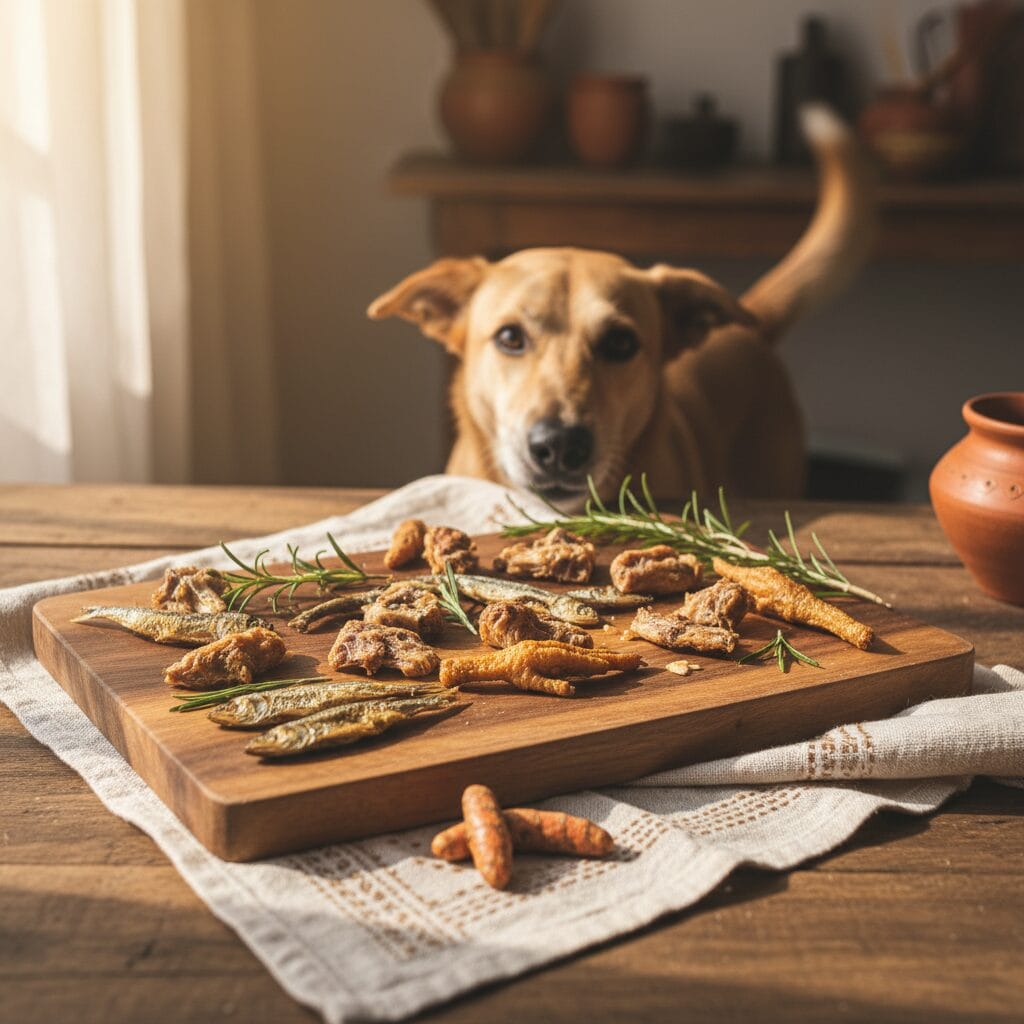
The first time I poured a handful of dehydrated anchovies into a client’s palm at our Thane store, her 6 kg Indie cross sat from across the room. She had not heard a cue. She had heard the smell, registered “food event in progress,” and offered the only behaviour she knew would get her closer to it. I had simply handed her the highest-value, lowest-calorie, single-ingredient training treat available in India, and her dog’s nose did the rest.
Anchovies for dogs are a category of one on the Indian market, and the customers who already know are buying packs in fours while the rest of you are still feeding Bonio biscuits in a marker-training session and wondering why your dog is gaining weight on a “training diet.”
Why Anchovies Are Training-Treat Gold
The five-part argument for the perfect training treat is short. Anchovies hit every line.
- Small. A whole dehydrated anchovy is roughly 4 to 6 cm long. It does not need breaking, does not crumble in your pocket, and a dog can swallow it in under a second.
- Smelly. Dogs have between 220 and 300 million olfactory receptors (we have 5 million). Your dog identifies the reward from across the room, which is the entire point of high-value training rewards.
- High-value. Behavioural research distinguishes “kibble-grade” rewards from “jackpot-grade” rewards (worth working through distractions). Oily fish is jackpot-grade for almost every dog. Owners who tell me their dog is “not food motivated” are usually feeding low-value rewards.
- Single-ingredient. The label reads “100% anchovies.” Compare to a typical Indian-market training treat, where the ingredient panel runs twelve lines and includes glycerol, propylene glycol, artificial chicken flavour, and “permitted colours.”
- Low-calorie per piece. A 2 to 4 kcal training treat is the difference between a real training session and an accidental binge.
The Math: 20 to 50 Reps Means 20 to 50 Treats
To install a new behaviour reliably, you need 20 to 50 successful repetitions across multiple short sessions. A sit takes maybe 20. A reliable recall through distractions takes 200 plus.
If each treat is 8 to 12 kcal (a typical chicken-flavoured biscuit), a 10 kg dog has just eaten 160 to 600 kcal in one session, between 25% and 90% of her daily caloric requirement. Do that three days a week and you have engineered obesity through good intentions.
Run the same math with anchovies. At 3 kcal per fish, 40 reps is 120 kcal, around 18% of daily calories, which is the ceiling most veterinary nutritionists recommend. Per-piece kcal is the most underrated metric in dog training.
| Treat type | Typical kcal per piece | 40-rep session for a 10 kg dog | % of daily calories |
|---|---|---|---|
| Dehydrated anchovy | 2 to 4 kcal | 80 to 160 kcal | 12 to 24% |
| Pumpkin PB biscuit (broken in half) | 4 to 6 kcal | 160 to 240 kcal | 24 to 36% |
| Commercial “chicken-flavoured” training treat | 8 to 12 kcal | 320 to 480 kcal | 48 to 72% |
| Cheese cubes | 10 to 15 kcal | 400 to 600 kcal | 60 to 90% |
| Boiled chicken cube | 5 to 8 kcal | 200 to 320 kcal | 30 to 48% |
Commercial Training Treats vs Single-Ingredient Fish
Pick up any “soft training treat” pack at an Indian pet shop. The first five ingredients are usually wheat flour or maida, vegetable glycerin, sugar or corn syrup, “meat by-product meal” (species unspecified), and artificial flavour. A dehydrated anchovy is an anchovy. Caught, cleaned, dried at low temperature for 12 to 18 hours, packed. Everything else (protein, fat, EPA, DHA, calcium from the intact bones, iodine, selenium) stays. Our guide to dehydrated treats for dogs walks through the processing and bioavailability argument in full.
The Omega-3 Bonus: Brain Food in a Training Treat
Per anchovy (roughly 1.5 g dried weight), you get about 25 to 40 mg of EPA plus DHA. Feed 15 anchovies in a training session and you have delivered the daily omega-3 requirement for a small breed without opening a fish-oil bottle.
DHA is the structural fat in the canine brain and retina. The National Research Council’s 2006 Nutrient Requirements of Dogs and Cats sets a minimum EPA plus DHA recommendation for growing puppies that most Indian commercial kibbles miss, because they rely on flaxseed-derived ALA, which dogs convert to EPA and DHA at under 10% efficiency. Whole-fish forms bypass the conversion problem entirely. For the long-form argument, our omega-3 for dogs in India guide is the deepest piece I have written, and the first-12-months puppy diet plan folds anchovies in as a brain-development treat from week 10 onwards.
How Many Anchovies Per Training Session, By Dog Size
| Dog weight | Anchovies per session | Sessions per day | Daily ceiling |
|---|---|---|---|
| Toy (under 5 kg) | 2 to 4 | 1 to 2 | 6 to 8 |
| Small (5 to 10 kg) | 5 to 8 | 2 to 3 | 12 to 20 |
| Medium (10 to 25 kg) | 8 to 15 | 2 to 3 | 25 to 40 |
| Large (25 to 40 kg) | 15 to 25 | 2 to 3 | 40 to 60 |
| Giant (over 40 kg) | 20 to 30 | 2 to 3 | 50 to 80 |
For long sessions (loose-leash walking outdoors, recall work), pre-portion into a treat pouch in the morning and stop when the pouch is empty.
Sustainability: Why Anchovies Are the Most Defensible Fish to Eat
Anchovies live 2 to 4 years, eat phytoplankton, and reproduce fast. They sit so low on the food chain that there is no biological pathway for them to accumulate mercury, cadmium, or PCBs in any measurable amount. Independent fisheries assessments rank small short-lived planktivores like anchovies, sardines, and Bombay duck in the lowest-risk tier. (For the underlying biology of mercury bioaccumulation in predators vs planktivores, the FDA’s mercury-in-fish reference categorises anchovies in the “best choices” group alongside sardines.) Compare to tuna (lives 15 years, eats other fish, accumulates mercury at every trophic level). “Eating low on the food chain” is the brand’s nutrition philosophy, and anchovies are the textbook example.
Storage in Indian Humidity
Decant the open pack into a wide-mouth airtight glass jar. Add a food-grade silica gel sachet if you have one. Store at room temperature, away from sunlight. Do not refrigerate, condensation will ruin the texture. A well-stored pack stays fresh for 8 to 12 weeks. White powdery bloom is salt and amino acid crystallisation, not mould. Actual fuzzy mould (rare) means discard.
From Mahiv’s practice: A 4 kg Pomeranian in Defence Colony, Delhi, came to me last summer with a loose-leash walking problem. Her pet parent had tried four trainers and a citronella collar (please don’t, ever). We dropped the collar, switched her rewards to dehydrated anchovies, and ran four 10-minute sessions per day for two weeks. She used roughly 80 anchovies across the week. By day 11 the dog was walking on a slack leash through Khan Market on a Sunday evening. The dog had not changed. The reward had.
Common Mistakes Indian Pet Parents Make
- Feeding them as a meal, not a training tool. Anchovies are nutrient-dense and salty. Training, topper duty (3 to 5 fish over a meal), or omega-3 support, not a primary protein.
- Doubling up on fish oil on anchovy days. If you are feeding 10 plus anchovies in a session, skip the fish-oil capsule that day.
- Worrying about the small bones. Dehydrated anchovy bones are soft, fully digestible, and contribute calcium. Cooked fish bones are the splintering ones, never feed those.
- Hiding the smell. The smell is the feature. Your dog needs to be able to smell the jar from across the house. That is what makes the training work.
Pairing Anchovies With Other Training Treats
For long sessions I run a two-tier reward system: anchovies for hard behaviours and high-distraction work, Pumpkin and Peanut Butter Biscuits (real pumpkin, real peanut butter, no xylitol) broken into thirds for easier reps. For variety on the fish front, rotate in dehydrated sardines (larger, better as a meal topper) or dehydrated Bombay duck (drier, crumbles smaller, useful for puppies).
Frequently Asked Questions
Are anchovies safe for puppies?
Yes, from around 10 to 12 weeks, once the puppy is on solid food. Start with one or two fish per session. DHA from anchovies is one of the best nutritional inputs you can give a young brain in its first six months.
Can my cat eat dehydrated anchovies?
Yes. Anchovies suit obligate carnivores beautifully, delivering taurine, EPA, DHA, and complete animal protein. Feed 1 to 3 anchovies per day as a treat, not a meal replacement. Most cats prefer the fish broken into halves.
How many anchovies can I feed per day?
Use the size table above. For most adult dogs the daily ceiling sits around 15 to 25 fish for medium breeds and 40 to 60 for large breeds, including training and topper use.
Do anchovies replace fish oil supplements?
Functionally, yes, for most healthy dogs. A 10 kg dog eating 10 to 15 anchovies in a session is getting the EPA plus DHA of a typical daily fish-oil capsule, plus complete protein, calcium, and the bioavailable nutrient matrix of whole fish. Bottled fish oil also oxidises fast in Indian heat.
Are anchovies high in mercury?
No. Anchovies live 2 to 4 years and eat plankton, too low on the food chain and too short-lived to accumulate mercury or other heavy metals. Independent fisheries assessments rank them in the lowest-mercury tier alongside sardines.
Are dehydrated anchovies the same as raw or canned anchovies?
No. Raw anchovies from a Mumbai fish-market table carry wet-market hygiene risks. Canned anchovies are packed in oil or brine, adding fat or sodium. Dehydrated anchovies are dried at low temperature with nothing added or removed except water.
Can I feed them to a dog with a fish allergy?
True fish protein allergy is rare but real. If your dog has a confirmed reaction to tuna or salmon, test anchovies cautiously, since they are a different species with different protein structures. Many fish-sensitive dogs tolerate them fine. Stop if you see itching, ear flare-up, or gut upset within 48 hours.
About the Author
Mahiv Amit Chhabra is a Certified Canine Nutritionist and author of The Desi Carnivore: The Indian Pet Parent’s Guide to Real Meat, Whole Prey, and Ancient Superfoods. He runs The Doggos from Thane, Maharashtra, alongside his dogs Tony and Toughie, the brand’s longest-serving quality-control team. Read more about Mahiv.
Ready to upgrade your training rewards?
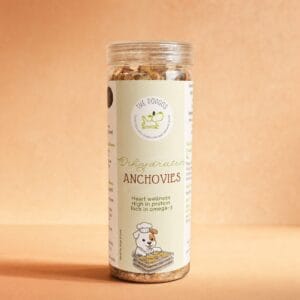
If you are tired of the calorie-bomb biscuit trap and want a training treat that actually pulls its weight, a pack of The Doggos dehydrated anchovies is the lowest-friction switch you can make this month. Single-ingredient, 2 to 4 kcal per fish, smelly enough to recall a Pomeranian off a pigeon, packed in Thane. Your dog will thank you. Your training will thank you. The ocean will thank you.