By Mahiv Amit Chhabra, Certified Canine Nutritionist and author of The Desi Carnivore. Last updated: 18 May 2026.
TL;DR
- The puppy diet India question has one biology-led answer: a home-cooked meat and pumpkin base bowl, balanced with the Bone and Organ Boost for taurine, iron, and Vitamin A, plus daily DHA from anchovies or hemp oil. Skip imported starter kibble. The biology is the same as for adult dogs, the stakes are much higher.
- The two non-negotiables are a calcium-to-phosphorus ratio close to 1.2:1 (over-supplement and you risk orthopaedic disease in large breeds, under-supplement and you get rubber jaw by month 6) and daily DHA for brain development, which directly affects how quickly your puppy trains.
- Growth has four phases: weaning at weeks 4 to 8 (pureed cooked meat, no bones), rapid growth at weeks 8 to 16 (protein-dense, DHA-rich), slower growth at months 4 to 9 (introduce dehydrated chews), and the adult transition at months 9 to 12 (full portions).
- Never raw, never cooked bones, never vegetarian for a puppy. Each of these is a developmental landmine in a way it is not for an adult dog.
- Most Indian puppy feeding mistakes are well-meaning: Cerelac, boiled chicken with rice as the entire diet, curd as the main meal, Marie biscuits as training treats, and pressure-cooked chicken with the bones still in. Every one of these has a fix.
The first time I sat across from a young Lab owner in Hyderabad whose six-month-old had X-rays showing softened mandibles, I had to tell him gently that he had not failed his puppy. He had followed exactly what his vet, his breeder, and the WhatsApp pet parents group had told him: boiled chicken and rice, twice a day, “nothing fancy.” The diet collapsed his puppy’s calcium-to-phosphorus ratio for four months straight, and his bones were paying the bill.
This is the post I wish someone had given that Lab owner before month one. Puppy nutrition India is the single highest-stakes decision a dog parent ever makes. The first 12 months write the cheque that the next 12 years cash. Get the four growth phases right, hold two ratios stable, and you build a dog that ages slowly.
Why the First 12 Months Matter More Than Any Other Year
Three windows close in the first six months and never re-open.
Growth-plate timing. Long-bone plates in large breeds fuse between months 14 and 18. Over-feed calories or calcium in the rapid-growth window and the plates close unevenly, locking in a Hip Dysplasia or Elbow Dysplasia diagnosis. Under-feed minerals and the bones soften into “rubber jaw” (juvenile osteopenia). The window is narrow.
Immune system priming. The gut-associated lymphoid tissue calibrates against the proteins it meets in the first 16 weeks. A puppy who only ever sees one brand of chicken protein is far more likely to develop chicken allergy by year three.
Microbiome formation. The bacteria a puppy carries to adulthood is largely set by month 6. Kibble feeding establishes a starch-fermenting biome. Whole-meat feeding establishes a protein-digesting one. The biome is sticky, switching diets at age four is far harder than getting it right at week eight.
An adult dog can recover from a bad diet. A puppy cannot un-set their growth plates, their immune calibration, or their microbiome.
The Four Growth Phases of a Puppy Diet in India
Phase 1: Weeks 4 to 8 (weaning, transition to solid food)
The mother is still the primary nutrition source. You are introducing the idea of solid food, not replacing milk.
What to feed: pureed cooked chicken or goat meat (boneless), softened with bone broth or warm water. Moisture is critical, four to five small meals a day, the consistency of porridge. No bones at any stage, raw or dehydrated, the dentition is wrong for it.
What to skip: cow milk (lactose load), Cerelac (sugar and cereal), kibble (too dry, too dense, too early).
Phase 2: Weeks 8 to 16 (rapid growth, socialisation window)
This is the steepest growth curve the puppy will ever climb. The diet has to be protein-dense and DHA-rich, with the Ca:P ratio held tight.
The base bowl: cooked chicken thigh (debone after cooking, always), mashed pumpkin, a soft-boiled egg three to four times a week, plus a half-teaspoon of Bone and Organ Boost per meal as the taurine, iron, and Vitamin A foundation. Feed four meals a day, dropping to three by week 12.
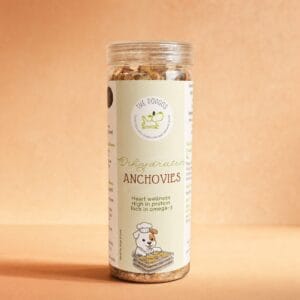
DHA: this is non-negotiable. One small dehydrated anchovy per day, broken into pieces for toy breeds, or 1 ml of hemp seed oil drizzled over the meal. Puppies on adequate DHA are measurably easier to train, the research on this is consistent across multiple peer-reviewed trials including the NRC 2006 Nutrient Requirements of Dogs and Cats growth-stage guidance.
What to skip: chicken feet (the molars are not in yet, and the calcium load is risky), large recreational bones, raw meat from any source, vegetarian-only meals.
Phase 3: Months 4 to 9 (slower growth, adult teeth coming in)
Around month 4, the puppy molars begin erupting and the growth rate slows from “exponential” to “steady”. This is when you introduce dehydrated chews, both for chewing musculature and because that pressure helps loosen the deciduous teeth.
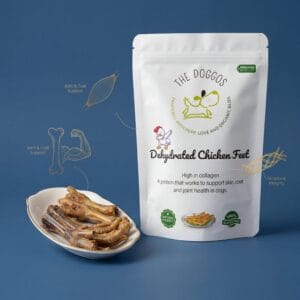
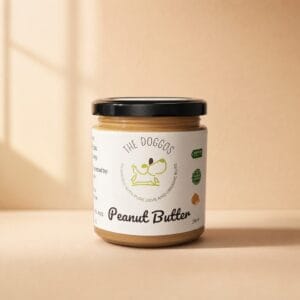
Introduce: a half dehydrated chicken foot twice a week from month 4, scaling to a full foot by month 6. Hold the heel-end while the puppy works on the toes for the first few sessions. Pair with training treats, an excellent low-stakes choice is a smear of peanut butter inside a lick mat after a long walk, or one pumpkin and peanut butter biscuit per recall command nailed.
Keep going: Bone and Organ Boost (half a teaspoon per meal), DHA daily, the home-cooked base bowl as the dietary backbone.
Phase 4: Months 9 to 12 (transitioning to adult portions)
Growth has slowed sharply. Calorie needs per kilo of body weight start to drop. This is when most Indian owners over-feed without realising it, the puppy still acts hungry because the appetite hormones lag the metabolic shift by weeks.
What changes: drop from three meals to two. Introduce full chicken feet for medium breeds, mutton trotters for giant breeds. Maintain the Bone and Organ Boost as the lifelong taurine and organ supplement. Watch the rib coverage, you should be able to feel ribs easily but not see them. If you can see them, feed more. If you cannot feel them, feed less.
The Two Non-Negotiables of Every Puppy Bowl
1. Calcium-to-phosphorus ratio of 1.2:1
This is the most-failed metric in Indian home-cooked puppy diets, and it has the worst consequences.
Meat is rich in phosphorus and poor in calcium. A puppy fed only boneless chicken and rice ingests roughly 30 times more phosphorus than calcium. The body pulls calcium out of the skeleton to balance blood serum. By month 4 to 6 you see soft mandibles, then a wobbly gait, then in severe cases, fractures from normal play.
Over-supplementing is the mirror failure, common in large-breed parents who panic about deficiency and overcorrect. Excess calcium during rapid growth interferes with bone remodelling and is a documented contributor to elbow dysplasia and osteochondritis dissecans.
The fix is a balancer, not a calcium tablet. The Bone and Organ Boost is calibrated to the right Ca:P window for growth-stage feeding, half a teaspoon per meal for puppies under 5 kg, one teaspoon for 5 to 15 kg, two teaspoons for over 15 kg. Eggshell powder is a respectable second-tier option (around 1.5 g finely ground per 500 g of meat) but lacks the organ-meat micronutrients the Boost layers in.
2. DHA for brain development
DHA (docosahexaenoic acid) is the structural omega-3 in the brain and retina. A puppy’s brain triples in mass in the first six months and DHA is the bottleneck nutrient for that build.
The AAFCO growth profile sets a minimum DHA + EPA intake for puppies (around 0.05% of dry-matter diet). Miss it and you get slower learning, worse vision, and longer time-to-trained on basic commands. Studies in working-breed puppies show DHA-supplemented groups learn novel tasks measurably faster than the controls.
Cheapest reliable source in India: one or two small dehydrated anchovies per day. Anchovies sit so low on the food chain that mercury bioaccumulation is negligible, the dehydrated form has no fish-cooking smell for vegetarian households, and a single anchovy delivers far more bioavailable DHA than the equivalent volume of flaxseed oil.
The Large-Breed Caveat: Slow Growth Is Better Growth
If you have a Labrador, German Shepherd, Golden Retriever, Saint Bernard, or any breed projected to cross 25 kg at adulthood, lean to underfeed, never overfeed, in months 3 to 9.
This is counter-intuitive. Indian breeders and many old-school vets equate “fat puppy” with “healthy puppy”. The data says the opposite. Faster growth in large breeds correlates with higher rates of hip dysplasia, elbow dysplasia, and osteochondritis. Slower, leaner growth gives the joints time to ossify properly.
A useful rule: at every weekly weigh-in, the puppy should be lean enough that you can feel each rib through a thin layer of muscle, with a visible “tuck” behind the ribcage when viewed from the side. If you cannot, drop calories by 10% and re-check in seven days.
From Mahiv’s practice: A Lab puppy in Hyderabad came to me at month 4. The owner had been feeding boiled chicken-and-rice, twice a day, plus three Parle-G biscuits as training treats. The puppy was bouncing on weight charts (good in the owner’s mind, alarming in mine). We switched him to a cooked-chicken-pumpkin base bowl, added 1 tsp Bone and Organ Boost per meal, 1 small anchovy per day, and swapped Parle-G for PB biscuits. Growth-plate X-rays at month 9 came back clean, hips and elbows perfectly developed. The puppy had grown more slowly than his litter-mates and was visibly leaner, and the orthopaedic surgeon called it the textbook ideal.
Common Indian Puppy Feeding Mistakes (And Their Fixes)
Cerelac. Marketed for human infants, weaponised against puppy guts. Sugar, processed cereal, no biologically useful protein for a carnivore. Fix: switch to pureed cooked meat plus pumpkin from week 4.
Boiled chicken and rice as the entire diet. The Ca:P collapse described above. Fix: add Bone and Organ Boost or 1.5 g eggshell powder per 500 g of meat, and replace half the rice volume with pumpkin or sweet potato.
Curd as the main meal. Curd is a fine topper (one teaspoon to test for lactose tolerance is the protocol I cover in detail in the curd guide), but it is not a meal. Puppies fed curd-heavy diets are protein-deficient and often calorie-deficient.
Marie biscuits and Parle-G as training treats. Sugar in a puppy’s mouth ferments and rots the soft enamel of the milk teeth. Fix: tear up one pumpkin and peanut butter biscuit into ten pieces for ten reward repetitions, or use a smear of peanut butter for high-value recalls.
Pressure-cooked chicken with the bones in. The deadliest mistake on the list. Heat makes bones brittle and splinter-prone, and a puppy oesophagus is small enough that one splinter can perforate. Fix: cook the chicken, then debone every single time. The full safety case is in the feeding philosophy guide.
Raw chicken for the immune system. A common piece of WhatsApp advice. A developing puppy immune system is far less equipped to handle the Salmonella, Campylobacter, and E. coli load of an Indian wet-market chicken than an adult dog’s. Cook the meat, dehydrate the bone, full stop.
Vegetarian puppy food. This is the one I push hardest on. Dogs are obligate-leaning carnivores. Puppies on vegetarian diets develop taurine deficiencies that progress to Dilated Cardiomyopathy (a fatal heart condition) on a timeline of years, not weeks. No amount of supplementation reliably replicates the bioavailable taurine, iron, and Vitamin A in real meat and organs. If your household is vegetarian, the Bone and Organ Boost over a cooked-meat base bowl is the absolute minimum.
A Sample Puppy Meal Plan (Months 3 to 6, Medium Breed)
For a 5 kg puppy projected to reach 18 kg at adulthood, feeding three meals a day.
| Meal | What | Approximate quantity |
|---|---|---|
| Morning | Cooked chicken thigh (deboned) + mashed pumpkin + 1/2 tsp Bone and Organ Boost | 100 g meat + 30 g pumpkin |
| Mid-day | Same base, with 1 soft-boiled egg mashed in | 80 g meat + 1 egg |
| Evening | Cooked chicken or goat + pumpkin + 1/2 tsp Bone and Organ Boost + 1 small anchovy crumbled on top | 100 g meat + 30 g pumpkin |
| Training rewards | 1 PB biscuit broken into 10 pieces, or peanut butter on a lick mat post-walk | as needed |
| Twice a week, from month 4 | Half a dehydrated chicken foot, supervised | 1/2 foot |
Adjust quantities by stool consistency (firm and shaped, not loose, not crumbling) and weekly rib check. For deeper context on egg incorporation, the egg guide covers raw vs cooked and the biotin question. For breed-specific context on Indies, who often need slightly less calorie density than their imported-breed peers, see the Indie dog diet guide.
Frequently Asked Questions
Can I feed my puppy chicken feet?
Not before month 4. Wait until the adult molars are coming in, then introduce half a foot twice a week, supervised. Full dosage details are in the chicken feet guide. Before month 4, the dentition is wrong and the calcium load is too aggressive for a still-soft skeleton.
How much should I feed my puppy at each meal?
Roughly 5 to 8 percent of current body weight per day, split across three or four meals depending on age. A 5 kg puppy needs around 250 to 400 g of total food per day. Adjust to maintain lean rib coverage, not to a chart.
Is curd OK for puppies?
Yes, as a topper, not as the meal. Start with one teaspoon to test for lactose tolerance, watch for loose stool over 24 hours, then build up to a tablespoon stirred into the main bowl two or three times a week. Probiotic benefit is real, but the protein density is too low for it to be the main calorie source.
Can I raise my puppy on a vegetarian diet?
No. Puppies have absolute taurine, Vitamin A, and bioavailable iron requirements that plant sources cannot meet reliably. Vegetarian puppy diets are a documented contributor to Dilated Cardiomyopathy and growth failure. If your household is vegetarian, the workaround is cooked meat (chicken, goat, or fish) plus the Bone and Organ Boost as the daily organ-and-taurine layer.
When do I switch my puppy to adult portions?
For small and medium breeds, between months 10 and 12. For large and giant breeds, between months 14 and 18 (their growth-plate fusion takes longer). The signal is a stable weight for two weeks in a row alongside reduced appetite. Drop from three meals to two and reduce daily volume by roughly 15 percent.
Is imported starter kibble better than homemade?
No. The argument that kibble is “complete and balanced” while homemade is not, is a marketing argument, not a biological one. A cooked meat base bowl plus the Bone and Organ Boost plus daily DHA meets every NRC 2006 growth-stage requirement, with the bonus of 90 to 94% digestibility (versus around 80% for kibble) and a microbiome built for protein, not starch.
My puppy refuses meals sometimes. Is that normal?
Yes, especially around the four-month dentition shift and again during the adolescent appetite drop at month 8 to 10. Do not switch foods every time the puppy skips a meal, you teach them to hold out for the next thing. Maintain the base bowl, skip the meal, offer it again at the next mealtime.
About the Author
Mahiv Amit Chhabra is a Certified Canine Nutritionist and author of The Desi Carnivore: The Indian Pet Parent’s Guide to Real Meat, Whole Prey, and Ancient Superfoods. He runs The Doggos from Thane, Maharashtra, alongside his dogs Tony and Toughie, the brand’s longest-serving quality-control team. Read more about Mahiv.