TL;DR: Most “itchy dog” cases in India aren’t an allergy you have to live with — they’re an omega imbalance you can feed your way out of. Commercial Indian chicken runs an omega-6 to omega-3 ratio of 20:1 to 30:1 (the healthy target is ~7:1), and that excess omega-6 is inflammatory fuel. The fix is three layers: pull the bowl’s ratio down with hemp seed oil (3:1) and small oily fish, rebuild the skin barrier topically with baobab oil, and stop re-loading omega-6 by rotating off everyday broiler chicken. Most dogs show visible change in 2–4 weeks.
First — why Indian dogs itch more than the internet admits
If your dog licks their paws raw, gets recurring hot spots, has chronic ear gunk, red belly skin, a dull coat, or tear stains — and you’ve already switched to a “clean” home-cooked or chicken-and-rice diet — the problem usually isn’t an exotic allergy. It’s the chicken.
“The problem usually isn’t chicken. It’s what the chicken ate.”
Commercial broiler chickens in India reach slaughter weight in about 40 days on a corn-and-soy diet. That diet pushes the meat’s omega-6 to omega-3 ratio to 20:1, sometimes 30:1 — versus roughly 7:1 in pasture-raised birds. Omega-6 isn’t evil, but at that concentration it becomes pro-inflammatory: feeding it daily is like pouring petrol on skin that’s already reactive — roughly three to four times the inflammatory load. The itch, the hot spots, the goopy ears are all downstream of that one ratio.
(The full breakdown is here: The Chicken Trap → and Dog Skin & Coat in India →.)
The three-layer fix
You don’t need a prescription diet. You need to change one ratio and support the skin while it heals.
Layer 1 — Pull the bowl’s omega ratio down (from the inside)
This is the layer that actually moves the itch. Add a concentrated omega-3 source so the bowl stops sitting at 20:1.
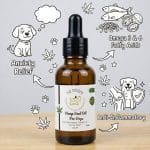
- Hemp Seed Oil → — a 3:1 omega-6 to omega-3 oil that also carries GLA (gamma-linolenic acid). GLA converts to Prostaglandin E1, which directly calms inflammation and keeps the skin barrier moist. As our nutritionist puts it: “GLA makes hemp oil a direct ‘medicine’ for dogs with dry, cracking paws or chronic dandruff.” Spoon it over the existing meal.
- Dehydrated Sardines → and Dehydrated Anchovies → — small oily fish rich in EPA and DHA, the two omega-3s that fight skin inflammation most directly. Being small, short-lived fish, they carry low heavy-metal accumulation — safer than big-fish oils for daily feeding. Use them as a daily topper or training treat.
(More on the science: Omega-3 for Dogs in India → · Hemp Oil Benefits →.)
Layer 2 — Rebuild the skin barrier (from the outside)
Diet fixes the cause; topical baobab fixes the surface while the bowl catches up.
- Baobab Oil for Dogs → — cold-pressed baobab is 23–34% linoleic acid, plus oleic acid and vitamins E, A and C. That matters because dogs with skin problems are almost always deficient in linoleic acid — the exact fatty acid the skin barrier is built from. It absorbs into the skin layers without leaving a greasy residue, so it works on a real, lived-in dog.
- For paws and nose leather specifically: Baobab Paw + Nose Balm →. For a full reset on a flaky, dull coat: Baobab Therapy Mask →.
(Application detail + timelines: Baobab Oil for Itching, Hot Spots & Coat Health →.)
Layer 3 — Stop re-loading the omega-6
There’s no point pulling the ratio down on Monday if Tuesday’s bowl is broiler chicken again. Rotate the everyday protein toward fish and other proteins so the omega-6 stops accumulating. You’re not banning chicken forever — you’re ending the daily 20:1 dose.
Exact dosages
| Product | How much | How often |
|---|---|---|
| Hemp Seed Oil | ¼ teaspoon per 10 kg body weight | Once daily, over food (check your bottle’s label for concentration) |
| Dehydrated Sardines / Anchovies | A few pieces as a topper or treat, sized to the dog | Daily |
| Baobab Oil — hot spot | 3–4 drops to the affected area | Twice daily (visible improvement usually in 3–5 days) |
| Baobab Oil — dry patches / dandruff | 4–5 drops to exposed skin | Every other day until resolved, then weekly |
| Baobab Oil — post-bath coat | 6–10 drops (by dog size), massaged through a damp coat | After each bath |
| Baobab Oil — cracked paw pads | 2–3 drops per paw, worked into pads and between toes | As needed |
Start hemp oil low and build up — too much, too fast can loosen stools. Give the inside-out work 2–4 weeks before you judge it.
The 4-week itch-reset
- Days 1–3 — Add hemp oil to the bowl; start daily baobab on the worst patches. Expect immediate relief from surface dryness and scratching.
- Days 4–7 — Hot spots start drying up; the coat shows a first hint of sheen.
- Weeks 2–3 — Coat texture improves, dry patches mostly resolve, paw-licking eases as the bowl’s ratio comes down.
- Weeks 4–6 — Full coat restoration and noticeably less shedding. This is the point most owners say “the itch is just… gone.”
“Balance the bowl. Watch the itch disappear.”
Summer vs monsoon: the Indian skin calendar
Indian skin flares are seasonal. Summer brings heat-driven flaking and dry, cracking paw pads — lean on baobab for the barrier and keep the omega-3 topper daily. Monsoon brings humidity, hot spots and fungal-smelling ears — that’s when the inside-out anti-inflammatory work (hemp + fish) earns its place, because you’re fighting moisture and inflammation at once.
Shop the skin & coat range
Everything in this guide lives in one place: the Doggos Skin & Coat range → — hemp seed oil, sardines and anchovies for the bowl; baobab oil, balm and mask for the barrier.
Frequently asked questions
Why is my dog itchy even on a “clean” home-cooked diet?
Because “clean” usually still means daily broiler chicken, which runs a 20:1–30:1 omega-6 to omega-3 ratio. The diet is clean of additives but heavy in inflammatory fat. Add an omega-3 source and rotate the protein.
What’s the single best supplement for a dog’s itchy skin?
Hemp seed oil — it’s a 3:1 oil and carries GLA, which converts to an anti-inflammatory prostaglandin and keeps the skin barrier moist. Pair it with small oily fish for EPA and DHA.
How long until the itching stops?
Allow 2–4 weeks for the dietary change to show, with surface relief from topical baobab in the first few days.
Can I use baobab oil on a hot spot?
Yes — 3–4 drops twice daily directly on the spot; most show visible improvement in 3–5 days. It absorbs without a greasy residue.
Is fish oil or hemp oil better for skin?
They do different jobs — fish (sardines/anchovies) brings EPA and DHA; hemp brings GLA and a balanced 3:1 ratio. The strongest results come from using both.
Do I have to stop feeding chicken completely?
No. You’re ending the daily dose of high-omega-6 broiler chicken by rotating in fish and other proteins — not banning it for life.
About the author
Mahiv Chhabra is a Certified Canine Nutritionist, founder of The Doggos, and author of The Desi Carnivore — an India-first playbook for feeding dogs by their biology. The Doggos makes single-ingredient, GMP-made nutrition for Indian dogs, from a kitchen and store in Thane.