By Mahiv Amit Chhabra, Certified Canine Nutritionist and author of The Desi Carnivore. Last updated: 18 May 2026.
TL;DR
- A dull, dry, or shedding coat is almost always a fat problem, not a shampoo problem. The coat is the last organ the body feeds, so a short diet shows up there first.
- Indian kibble is the worst food for skin. High-heat extrusion oxidises the few fats in the bag, and the chicken-meal base sits at an Omega-6 to Omega-3 ratio of 20:1 or worse, the exact opposite of what skin needs.
- The four pillars of a glossy coat: whole-food EPA and DHA (the anchor here is dehydrated sardines), GLA from hemp seed oil, zinc and Vitamin A from organ meat, and topical baobab oil for the lipid barrier.
- Expect visible change at week 6, not week 1. Weeks 1 to 2 the gut adjusts, weeks 3 to 4 healthier hair grows in, weeks 5 to 6 the shine arrives in the photos before the mirror.
- Bathing more, switching shampoos every fortnight, and ignoring the diet is the most common Indian mistake. The fix is metabolic, not cosmetic.
The shiniest coat I have ever put my hand on belonged to a stray Indie outside a fish-market in Bandra. She ate scraps. The Lab in the air-conditioned flat upstairs, on imported kibble, looked like a dusty doormat. The market dog was getting one thing the Lab was not: real fat, from real fish, every day.
The coat is built from the inside. The fix is six weeks of correct fats away.
What “Dull Coat” Actually Means Biologically
A coat is keratin, lubricated by sebum, sitting on a lipid barrier. Three things have to be right.
- Keratin quality. Hair shafts are built from sulphur-rich amino acids (cysteine, methionine). Rendered meat-meal and corn gluten are low in bioavailable sulphur amino acids. Hair grows in thinner and breaks earlier.
- Sebum production. The sebaceous glands need EPA, DHA, and GLA to make a slick, water-resistant sebum. Without those fats they pump out a dry, waxy, dandruff-prone secretion.
- Lipid barrier integrity. The skin’s outermost layer is a brick-and-mortar wall of corneocytes and ceramides. Run short on the right fats and the mortar crumbles. Water evaporates out, allergens get in, the dog starts to itch.
Dullness, dandruff, and the “open-coat” limp look are all three failures stacked. The cause is upstream, in the bowl.
Why Indian Kibble Fails Your Dog’s Skin and Coat
Indian commercial kibble is the worst food I can think of for a dog’s skin, and there are four specific reasons.
Extrusion oxidises the fats. Kibble is made by forcing meal, starch, and oils through a high-pressure nozzle at 120 to 150 °C. The few omega-3 fats in the recipe oxidise on the way through. Oxidised fats are pro-inflammatory, the opposite of what skin needs.
The chicken-meal base is Omega-6 dominant. Indian kibble is built on rendered chicken meal from broiler birds raised on corn and soy. Those birds carry an Omega-6 to Omega-3 ratio of 20:1 to 30:1 in their tissue. NRC literature points to an ideal closer to 5:1. Kibble feeds a four-times-too-inflammatory fat profile, three meals a day, for years.
The protein is rendered, not whole-food. High heat and pressure dry meat into a powder, oxidising sulphur amino acids and lowering the bioavailability of zinc and Vitamin A, the two micronutrients the skin needs most. The numbers on the bag are total content, not absorbable content.
EPA and DHA delivery is negligible. NRC 2006 recommends a minimum of 30 mg combined EPA + DHA per kg metabolic body weight for adult dogs. A 25 kg Lab needs around 350 mg per day at the floor, and far more during a coat-restoration phase. Most kibble delivers a fraction of that, before oxidation losses.
The Four Pillars of a Glossy Coat
Get all four right and the change is visible inside six weeks.
Pillar 1, Whole-Food Omega-3 from Dehydrated Sardines
EPA and DHA are the omega-3 fats the canine body actually uses. Dogs convert plant ALA (flaxseed, chia) to EPA at 5 to 15% and to DHA at under 5%. Plant omega-3 is, for coat purposes, close to useless.
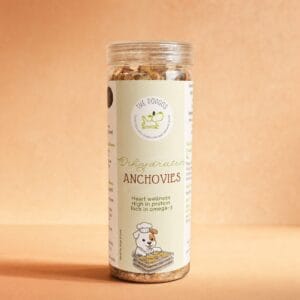
Dehydrated sardines are the most concentrated, lowest-mercury, easiest-to-feed source of EPA and DHA available to an Indian household. Sardines sit low on the food chain, eat plankton, live short lives, and accumulate negligible heavy metals (unlike tuna or kingfish). Dehydration at low temperature retains the omega-3 fats far better than extrusion. Two sardines (around 10 g) deliver roughly 800 to 1200 mg of combined EPA and DHA, well past the NRC minimum for a 25 kg dog and into the therapeutic range used in canine dermatology trials. Dehydrated anchovies work the same way, slightly smaller, useful for small breeds.
If you can change one thing, change to a daily serving of dehydrated sardines.
Pillar 2, GLA from Hemp Seed Oil
Gamma-Linolenic Acid (GLA) is a rare omega-6 fat that behaves like an omega-3 inside the body. It converts to Prostaglandin E1, anti-inflammatory and a direct precursor for healthy sebum.
Most dogs with chronic dull coat or atopic dermatitis are partly deficient in the delta-6-desaturase enzyme that turns ordinary omega-6 into GLA. The fix is to feed GLA directly. Hemp seed oil is the cleanest plant source, around 3% GLA, no fish smell. Dose: 1 ml per 5 kg body weight, once daily, on food.
Pillar 3, Zinc and Vitamin A from Organ Meat
Zinc deficiency is one of the most under-diagnosed coat problems in Indian dogs, particularly in northern-breed mixes with a higher zinc requirement. Vitamin A drives skin cell turnover. Both are concentrated in organ meat.
The cleanest delivery is Bone and Organ Boost, a teaspoon over the daily meal. It also supplies taurine and iron, both of which support red blood cell function (the coat reflects red blood cell health more than most owners realise).
Pillar 4, Topical Baobab Oil for the Lipid Barrier
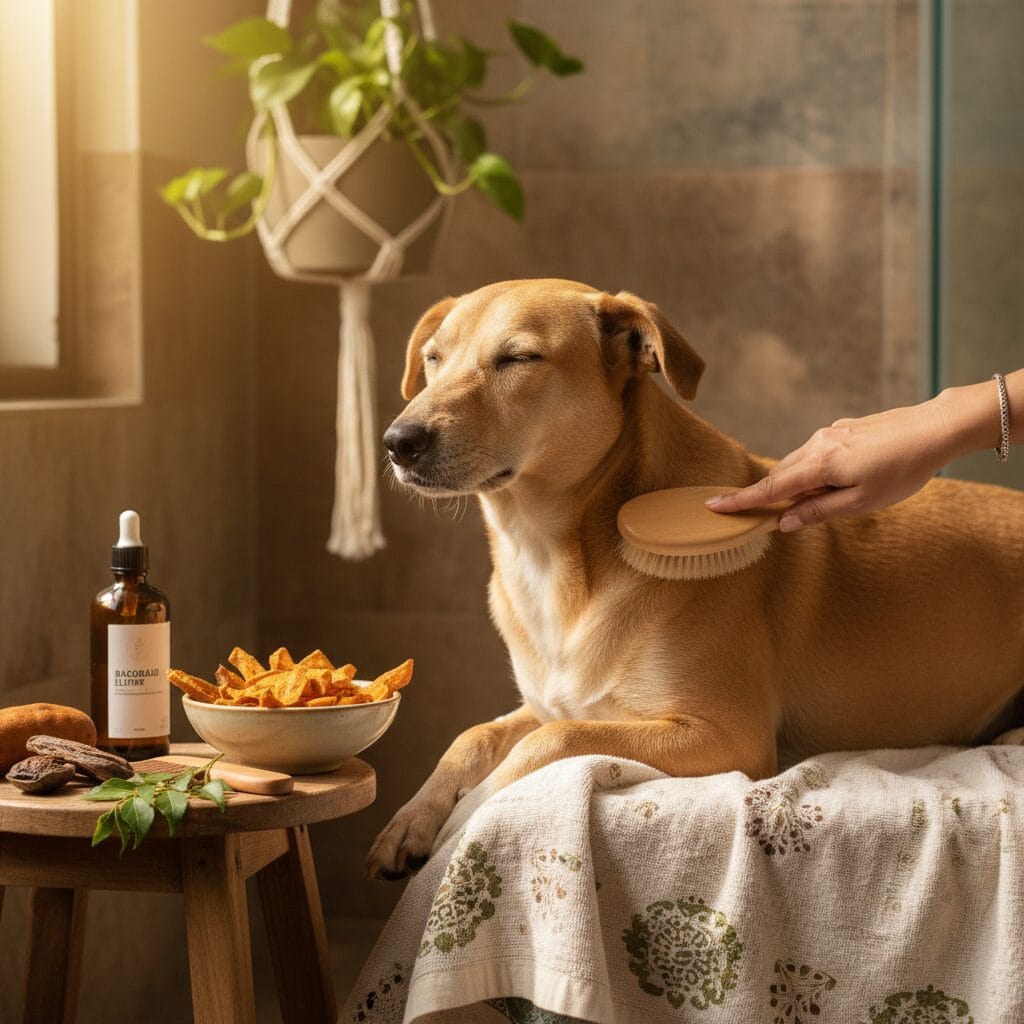
Coconut, olive, and mustard oils sit on the coat surface, trap heat, and in Indian humidity, contribute to fungal overgrowth. Baobab oil is different. Rich in palmitic and oleic acid, it absorbs into the epidermis and mimics the dog’s natural lipid mortar. A few drops massaged in once or twice a week speeds the shine arrival. Avoid it in monsoon if your dog is prone to fungal patches.
The 6-Week Coat Restoration Timeline
Most owners bail at week two. Expectations matter.
Weeks 1 and 2, gut adjusting. No coat change yet. The gut is shifting from a starch-heavy fuel to protein-and-fat. Stool firms up. Some dogs pass a brief mucus shedding around day 3 to 4 (normal). Energy rises first.
Weeks 3 and 4, new hair growing in healthier. The old dull hair is still on the dog, but the new shafts pushing up through the follicles are being built from the correct fats. Part the coat and the fur at skin level looks slicker than the older hair above it.
Weeks 5 and 6, visible shine arrives. Around week 5 there is what I call the “photo shift.” Owners send me a phone picture in window light and say “the coat looks different.” Dandruff is usually gone by week 6. The work is happening underneath, trust the timeline.
The Indian Climate Angle
Monsoon (June to September). Humidity drives yeast and bacterial overgrowth in coat folds and between toes. Push the EPA and DHA dose up by 30%, dry the coat thoroughly after every wet walk, and pause the baobab oil if you see greasy or yellowish patches (those are fungal). Our guide on monsoon itching and hot spots covers the overlap.
Summer. Heat increases water loss through the skin barrier. Hydration goes up, oily fish daily, weekly baobab oil massage on the spine and flanks.
Winter. Sebum production naturally slows. Keep the omega-3 going. Do not over-bathe.
Common Owner Mistakes
- Switching shampoos every two weeks. Shampoo cannot fix a fat-deficient coat. Every switch disrupts skin pH. Pick one mild, soap-free, neutral-pH shampoo and fix the diet.
- More bathing, not less. Bathing strips sebum. A healthy adult dog needs a bath every 4 to 6 weeks at most.
- Treating the coat as cosmetic. The coat is a metabolic readout. The bowl is the lever.
- Adding capsule fish oil to kibble and hoping. Whole-food fish is more stable and more bioavailable, and the dog enjoys it. Our guide to dehydrated treats walks through why low-temperature drying preserves the omega-3 profile that extrusion destroys.
The 4-Week Coat Reset Protocol
For a 20 to 25 kg Indian dog with a dull, dry, or shedding coat. Scale portions proportionally for smaller or larger dogs.
| Element | Daily Amount | Why |
|---|---|---|
| Dehydrated sardines | 10 g (about 2 sardines) | EPA + DHA, the anchor |
| Hemp seed oil | 4 ml on food | GLA for sebum and barrier |
| Bone and Organ Boost | 1 tsp over meal | Zinc, Vitamin A, taurine |
| Base bowl | Cooked chicken or mutton + pumpkin + a little rice | Whole-food protein, no extrusion |
| Topical baobab oil | A few drops, twice weekly | Lipid barrier mimicry |
Run this for 28 days. Take a phone picture of your dog in the same window on day 1 and day 28. The difference will be in the photo.
Kibble vs Fresh Bowl: Skin and Coat Nutrient Delivery
Daily amounts for a 25 kg adult dog.
| Nutrient | Indian Kibble (300 g) | Fresh Bowl + Sardines + Hemp + Boost |
|---|---|---|
| Combined EPA + DHA | 100 to 200 mg | 1000 to 1400 mg |
| GLA | Trace | 120 to 150 mg |
| Bioavailable zinc | 25 to 40 mg (poor absorption) | 18 to 25 mg (high absorption) |
| Vitamin A | 4000 to 6000 IU (synthetic) | 6000 to 10,000 IU (retinol from liver) |
| Omega-6:3 ratio | 15:1 to 25:1 | 4:1 to 6:1 |
Kibble label numbers are total content, not absorbable content. After extrusion losses and poor uptake of synthetic micronutrients, the real delivery to the dog’s tissues is a fraction of the label claim.
From Mahiv’s practice: A 4-year-old Golden Retriever in Lower Parel came in last July, end of monsoon, with what her owner called a “haunted-attic coat”, limp, dry, smelling of mildew despite two baths a week. We dropped her premium kibble entirely, switched her to a cooked-chicken-and-pumpkin base, added 12 g dehydrated sardines daily, 4 ml hemp oil, and 1 tsp Bone and Organ Boost. Bathing dropped to once every five weeks. By week 6 her owner sent me a picture of her in the lift mirror and the coat had its sheen back. Three years on, that bowl is still her bowl.
If you want one place to start, start with a jar of dehydrated sardines on the counter and a daily portion in the bowl. The rest of the protocol slots in on top. Six weeks later, take the photo.
Frequently Asked Questions
How long until I see a change in my dog’s coat?
Six weeks for visible shine, six months for full coat density. Weeks 1 and 2 are gut adjustment, weeks 3 and 4 the new hair is growing in correctly, weeks 5 and 6 the shine catches the light. If you are at week 3 and not seeing it, that is normal.
Can I just add fish oil capsules to my dog’s kibble?
You can, but it is the least effective fix. Kibble’s extruded fats are already oxidised, and adding fish oil on top does not undo that. Capsule fish oil also oxidises fast in Indian humidity once opened. Whole-food fish (dehydrated sardines or anchovies) is more bioavailable, more stable, and the dog enjoys eating it.
My household is vegetarian and I cannot cook fish at home. Can I still fix my dog’s coat?
Yes. Dehydrated sardines and anchovies are odour-controlled, dry, and stored in a sealed jar away from the kitchen. Hemp seed oil is plant-based. Many of our most committed customers are vegetarian households whose dogs eat better fish than the family does.
Is hair fall normal during the monsoon?
Some seasonal shedding is normal. Heavy hair fall, dandruff, and patchy thinning during monsoon usually point to a yeast or fungal overgrowth on a compromised skin barrier. The protocol above repairs the barrier so seasonal shedding goes back to background levels. If you see bald patches or red skin, see your vet to rule out a fungal infection.
Will eggs or coconut oil work as well as sardines?
No. Eggs are a great daily food but contain no meaningful EPA or DHA. Coconut oil is medium-chain triglyceride, not useful for skin. Only marine omega-3 from low-mercury fish moves the needle on coat dullness. See our omega-3 deep dive for Indian dogs for the math.
How much hair fall is too much?
A pinch of fur after a one-minute brush is normal. Visible thinning over the hips, flanks, or tail base is not. Bald patches are not. Any spot where scalp shows through needs a vet check first, then this protocol. Our guide on dog itching and hot spots covers the overlap.
Can puppies follow this protocol?
Yes, scaled. A 5 kg puppy gets about 2 g of dehydrated sardines, 1 ml hemp oil, and a pinch of Bone and Organ Boost daily. Puppy coats normally look soft and slightly dull until adult coat comes in around 8 to 12 months.
About the Author
Mahiv Amit Chhabra is a Certified Canine Nutritionist and author of The Desi Carnivore: The Indian Pet Parent’s Guide to Real Meat, Whole Prey, and Ancient Superfoods. He runs The Doggos from Thane, Maharashtra, alongside his dogs Tony and Toughie, the brand’s longest-serving quality-control team. Read more about Mahiv.