By Mahiv Amit Chhabra, Certified Canine Nutritionist and author of The Desi Carnivore. Last updated: 18 May 2026.
TL;DR
- Whole-prey feeding means a dog eats the whole animal (muscle, bone, organ, skin, feather, cartilage), not the trimmed chicken-breast cubes most Indian homes serve. This is the diet dogs evolved on for 30,000 years.
- The Western prey-model raw ratio is 80% muscle, 10% bone, 10% organ (half of which is liver). It is biologically correct. It is also not safe to replicate raw in an Indian kitchen, and that is the entire problem this post fixes.
- The Doggos middle path: Cook the Meal, Dehydrate the Bone and Organ. Cook the muscle meat at home for hygiene. Use dehydrated chicken heads, whole quail, and the Bone and Organ Boost for the parts the wet market discards and the kitchen cannot safely replicate.
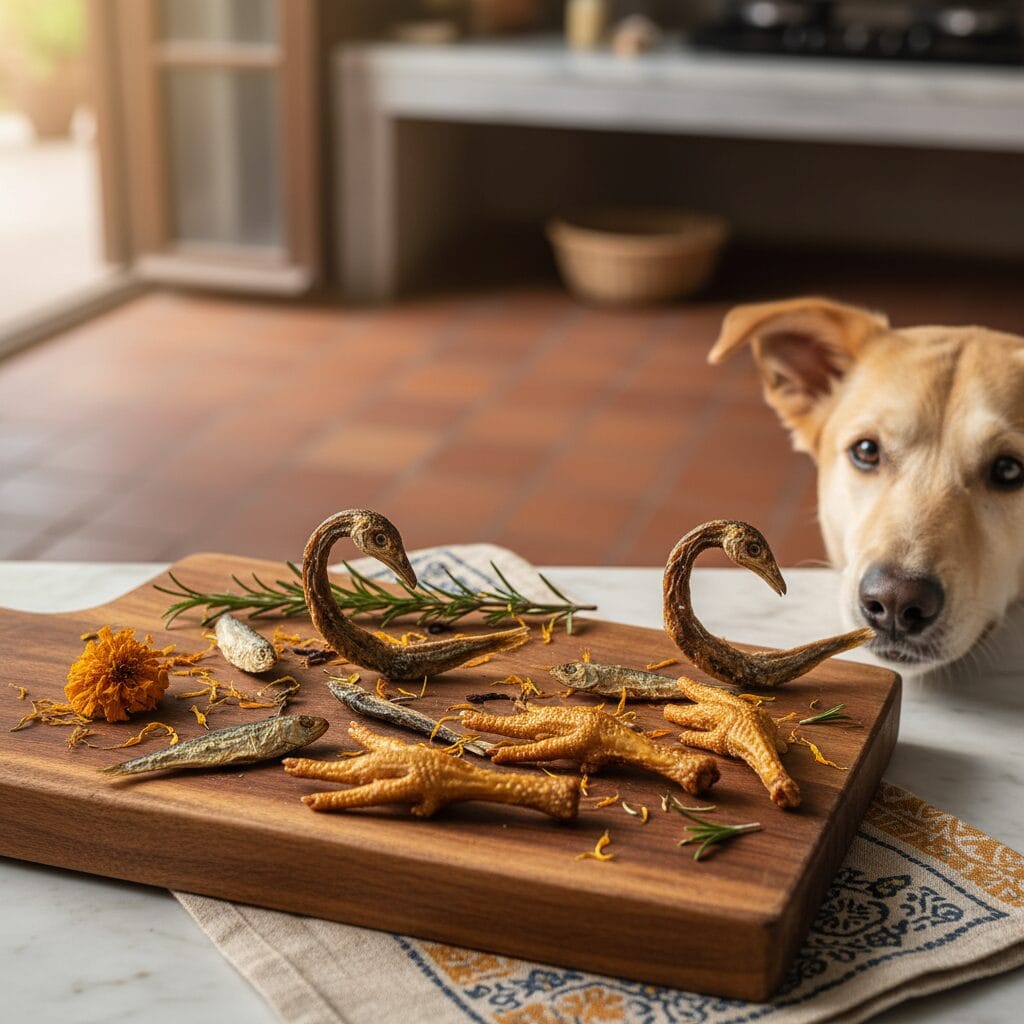
- A dehydrated chicken head is the single most “whole-prey” SKU we sell, skull, brain tissue, beak keratin, eye DHA, and feather remnants in one chew. It is also the one that makes new customers gasp the loudest.
- Most “complete and balanced” kibbles plug the whole-prey gap with synthetic taurine, synthetic manganese, and synthetic Vitamin A, because their underlying deck is muscle meat plus grain. Real prey delivers all three in food form. The NRC 2006 nutrient requirements are the same either way.
The first time I unboxed a sample of dehydrated chicken heads in our Thane office, our packaging lead put her phone down and walked out of the room. Eight months later that same product is one of our top three repeat-purchase SKUs. The buyers are people who read about prey-model raw, recognised the biology, and asked the obvious next question: why does my dog’s bowl have only chicken breast in it when a real prey animal would have been the whole bird?
This is the article for that reader. The biology, the Western raw-feeding ratio, why we do not feed it raw in India, and how a chicken head and a teaspoon of organ powder do the same work without the wet-market hygiene problem.
What “Whole-Prey Feeding” Actually Means
A wolf in the Deccan plateau 30,000 years ago did not eat chicken breast. She ate everything. Muscle for protein. Bone for calcium and phosphorus. Liver and kidney for Vitamin A, copper, and iron. Heart for taurine. Brain for DHA. Trachea and cartilage for glucosamine and chondroitin. Skin and feathers for keratin. Eyeballs for, yes, more DHA.
The shorthand for this is nose to tail feeding, or in the Western raw-feeding community, prey-model raw (PMR). The accepted ratio is:
- 80% muscle meat
- 10% raw meaty bone
- 10% organs (5% liver + 5% other secreting organs like kidney, spleen, pancreas)
This ratio is not folklore. It approximates the carcass composition of a small prey animal (rabbit, quail, chicken) once you weigh out the parts. Peer-reviewed analysis of the prey-model whole-carcass nutrient profile has shown that, fed at roughly these proportions, the diet meets or exceeds the NRC 2006 Nutrient Requirements of Dogs and Cats for almost every micronutrient without supplementation. Taurine, manganese, Vitamin A, and DHA all sit comfortably above the daily minimums.
The implication is the whole reason this conversation matters: trimmed-muscle-only feeding is missing entire nutrient classes, and most Indian dog parents do not realise they are running that deficit.
Why Indian Butchering Culture Discarded These Cuts
Walk into any Mumbai or Delhi chicken shop and ask for chicken heads, feet, livers, and trachea. The butcher will look at you the way our packaging lead did. Heads and feet have, for two generations, been treated as scrap. The reason has nothing to do with biology.
Middle-class Indian consumer aesthetics, from the 1970s onwards, started treating organ meats and extremities as low-status food. The supermarket-isation of meat (clean trays, boneless breast, cubed thigh) reinforced it. The waste stream, heads, feet, trachea, organ trim, got sold cheap to broiler-feed plants or simply binned. The same shift happened in the West two decades earlier.
Our grandparents in Punjab, Bengal, Andhra, and the Konkan cooked organ dishes regularly (kaleji, gurda, bheja fry, magaj masala). Dogs in those households ate the trim, the bones, and the heads. Today’s urban Indie eats parle-G and roti, and her grandmother’s dog, on muscle plus organ scraps, would have looked healthier on bloodwork. This is a nutrient gap that opened in living memory.
The Indian Middle Path: Cook the Meal, Dehydrate the Bone and Organ
The biology of prey-model raw is right. I still do not recommend feeding it raw in Indian homes, and I have written about why in the raw food diet guide for India. The short version: Indian wet markets are not European supermarkets, humidity in Mumbai or Chennai breeds bacteria in minutes, cold chain is unreliable, and cross-contamination in a tropical household with a child on the floor is a risk we cannot ethically ignore. A dog’s pH 1 to 2 stomach acid handles Salmonella fine. Your toddler’s gut does not.
So we split the difference. Cook the muscle meat at home, pressure-cooked and deboned, mixed into a base recipe. Add back the bone, cartilage, organ, head, and feather parts as low-temperature dehydrated products, which kill pathogens by water removal rather than heat denaturation, and crucially never cook bones (cooked bones splinter and can perforate the gut, the physics of which we cover in dehydrated vs freeze-dried vs raw).
That is the whole-prey diet, Indianised. The biological argument is intact. The hygiene risk is removed.
The Cartilage, Glucosamine, and Chondroitin Chain
This is the most overlooked nutrient class in the trimmed-muscle Indian bowl.
When a dog eats a chicken only as breast meat, she gets none of the following:
- Glucosamine (concentrated in cartilage and the small joints in feet)
- Chondroitin sulphate (cartilage, trachea, joint capsules)
- Type II collagen (the specific collagen of joint surfaces, in tracheal rings, ear cartilage, and the gristly bits of a chicken head)
- Hyaluronic acid (eye and joint fluid)
These are not optional. They are the structural raw materials of cartilage. A dog eating only muscle meat eventually mines her own joints for them, the way a boneless diet leaches calcium. Show me a 9-year-old Indian Lab on roti-plus-chicken-breast and I will show you a hip X-ray with grade-2 dysplasia.
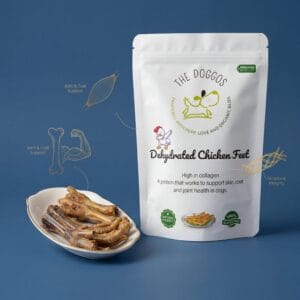
The whole-prey fix is to feed the parts that contain the cartilage. Dehydrated chicken feet carry the glucosamine load (we cover the dose math in the chicken feet guide). Mutton trotters bring the larger collagen and connective tissue. Chicken heads add the brain, eye, and beak components no other SKU covers. The Bone and Organ Boost supplies the taurine, iron, and Vitamin A from secreting organs in a measured teaspoon form for the daily bowl.
The Chicken Head: Our Most Striking Whole-Prey Product
A dehydrated chicken head, broken down, contains:
- Skull bone: porous, low-density bone that crumbles under chewing, supplying calcium and phosphorus at the natural Ca:P ratio of around 1.2:1, the NRC 2006 adult dog target.
- Brain tissue: roughly 60% fat by dry weight, with DHA at 10 to 12% of total fatty acids. Brain is the highest-DHA tissue in the body. For senior dogs, DHA from food is one of the cleanest tools we have against cognitive dysfunction syndrome.
- Eye: more DHA, plus taurine and a small amount of hyaluronic acid.
- Beak: pure keratin. Indigestible to dog enzymes, which is the point. Keratin acts as insoluble fibre, scrubs the intestinal wall, and bulks the stool, helping natural anal-gland expression. Scooting dog at home? A chicken head a week is one of the most effective non-pharma fixes I know.
- Feather remnants: more keratin, same colon-sweep effect.
- Cartilage at the head-neck joint: more chondroitin.
In one chew you have brain, eye, skull, beak, and feather. There is no other single product in our catalog, or anyone else’s, that is more “whole-prey” than this. It is Rs.119 for a pack. A bottle of fish oil capsules with comparable DHA per serving costs five times that, and the dog will not voluntarily eat the capsule.
The trade-off is visceral. Chicken heads look like what they are. Some customers find the first pack confronting. We tell them so honestly.
How to Introduce Chicken Heads: A 7-Day Protocol
The first time a chicken head comes out of the bag, your dog will be calmer than you are. Trust that.
- Day 1: Break one head in half. Hand half to the dog, save the other for tomorrow.
- Day 2: Give the second half. Watch chewing pattern. Most dogs work it for 2 to 4 minutes.
- Day 3: Skip. Let the digestive load settle.
- Day 4: Whole head, supervised, on a hard floor.
- Day 5: Skip.
- Day 6: Whole head again. Note stool quality the next morning. Slightly firmer and lighter in colour is normal, that is the calcium and keratin doing their jobs.
- Day 7: Steady state. Continue at 1 to 2 heads per week for a 10 to 25 kg dog, 2 to 3 for a large breed, 1 every 10 days for a small breed.
Run this alongside the regular bowl, do not replace meals. Heads are an addition, not a substitute. If you see vomiting, loose stool lasting more than a day, or a hard refusal to chew, stop and write to us.
From Mahiv’s practice: A young Pune couple walked into the Thane store last August looking for “something natural” for their year-old Indie, Brownie. The wife saw the chicken heads on the counter and physically stepped back. We talked through the biology for ten minutes. She bought one pack reluctantly. Two weeks later they were back. Brownie’s anal-gland scooting (the reason they had walked in) had stopped after the third head. The husband, who had been the keen one, was now slightly grossed out. The dog, predictably, had no opinion either way and just wanted another one. That story repeats roughly twice a week in our store.
“Complete and Balanced” Kibble vs Real Whole-Prey
Read the ingredient deck on any “complete and balanced” Indian kibble. The pattern is consistent: muscle meat or meat meal, grain or grain by-product, a vegetable filler, then a long fortification list (taurine, L-carnitine, manganese sulphate, zinc oxide, copper sulphate, Vitamin A acetate, Vitamin D3, choline chloride, biotin, mixed tocopherols).
That fortification list is doing the work of the missing whole-prey carcass. If the deck was actually whole-prey, you would not need synthetic taurine (heart and brain bring it), synthetic manganese (trachea and feet bring it), Vitamin A acetate (liver brings it), or added DHA (brain and eye bring it). The kibble industry is not wrong to fortify. It is doing the best it can with a muscle-meat-plus-grain base that is itself wrong. The whole-prey approach skips the deficit and the bandage at the same time.
A bowl built on cooked muscle meat plus dehydrated chicken heads, whole quail, chicken feet, and a teaspoon of Bone and Organ Boost gets you the same NRC 2006 compliance the kibble bag claims, with the nutrients arriving in food form. Bioavailability research, in both canine and human studies, shows whole-food nutrients absorbing better than synthetic isolates, often by 20 to 40%.
A Practical Weekly Whole-Prey Schedule
For a 15 to 20 kg adult with no specific medical issues, a balanced week looks like this:
| Day | Base bowl | Whole-prey add |
|---|---|---|
| Mon | Cooked chicken thigh + pumpkin + Hemp Balancer | 1 chicken foot |
| Tue | Cooked chicken thigh + sweet potato + Hemp Balancer | 1 tsp Bone and Organ Boost |
| Wed | Cooked mutton curry-cut + greens | 1 dehydrated chicken head |
| Thu | Cooked chicken thigh + pumpkin + Hemp Balancer | 1 mutton trotter |
| Fri | Cooked chicken thigh + sweet potato + Hemp Balancer | 1 tsp Bone and Organ Boost |
| Sat | Whole dehydrated quail (no cooking) | included in quail |
| Sun | Cooked chicken thigh + pumpkin + Hemp Balancer | 1 dehydrated chicken head |
That gives you 2 heads, 2 organ-boost doses, 1 foot, 1 trotter, and 1 quail-meal per week. The Ca:P sits around the NRC target. Taurine, manganese, Vitamin A, and DHA all come from food. The cartilage chain is intact. The keratin colon-sweep is in there twice. There is no kibble in the bowl. For smaller dogs, scale down portions, do not eliminate categories.
Common Mistakes with Whole-Prey
- “I will just feed it raw, India is fine.” It ends badly often enough that I will not endorse it. If you must feed raw, source from a cold-chain certified supplier, not your kirana butcher.
- Feeding only organ. Liver above 10% of the bowl gives loose stools and Vitamin A overload. Stick to the 10% rule.
- Skipping the cartilage parts. People feed chicken breast and a teaspoon of liver and feel they have “done whole-prey”. The feet, heads, and trachea pieces are not optional.
- Feeding cooked bones. Never. Cooked bones splinter. Dehydrated bones do not.
- Switching cold turkey. Layer whole-prey adds into an existing bowl over 7 to 14 days. The gut needs time to adjust bile output for the higher fat content of brain and organ. See our dehydrated treats guide for the wider transition logic.
Frequently Asked Questions
What is whole-prey feeding for dogs?
Whole-prey feeding means a dog eats the entire prey animal, muscle meat, bone, organ, cartilage, skin, and feather, rather than only the trimmed muscle cuts humans typically eat. It mirrors what wild canids ate for tens of thousands of years and supplies nutrients (taurine, manganese, DHA, glucosamine) that a boneless, organless bowl misses.
Is whole-prey raw feeding safe in India?
The biology is right but the hygiene is hard. Indian wet-market meat carries Salmonella and Campylobacter loads that are not safely managed in a tropical household, and cross-contamination from a dog’s chew area is real. We recommend cooking the muscle meat at home and using low-temperature dehydrated products for the bone, organ, head, and cartilage components, which gets the same nutrient profile without the pathogen risk.
Why are chicken heads considered a whole-prey food?
A chicken head contains skull bone (calcium, phosphorus), brain (DHA, cholesterol), eye (DHA, taurine), beak (keratin), and joint cartilage (chondroitin) in one chew. It is the closest single-SKU representation of a real prey animal’s nutrient profile we sell, and most of those nutrients are not present in chicken breast or thigh.
What is the 80-10-10 prey-model raw ratio?
It is the Western raw-feeding standard: 80% muscle meat, 10% raw meaty bone, and 10% organ (5% liver and 5% other secreting organs). The ratio approximates the actual composition of a small prey carcass and, fed correctly, meets NRC 2006 nutrient requirements for adult dogs without synthetic supplementation. We adapt it for Indian homes by cooking the muscle portion and using dehydrated products for the bone and organ slices.
Can I feed organ meat instead of giving my dog a multivitamin?
For most healthy dogs, yes, with caveats. Organ meat (especially liver, kidney, and heart) supplies Vitamin A, taurine, iron, copper, B12, and Vitamin D in bioavailable food form, often at 20 to 40% better absorption than synthetic isolates. Keep liver under 5% of the total diet to avoid Vitamin A overload, and rotate organs so you are not relying on liver alone.
Are chicken heads safe for puppies and small breeds?
For puppies over 12 weeks with their adult molars in, yes, half a chicken head once a week is a reasonable introduction. For small breeds under 5 kg, half a head per week is the standard portion. Always supervise the first few sessions and watch for gulping rather than chewing. For very small dogs, the whole quail or Bone and Organ Boost are easier whole-prey entry points.
Do dehydrated chicken heads smell?
Less than you would expect. Low-temperature dehydration removes the moisture that drives most meat odour. The pack has a mild roasted-poultry smell on opening and is largely odour-neutral once stored in an airtight jar. Cats and dogs detect more of it than humans do, which is part of why they are drawn to them.
About the Author
Mahiv Amit Chhabra is a Certified Canine Nutritionist and author of The Desi Carnivore: The Indian Pet Parent’s Guide to Real Meat, Whole Prey, and Ancient Superfoods. He runs The Doggos from Thane, Maharashtra, alongside his dogs Tony and Toughie, the brand’s longest-serving quality-control team. Read more about Mahiv.
Try the Whole-Prey Starter
If you want to actually run the whole-prey approach, the easiest entry is a pack of dehydrated chicken heads plus a tub of the Bone and Organ Boost. Two SKUs, no kibble, a week of acclimation, and your dog’s bowl moves closer to what her biology is built for. For the cartilage layer add chicken feet or mutton trotters. If your dog has chicken sensitivity, a whole dehydrated quail is the novel-protein entry point. For the wider philosophy, our single-ingredient dog treats guide walks through the argument.
References
- National Research Council. (2006). Nutrient Requirements of Dogs and Cats. Washington, DC: The National Academies Press. (Source for Ca:P 1.2:1, taurine, manganese, and Vitamin A daily minimums referenced above.) Available at the NRC overview.
- Dillitzer, N., Becker, N., & Kienzle, E. (2011). Intake of minerals, trace elements and vitamins in bone and raw food rations in adult dogs. British Journal of Nutrition, 106(S1), S53 to S56. (Peer-reviewed analysis of prey-model whole-carcass nutrient profile against NRC minimums.) Available via Cambridge Core.