By Mahiv Amit Chhabra, Certified Canine Nutritionist and author of The Desi Carnivore. Last updated: 18 May 2026.
TL;DR
- Indian-summer pavements hit 55 to 65 °C when the air is 38 to 42 °C, hot enough to blister and slough a dog’s paw pads after as little as 10 minutes of contact.
- The 7-second pavement rule: place the back of your hand on the asphalt for 7 seconds. If you cannot keep it there, your dog cannot walk on it. Move the walk to pre-7 am or post-7 pm.
- The anchor of the season is Baobab Paw and Nose Balm. Unlike coconut or olive oil that sit on top, the Palmitic and Oleic acids in baobab absorb into the epidermis and mimic the skin’s own lipid barrier, healing cracked pads and crusty noses in 7 to 10 days.
- Summer is the worst season to feed dry kibble. Kibble is 10 per cent water, fresh food is 70 per cent water. Switch to fish-led cooling proteins (sardines, anchovies) and a home-cooked base bowl through April to July.
- Never shave a double-coated dog. The coat insulates both ways. Shaving exposes raw skin to UV and removes the natural cooling architecture.
Every April my inbox fills with the same photo: a paw pad with the surface keratin peeling off in a pink-and-white sheet, taken after a “quick walk down the block” at 11 am. By June the photos shift to the nose, dry, cracked, and crusty from car-window radiation and AC desiccation. By the time the family books a consultation, the dog is limping on three legs and refusing the kibble that has been sitting in its bowl since morning.
This is preventable. The Indian-summer playbook is not complicated, but it is non-negotiable, and most of it has nothing to do with what the pet shop down the road will try to sell you. Below is the four-pillar protocol I run with clients across Delhi, Hyderabad, Chennai, and Bombay, and the one product I will not let any of them go into May without.
The Indian Summer Reality: Pavements at 65 °C
Air temperature is not the number that matters. Surface temperature is. When the Delhi or Hyderabad mercury reads 40 °C, the asphalt absorbs solar radiation and re-radiates it as longwave heat, and surface readings of 55 to 65 °C are routine through April to June. Studies by the American Veterinary Medical Association and pavement-thermal research summarised by the Journal of the American Medical Association on pediatric burn cases on asphalt have found surface temperatures of 60 to 70 °C even at modest air temperatures of 31 to 36 °C. The Indian summer is well past those numbers.
Canine paw pad keratin starts to denature at roughly 50 °C. Below that, the pad is tough and protective. Above it, the keratin layer softens, blisters, and after about 10 minutes of sustained contact, sloughs off, exposing the raw dermis underneath. This is the limping-on-three-legs photo I get every May.
The 7-Second Pavement Rule
Forget thermometers. Use your hand. Press the back of your hand (more heat-sensitive than the palm) flat against the pavement for 7 seconds. If you cannot keep it there, your dog cannot walk on it. This is the only field test that matters, and it works on tarmac, paver tiles, and red oxide flooring alike.
Through Indian summer, the only reliably safe walk windows in Delhi, Hyderabad, Chennai, and Bangalore plains are before 7 am and after 7 pm. Even 8 am in Hyderabad in late April is too hot for a Lab in the sun. Move your alarm, change your routine, accept the trade-off. Your dog does not get to choose.
Paw Pad Biology: Why They Fail in Heat
A paw pad is not a generic patch of tough skin. It is a layered keratinised structure with sweat glands, fat cushioning, and a vascular network designed to dissipate heat from the core. Three things happen when it overheats.
- Keratin denatures. The outer surface softens, loses its grip strength, and starts to peel. This is the “my dog’s pads look like cracked rubber” complaint.
- The fat cushion swells. Heat causes the subcutaneous fat to expand, making the pad more sensitive to pressure and more vulnerable to abrasion.
- The sweat glands overload. Dogs cool primarily through panting, not paw sweat, but the small amount of paw perspiration in extreme heat softens the keratin further from the inside.
After 10 minutes on a 60 °C surface, the pad is no longer functional as armour. Add a few sharp pebbles or a road expansion joint and you are looking at full-thickness pad ulcers that take 3 to 6 weeks to heal without targeted topical care.
The Four-Pillar Summer Protocol
This is the protocol I email new clients every March. It is built around four levers, not one, because there is no single product that fixes all of it.
Pillar 1: Walk Timing
Pre-7 am, post-7 pm, no exceptions through April to July across most of the Indian plains. In coastal cities like Mumbai and Chennai where humidity stays high through the night, push the evening walk to 8 pm. Use the 7-second hand test every time, because shaded asphalt can still hold 50 °C heat at 6 pm.
Skip the midday “potty walk down the block.” Train your dog to relieve themselves on the balcony, the terrace, or a small patch of artificial turf indoors through summer. The trade-off (a little training inconvenience) is worth the trade (no blistered pads).
Pillar 2: Paw Protection, the Anchor Product
This is where Baobab Paw and Nose Balm does the heavy lifting. The biology is the entire reason it works.
Most “paw balms” sold in Indian pet shops are coconut oil, beeswax, and a fragrance. Coconut oil sits on top of the keratin layer, traps heat, and clogs the small sweat glands. It looks shiny for an hour, then it absorbs into your floor and your sofa, and the pad is unprotected again.
Baobab oil is structurally different. The seed pressing is high in Palmitic acid (around 30 per cent) and Oleic acid (around 35 per cent), the same two fatty acids that dominate the skin’s own lipid barrier. Apply it and it absorbs into the epidermis within minutes, replacing lost lipids and reinforcing the barrier from within. It does not sit on top. It becomes part of the pad.
The protocol I run is simple. Apply a pea-sized amount to each pad before the morning walk and again after the evening walk. Massage in for 20 seconds. The same balm goes on the nose at night, where it works on age-related hyperkeratosis (the crusty senior-dog nose) as well as it works on summer heat damage.
Pillar 3: Hydration Through the Bowl, Not the Bowl
The standard Indian-summer advice is “leave fresh water out.” Useful, but it misses the bigger lever. A dog on dry kibble pulls all its hydration from the water bowl. A dog on fresh food gets 70 per cent of its hydration through the food itself.
Kibble is 10 per cent moisture by weight. Fresh home-cooked food is 70 to 75 per cent moisture. A 20 kg dog on kibble needs to drink around 1.2 to 1.5 litres of water a day in 42 °C heat to stay hydrated. The same dog on a fresh-food bowl pulls 500 to 700 ml from the food and only needs another 600 to 800 ml from the bowl. The fresh-fed dog is structurally more resilient to summer dehydration.
Summer is the season to abandon dry kibble if you have not already. Kibble left out at 38 °C oxidises within hours, the fats turn rancid, ants find it, and dogs lose interest in eating it anyway. If you only make one nutritional change in the year, make it in April.
Pillar 4: Cooling Diet
Three things go into the summer bowl.
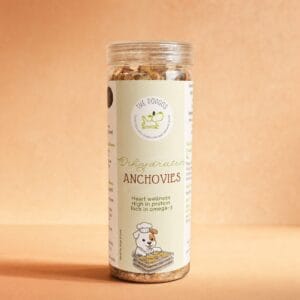
- Fish proteins over chicken. Fish has a lower thermic effect of food than chicken or mutton, less digestion heat generated per gram of protein. Dehydrated sardines and dehydrated anchovies are the easiest swap, two or three times a week as the main protein, or daily as a topper. They also deliver the EPA and DHA Omega-3 that calms summer inflammation, see our deeper read in the omega-3 for dogs India guide.
- Anti-inflammatory fats. Add 2 to 5 ml of hemp seed oil to the daily bowl. The GLA in hemp converts to Prostaglandin E1, which damps down the heat-driven inflammatory loop that shows up as paw licking and hot spots in summer.
- Electrolyte toppers, small amounts. A teaspoon of plain curd (dahi) for medium dogs, or 2 to 3 tablespoons of fresh coconut water poured over the food, replaces sodium, potassium, and chloride lost to panting. Start small to test for lactose tolerance.
For dogs that go off food entirely in heat (the most common April-to-June complaint), read our dog not eating in summer protocol, which walks through the meal-timing and texture changes that bring appetite back.
The Cracked Paw and Cracked Nose Recovery Protocol
For dogs already showing damage, the recovery protocol is tighter than the prevention one.
- Rinse the pads with cool water after every walk. Not cold, not iced, just tap water at room temperature. Pat dry, do not rub.
- Apply Baobab Paw and Nose Balm twice a day, morning and night. A pea-sized amount per pad, massaged in for 20 to 30 seconds. The same on the nose at bedtime.
- Restrict walking surfaces to grass, mud, or indoor flooring for the first 5 to 7 days of recovery.
- Visible improvement in 5 days, full re-epithelialisation in 7 to 10 days for most mild cases. Deep cracks may take 14 days.
- For very dry or infected patches, layer Baobab Oil underneath the balm in the evening application. The oil drives deeper, the balm seals.
If the pad is bleeding, ulcerated, or the dog has stopped weight-bearing, this is a vet visit, not a home-care case. The protocol above is for surface damage.
From Mahiv’s practice: A 6-year-old Labrador in Chennai came to me in late April with three of four paw pads cracked open, raw, and weeping at the edges. The owner had been walking him at 3 pm because “the dog gets restless if we skip the routine.” We moved walks to 6 am and 8 pm, started Baobab Paw and Nose Balm twice a day, switched his bowl to a sardine-and-pumpkin base with hemp oil. By day 8 the pads had fully re-epithelialised. The dog has not had a flare since, and we are now in his third summer on the protocol.
Heat Stroke: The Warning Signs You Cannot Miss
Heat stroke kills dogs in India every summer, and almost all of it is preventable. The threshold is a core body temperature above 41 °C (normal canine core is 38.3 to 39.2 °C). Above 41, organ damage begins within minutes. Above 43, mortality climbs steeply.
Watch for, in order of escalation:
- Heavy panting that does not slow down with rest. Normal panting eases within 5 to 10 minutes of getting indoors. Heat-stroke panting does not.
- Excessive drooling, often thick and ropey.
- Bright red gums and tongue, then progressing to pale or grey.
- Vomiting or diarrhoea, sometimes with blood.
- Stumbling, disorientation, collapse, seizure.
If you see any of stages 3 to 5, this is an emergency. Move the dog to shade or AC, wet the underside of the body and the paws with room-temperature water (not ice, not freezing water, which causes peripheral vasoconstriction and traps heat in the core), and drive to the nearest vet. Do not wait it out.
Brachycephalic breeds (Pugs, French Bulldogs, Bulldogs, Boxers) and double-coated breeds in Indian climates (Huskies, Goldens, GSDs) hit heat stroke at lower exertion levels than the average Indie or Lab. Adjust thresholds down for them.
Indoor Cooling: The Counterintuitive Coat Rule
Every May I get the question: “Should I shave my Golden / Husky / GSD for summer?” The answer is no. The double coat is not a heat-trapping liability. It is a thermal insulator that works in both directions.
The outer guard hairs reflect UV and shed heat. The undercoat creates an air pocket that buffers the skin from outside temperature swings, the same way a thermos works. Shave it and you remove that buffer, exposing the skin to direct UV (sunburn risk on lighter-skinned dogs) and stripping the cooling architecture.
What you should do instead is brush daily through shedding season. A slicker brush or undercoat rake pulls out the loose undercoat and lets the rest sit naturally. A weekly bath with a gentle, non-stripping shampoo (not the antibacterial-medicated kind unless prescribed) keeps the coat clean. For dull or dry coats in summer, the deeper read is our dog skin and coat guide for India.
Inside the house, the basics matter more than gadgets. Run a fan over a wet towel for cheap evaporative cooling. Keep the floor mopped (cool tile is the best dog air conditioning ever invented). Provide a deep, shaded water bowl, refilled three times a day, with one ice cube per litre, not a tray full of ice.
Common Indian Owner Mistakes
- Walking dogs at 11 am because “it is just to the corner.” The corner is hot enough to blister pads.
- Shaving double-coated breeds. Increases heat absorption and UV damage, does nothing for cooling.
- Leaving dry kibble out all day. It oxidises within hours, attracts ants, and most dogs lose interest in eating it through summer.
- Adding ice to water. Causes peripheral vasoconstriction and slows core cooling. Cool water, not iced water.
- Buying generic coconut-based “paw balms” from pet shops. Sit on top of the pad, do not absorb, wear off in an hour. Skin-mimicking lipid oils are the only ones that work.
- Ignoring early heat-stroke signs. Heavy panting that does not slow down is the first warning, not the last.
Frequently Asked Questions
What is the safest time to walk a dog in Indian summer?
Pre-7 am and post-7 pm through April to July across most Indian plains. Even shaded pavement at 6 pm can hold 50 °C of latent heat. Always use the 7-second hand test before stepping out. Coastal humidity may push the evening walk to 8 pm.
How do I know if my dog has burned paw pads?
The signs are limping on one or two legs after a walk, licking the pads excessively, visible redness or peeling on the underside, and reluctance to step onto warm surfaces. Mild burns peel in pink-and-white sheets. Severe burns leave the dermis raw and weeping. Severe cases need a vet visit, mild cases respond to twice-daily Baobab Paw and Nose Balm.
Is Baobab Paw and Nose Balm better than coconut oil?
Functionally, yes, for the pad and nose application. Coconut oil sits on the surface of the keratin and wears off within an hour or two. Baobab oil’s Palmitic and Oleic acid profile matches the skin’s own lipid barrier, so it absorbs into the epidermis and reinforces the structure from within. The balm form (oil plus a small amount of wax) extends the contact time without blocking the pad.
Should I feed my dog less in summer?
Most dogs naturally self-regulate down by 10 to 20 per cent in peak summer, particularly on the digestion-heat-heavy proteins like chicken. Switch the main bowl to fish proteins, add 70 per cent moisture from fresh food, and keep portions slightly smaller. A dog that has gone fully off food for more than 24 hours needs investigating, see the summer appetite loss guide.
Can I shave my Husky or Golden for summer?
No. The double coat insulates against heat as well as cold. Shaving removes the UV-reflecting guard hairs and the air-pocketing undercoat, leaving the skin exposed and the dog hotter, not cooler. Brush daily through shedding, do not shave.
How much water should my dog drink in summer?
A rough benchmark is 50 to 70 ml per kg of body weight per day in hot weather, more for active dogs and dogs on dry kibble. A 20 kg dog needs 1 to 1.4 litres a day in summer. Fresh-fed dogs drink less from the bowl because food carries 70 per cent moisture. Watch the gum colour and skin elasticity (pinch the scruff, it should snap back instantly) as the hydration indicators.
What are the first signs of heat stroke in dogs?
Heavy panting that does not slow down after 10 minutes of rest, thick ropey drool, bright red gums, and restlessness. Progression goes to vomiting, stumbling, and collapse. Any of these signs is an emergency, move to shade or AC, wet the underside of the body with room-temperature water, and head to a vet immediately.
About the Author
Mahiv Amit Chhabra is a Certified Canine Nutritionist and author of The Desi Carnivore: The Indian Pet Parent’s Guide to Real Meat, Whole Prey, and Ancient Superfoods. He runs The Doggos from Thane, Maharashtra, alongside his dogs Tony and Toughie, the brand’s longest-serving quality-control team. Read more about Mahiv.