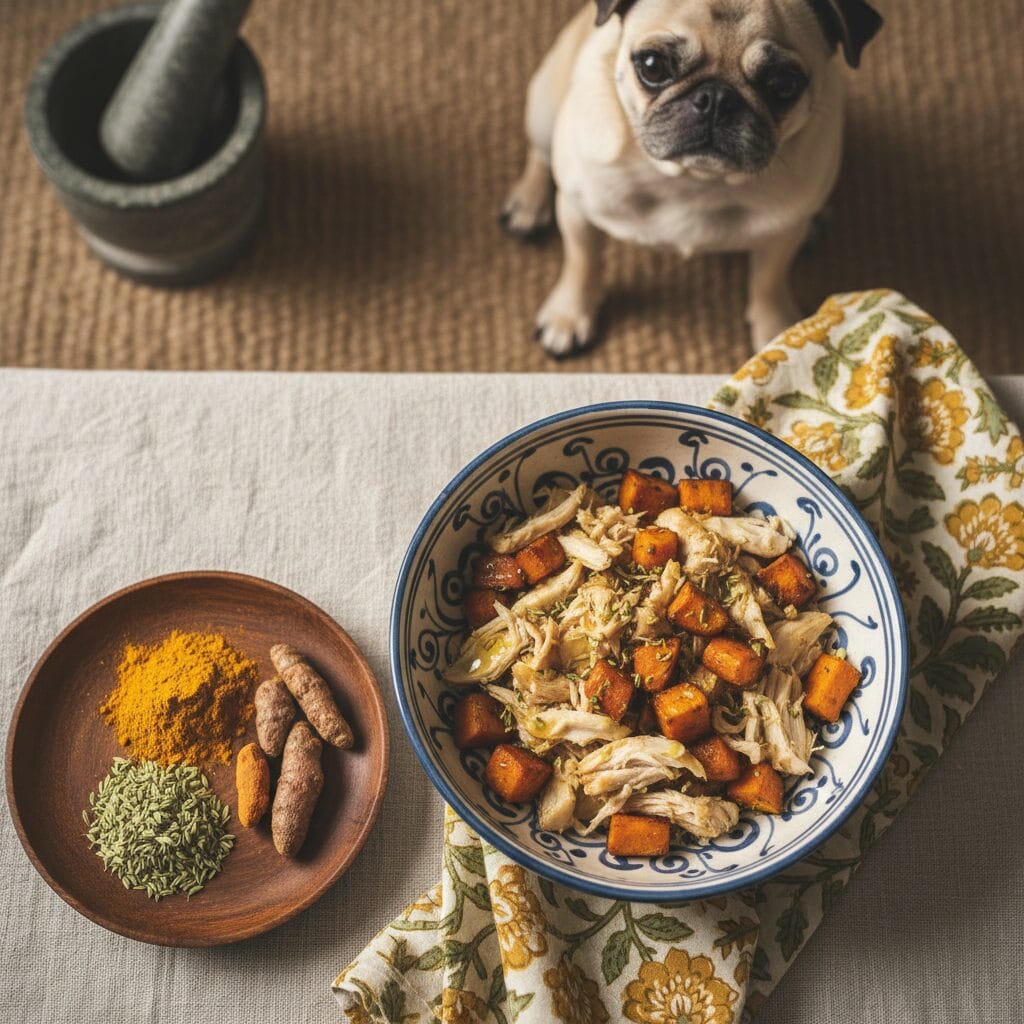
By Mahiv Amit Chhabra, Certified Canine Nutritionist and author of The Desi Carnivore. Last updated: 18 May 2026.
TL;DR
- A Pug’s diet is a medical decision, not a flavour decision. The flat face is already breathing through a partially obstructed airway (BOAS), so any extra inflammation from Omega-6-heavy chicken, allergens, or extra body weight makes the breathing measurably worse. Macros should sit at roughly 30 to 40% protein, 18 to 25% fat, and under 25% carbohydrates.
- The single most important daily addition for an Indian Pug is hemp seed oil. It is the rare Omega-6 (GLA) that acts anti-inflammatory, easing both the airway tissue swelling and the chronic skin-fold dermatitis Pugs are notorious for.
- Indian summer is genuinely dangerous for Pugs. Brachycephalic dogs cannot pant efficiently to cool themselves. Feed cooling proteins (quail, fish), avoid Omega-6 inflammation spikes, and never let body weight creep up. Every extra kilogram is a kilogram more breathing effort.
- Skin folds are not cosmetic. Wipe them dry after every meal and every walk, and treat them with baobab oil once cleaned. The fold dermatitis you ignore at 2 will become the bacterial infection you fight at 5.
- The common Indian Pug feeding pattern (puppy food for life, milk and biscuits, daily bathing, no Omega-3) is responsible for most of the breathing crises and skin infections owners blame on the breed.
The Pug is one of urban India’s most loved dogs and one of its most medically misunderstood. A fawn Pug snoring on a Mumbai sofa is iconic. A fawn Pug overheating on a Mumbai afternoon, fold-dermatitis weeping under the eye, breathing like a steam engine after one flight of stairs, that is also iconic and entirely avoidable. The difference, nine cases out of ten, is the diet. The Pug is a high-care breed in Indian climate, and the food bowl directly affects how well the dog breathes, how stable the folds stay, and whether the dog survives the next Delhi summer.
Why the Pug Diet Is Different from Every Other Breed
Most breed-diet pages can be written interchangeably. Pug diet cannot. Three pieces of biology force the rules:
- Brachycephaly and BOAS. The Pug has a shortened skull, narrow nostrils (stenotic nares), and an elongated soft palate that drapes into the airway. This is Brachycephalic Obstructive Airway Syndrome, well-documented in the Royal Veterinary College’s BOAS research programme. The dog is breathing through a partially blocked pipe at rest. Anything that adds inflammation to that pipe (Omega-6 spike, allergens, extra fat around the neck) makes the obstruction worse. Diet is breathing.
- Skin folds. The Pug’s face has anatomical folds where bacteria, yeast, food, tears, and sweat collect. Dietary inflammation makes the fold environment redder, weepier, and more infection-prone. Topical care matters. Internal anti-inflammatory care matters more.
- Heat sensitivity. Pugs cannot pant efficiently to dump heat. A Lab pants and cools. A Pug pants, the airway swells, and the dog gets hotter. In a 42°C Delhi May or 90% humidity Chennai July, a fat Pug is one walk away from heatstroke. The diet has to protect against weight gain and inflammation in a way no other breed truly needs.
A Pug fed the way an Indian household feeds a Labrador will spend ten years on antibiotics and antihistamines. A Pug fed correctly will breathe better, sleep better, and live closer to the breed’s healthy lifespan of 12 to 15 years.
The Anti-Inflammatory Pug Plate
Take the standard “Cook the Meal, Dehydrate the Bone” framework and bend it for the Pug. The dial that matters most is inflammation. Every choice on the plate should answer one question, does this raise or lower the inflammatory load on a dog already breathing through a swollen airway.
| Macronutrient | Pug target (% of dry matter) | Why for this breed |
|---|---|---|
| Protein | 30 to 40% | Lean muscle, fold healing, organ function, no excess for the kidneys |
| Fat | 18 to 25% | Lower than an active Indie, fats drive weight gain and Pugs cannot run it off |
| Carbohydrates | Under 25% | Higher carbs feed yeast in skin folds and raise stomach pH |
| Omega-6 to Omega-3 ratio | 4:1 or tighter | Single most important Pug-specific dial |
| Moisture (fresh diet) | 60 to 75% | Reduces the heat-stress load |
The headline number is the Omega-6 to Omega-3 ratio. Commercial Indian chicken is corn and soy fed, which pushes the ratio in the meat to 20:1 or worse against the 7:1 of pasture-raised. That ratio is bad for any dog. For a Pug, it is a slow-burn airway tax. Every meal of plain boiled chicken without an Omega-3 balancer is a meal that adds tissue swelling to a dog who cannot afford it.
For a 7 to 10 kg adult Pug, the daily energy target is roughly 350 to 500 kcal, or about 3 to 4% of body weight in fresh food. Notice how much lower this is than an Indie of the same weight. Pugs are sedentary by design. The plate has to respect that, or the dog rounds out within six months and breathing collapses.
Why Hemp Seed Oil Is the Pug’s Anchor Product
Most breeds benefit from hemp seed oil. The Pug needs it. The argument is specific.
Hemp seed oil is the richest food source of Gamma-Linolenic Acid (GLA), a rare Omega-6 that the body converts to Prostaglandin E1, a powerful anti-inflammatory signalling molecule. Standard Omega-6s drive inflammation. GLA does the opposite. For a brachycephalic dog whose airway tissue is chronically inflamed, GLA is direct medicine.
The same molecule works on the second Pug problem, skin fold dermatitis. Atopic, fold-prone skin often lacks the enzyme to convert linoleic acid into GLA, so the skin barrier collapses, water evaporates, and the dog itches and weeps. GLA bypasses that broken conversion step. Hemp seed oil is plant-based, smells like a salad rather than fish, and most Indian vegetarian households accept it without the friction that a fish-oil capsule causes.
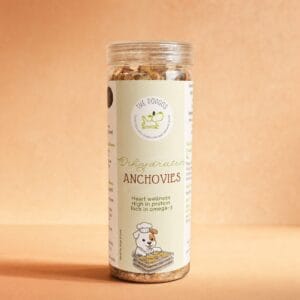
The daily dose for a 7 to 10 kg Pug is 2 to 4 ml drizzled over food, started slowly and built up over a week. Pair it with a few dehydrated anchovies two or three times a week for the EPA and DHA that hemp does not provide. The combination, hemp daily plus anchovies a few times a week, is the single most effective dietary intervention for an Indian Pug, full stop. For the deeper science on dosing fish-derived Omega-3, see our Omega-3 for dogs in India guide.
The Cooling Protein Angle (Critical for Indian Summer)
Pugs overheat catastrophically in Indian summer, and the food bowl is part of the cooling strategy. Ayurveda and TCM classify some proteins as “cooling” and others as “heating”. The biology lines up, commercial Indian chicken (corn and soy fed) drives Omega-6 inflammation, which raises tissue heat at the cellular level. The owner sees the dog “getting heated up”. A blood test would show raised inflammatory markers. Same phenomenon, two languages.
Practical cooling protein options for the Indian Pug summer:
- Quail. Hypoallergenic, novel protein, mild flavour, gentle on the gut. A whole dehydrated quail once a week resets a struggling Pug system.
- Fish. Anchovies, sardines, Bombay duck. Omega-3 rich, low-mercury, cooling by both frameworks.
- Goat (mutton). Lower in Omega-6 than commercial chicken. Use the lean curry cut.
Commercial chicken is not banned, it has to be balanced. Every chicken meal needs hemp seed oil or anchovies. For a Pug, that balance is non-negotiable.
Skin Folds Are a Diet Problem, Not Just a Hygiene Problem
The face fold under the eye, the nose roll, the deep fold at the base of the tail, owners tend to ignore these until they go septic. Cleaning the folds is necessary but not sufficient. The fold environment is warm, dark, moist, and rich in food residue. Inflammation from a poor diet (high Omega-6, food allergens, yeast-feeding carbohydrates) means the fold skin is already barrier-compromised. Once the barrier breaks, bacteria and yeast colonise the fold, and you spend the next year on antibiotic creams that work for two weeks at a time.
The Doggos protocol for Pug folds is three daily steps.
- Clean the fold dry. A soft cotton pad or microfibre cloth after meals and walks. No alcohol, no fragranced wet wipes. Dry is the goal.
- Apply baobab oil. Unlike coconut, mustard, or olive oil (which sit on the surface and trap heat), baobab oil absorbs into the epidermis and restores the lipid barrier. A few drops worked into the cleaned fold once a day calms the redness. For the dry nose Pugs are famous for, baobab paw and nose balm is the targeted product, especially in winter when nose hyperkeratosis spikes.
- Fix the diet. No fold protocol survives a bad bowl. Hemp seed oil daily, balanced Omega-6 to Omega-3, no kibble, no biscuits, no daily bath stripping the skin barrier further. The deeper logic is in why is my dog always itching and the dog itching in India guide.
From Mahiv’s practice: A 4-year-old Pug named Coco from Bangalore came to me last monsoon. The presentation was textbook, weeping fold dermatitis under both eyes, snoring loud enough to wake the household, and a body weight of 11.5 kg on a 7 kg frame. The owner had been on antibiotics for the folds for two years. We dropped the kibble, switched her to cooked chicken plus mutton on alternate days, added 3 ml hemp seed oil daily and 4 anchovies three times a week, started baobab oil on the cleaned folds at night, and cut treats to single-ingredient only. Four weeks in, the folds were dry. Eight weeks in, she was 9.8 kg, sleeping quieter, and the owner said the walks had stopped becoming respiratory events. No new antibiotic prescription since.
A Weekly Pug Meal Plan Using the Doggos Catalog
This is the template I hand new Pug clients. Assume a 7 to 10 kg adult, two small meals a day, no underlying medical conditions.
| Day | Morning bowl | Evening bowl | Topper or treat |
|---|---|---|---|
| Mon | Cooked chicken thigh + pumpkin + Bone and Organ Boost (1/2 tsp) | Same | 3 ml hemp seed oil |
| Tue | Cooked goat curry-cut + sweet potato + Bone and Organ Boost (1/2 tsp) | Same | 4 dehydrated anchovies |
| Wed | Cooked chicken + spinach + Bone and Organ Boost (1/2 tsp) | Whole dehydrated quail (half, soaked) | 3 ml hemp seed oil |
| Thu | Cooked goat + pumpkin + 4 anchovies | Cooked chicken + Bone and Organ Boost | None |
| Fri | Cooked chicken + green beans + Bone and Organ Boost (1/2 tsp) | Same | 3 ml hemp seed oil |
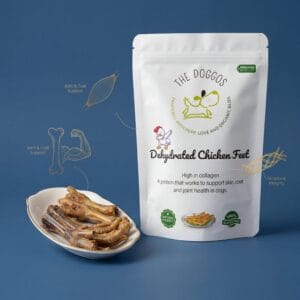
| Sat | Cooked goat + sweet potato + Bone and Organ Boost (1/2 tsp) | Same | Half a dehydrated chicken foot (size-matched) |
| Sun | Bone broth morning (cooling) | Quail + steamed vegetables | None |
Notes that matter for a Pug specifically:
- Cook, then debone, every time. Pug airways do not tolerate a bone-splinter scare. Cooked bones go in the bin. Calcium comes from the Bone and Organ Boost or correctly-sized dehydrated chews.
- Portion control is the breathing strategy. A 10 kg Pug eats roughly 350 to 400 g of fresh food a day, less than half what a Lab eats. Measure the food. Do not eyeball it.
- Anchovies double as training treats. Three or four anchovies during a short morning walk is a high-value reward and a low-calorie one. Skip the Parle-G entirely.
- Pumpkin every day. A tablespoon of plain cooked red pumpkin per meal supports the gut and gives soluble fibre that helps the fold-yeast problem indirectly by stabilising stool quality.
Indian Climate and the Pug
Indian climate is one of the hardest environments in the world for a Pug. The breed was developed for Chinese imperial laps, not Mumbai monsoon or Jaipur May. Practical adjustments:
- Walk timing. Before 7 am and after 7 pm in summer. A 4 pm walk in Hyderabad May is a hospital visit waiting to happen. If the dog refuses food in summer, our summer appetite loss in dogs guide unpacks why.
- Humidity and folds. Monsoon is fold dermatitis season. The fold protocol runs daily through July and August. The hot spots in dogs in India guide covers related skin-barrier care.
- Cooling, not bathing. Frequent bathing strips the skin barrier and worsens the fold environment. Wipe the dog down with a damp cloth instead. Two baths a month is plenty.
- Air circulation over air-conditioning. Cool moving air helps the brachycephalic airway. Stagnant cold AC with closed windows dries the airway out.
Life-Stage Adjustments
Puppies (8 weeks to 12 months). Higher protein (35 to 45%), lower fat than most puppy foods sell you. The classic mistake is feeding “premium puppy food” for the full first year and beyond, which is too fat-dense for a brachycephalic puppy and locks the Pug into early weight gain. Start the fresh-food transition by 12 weeks. Two to three meals a day, scaled to 5 to 7% of body weight, dropping as growth slows.
Adults (1 to 7 years). The weekly meal plan above. The single critical metric is body condition, not body weight. You should feel ribs under a light fat cover. If the ribs require excavation, the Pug is overweight and the breathing is suffering.
Seniors (7+). Slightly more Omega-3 for the brain and joints, slightly softer textures for older teeth, and a careful eye on weight. Senior Pugs often develop tracheal issues alongside BOAS, so anti-inflammatory feeding (hemp seed oil, anchovies) becomes even more important. I lean on the Bone and Organ Boost for senior Pugs as the daily organ source, easy to digest and reliable for taurine and B vitamins.
Common Indian Pug Feeding Mistakes
Every one of these I see weekly.
- “Puppy food” for the entire first two years. The high fat content in puppy formulas becomes permanent body fat in a Pug. Switch to an adult fresh diet by 12 months.
- Letting the Pug get fat because “they look cute that way”. Every extra kilogram is more breathing effort. A fat Pug is a Pug in respiratory debt.
- Daily bathing. Strips the skin barrier, worsens fold dermatitis, removes natural lipids. Twice a month is the upper limit for a Pug.
- Milk and biscuits as the daily ritual. Adult Pugs are largely lactose-intolerant, and Marie or Parle-G is sugar plus maida. Replace the ritual with one anchovy or half a dehydrated chicken foot.
- No Omega-3 in the bowl, ever. Pure boiled chicken plus rice is the most common “homemade” Indian Pug diet and the worst possible meal for this breed. Hemp seed oil or anchovies are not optional, they are medicine.
- Treating folds with antibiotics on repeat instead of fixing the diet. Antibiotics treat the symptom. The fold environment is a diet problem. The cycle ends when the bowl changes.
- Feeding raw from the Indian wet market. Pug airways and folds are already barrier-compromised. Cross-contamination from Indian wet-market raw is a risk we cannot ethically endorse. Cook the meat, use dehydrated bone, full reasoning in raw feeding in India.
Frequently Asked Questions
What is the best food for a Pug in India?
A cooked fresh-food diet of lean meat (chicken, goat, fish) at roughly 30 to 40% protein, balanced with hemp seed oil daily and a Bone and Organ Boost topper for calcium, taurine, and iron. Avoid Indian kibble, which is 50 to 70% carbohydrate and pushes brachycephalic dogs toward inflammation, weight gain, and skin-fold infections. The aim is anti-inflammatory at every meal.
Why is hemp seed oil specifically recommended for Pugs?
Hemp seed oil is the richest plant source of Gamma-Linolenic Acid (GLA), a rare Omega-6 that converts to Prostaglandin E1 and reduces inflammation. Pugs have chronically inflamed airway tissue from Brachycephalic Obstructive Airway Syndrome and chronically inflamed skin folds. GLA addresses both conditions internally rather than just topically. Dose 2 to 4 ml daily for a 7 to 10 kg Pug.
How do I manage my Pug’s skin folds through diet?
Skin fold dermatitis is downstream of internal inflammation. Cut commercial kibble, balance every chicken meal with hemp seed oil or anchovies, and remove sugar-heavy treats like biscuits. Externally, wipe the folds dry twice daily and apply baobab oil to cleaned folds at night. The combination of internal anti-inflammatory feeding and external barrier support resolves most fold issues within 6 to 8 weeks.
How much should a Pug weigh and how do I keep them lean?
A healthy adult Pug weighs 6 to 8 kg with a visible waist when viewed from above and ribs you can feel under a light fat cover. Every kilogram over that ideal weight increases breathing effort and heat-stress risk. Feed roughly 3 to 4% of body weight in fresh food daily, measure the portion, and replace processed treats with single-ingredient anchovies or small dehydrated meat pieces.
Can Pugs eat raw food in India?
I do not recommend raw feeding for Pugs in Indian homes. The wet-market supply chain plus high humidity in Indian climate creates a real cross-contamination risk. Pugs also have compromised barrier function in airway and fold tissue. The Doggos method is to cook the muscle meat for pathogen safety and supply calcium through dehydrated bone products, which retain nutrients without the splintering risk of cooked bones.
How do I keep my Pug safe in Indian summer?
Walk only before 7 am and after 7 pm during May and June. Keep weight in the healthy range, every extra kilogram raises heat-stress risk. Feed cooling proteins like quail and fish, balance commercial chicken meals with hemp seed oil to reduce inflammatory heat, and ensure constant access to clean water. Watch for any laboured breathing, blue-tinged gums, or refusal to walk, which are signs of impending heatstroke.
Are Pugs prone to allergies?
Yes, Pugs are over-represented in the allergy population, partly because of brachycephalic skin barrier issues and partly because of over-exposure to chicken in commercial Indian pet food. Rotate proteins (chicken, goat, fish, quail), balance Omega-6 with Omega-3 daily, and consider a 4-week elimination diet on a novel protein like quail if itching and fold dermatitis persist. Many “allergic” Pugs are simply inflammation cases that resolve once the bowl changes.
About the Author
Mahiv Amit Chhabra is a Certified Canine Nutritionist and author of The Desi Carnivore: The Indian Pet Parent’s Guide to Real Meat, Whole Prey, and Ancient Superfoods. He runs The Doggos from Thane, Maharashtra, alongside his dogs Tony and Toughie, the brand’s longest-serving quality-control team. Read more about Mahiv.